

Hazmat box requirements start with correctly identifying the material, selecting packaging authorized for its hazard class and packing group, and preparing the box exactly as the packaging manufacturer instructs. The completed package must prevent leaks or releases in normal transport, show the required markings and hazard labels, and travel with compliant shipping papers when required.
For most shipments, that means checking the product’s Safety Data Sheet (SDS), confirming the packaging and label rules in the 49 CFR 172.101 Hazardous Materials Table, choosing a properly rated UN specification box or authorized exception, and securing inner containers with compatible cushioning and absorbent material.
The U.S. Department of Transportation regulates materials that may create an unreasonable transport risk, including corrosive chemicals, flammable solvents, lithium batteries, aerosols, fragrances, and paint. A box is not compliant simply because it is sturdy or marked “UN.” Its rating, inner packaging, closure method, contents, and hazard communication must all match the shipment.
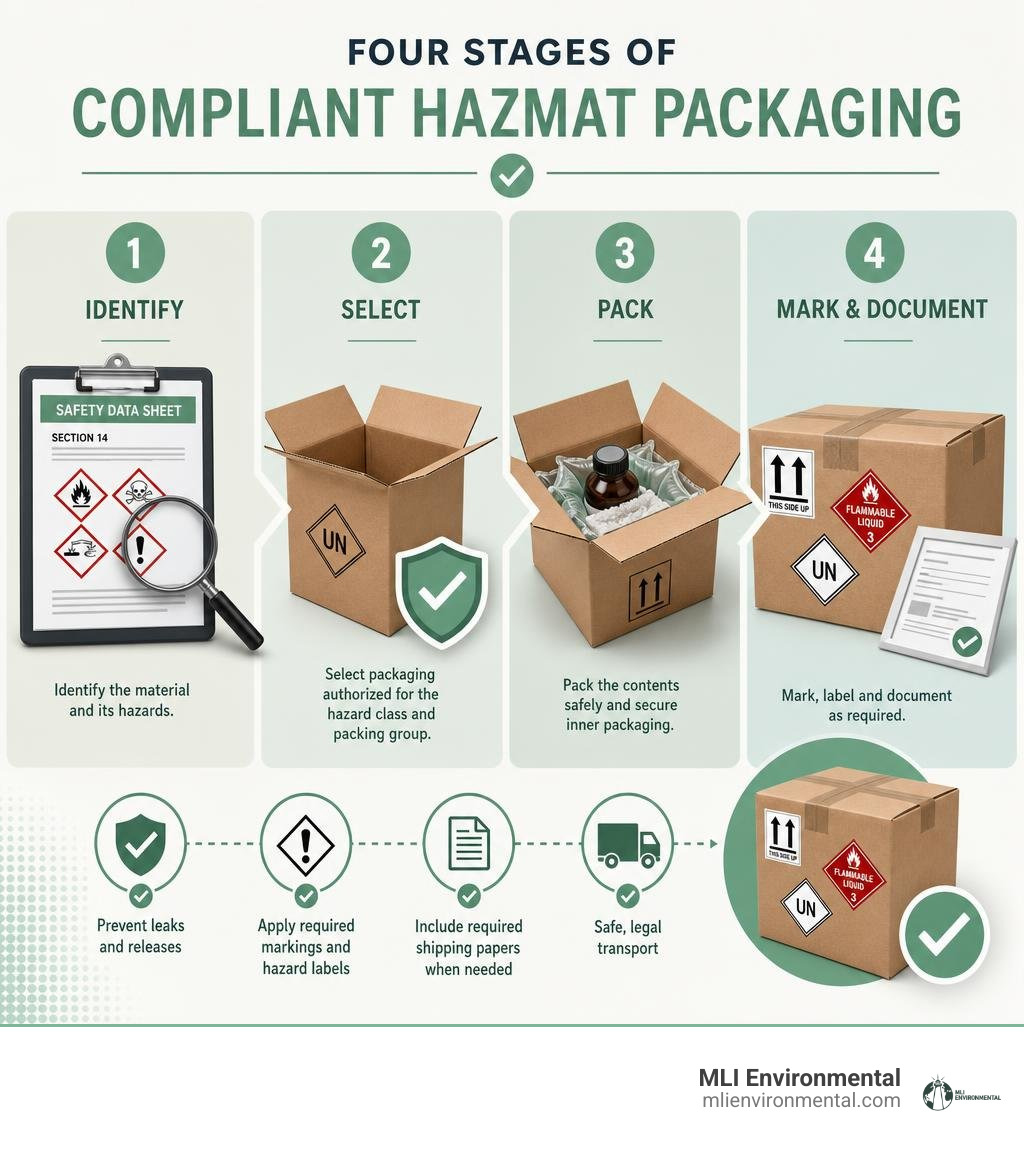
For related guidance, see MLI Environmental’s resources on infectious substance packaging, hazardous materials shipping kits, and hazmat container types.
What Qualifies as Hazardous Material and How to Identify It
According to the U.S. Department of Transportation (DOT) and the Pipeline and Hazardous Materials Safety Administration (PHMSA), a hazardous material is any substance or material capable of posing an unreasonable risk to health, safety, and property when transported in commerce. These rules are codified in 49 CFR Parts 100–185, collectively known as the Hazardous Materials Regulations (HMR).
The DOT’s Check the Box: Is it Hazmat? campaign helps shippers recognize hidden hazards in everyday goods. While an industrial acid drum is obviously hazardous, many consumer items share the same regulated chemical properties.
The DOT divides dangerous goods into the 9 classes of dangerous goods: explosives; gases; flammable liquids; flammable solids; oxidizers and organic peroxides; toxic and infectious substances; radioactive materials; corrosives; and miscellaneous dangerous goods such as dry ice and lithium-ion batteries.
Safety Data Sheets (SDS) and Hazard Classification
To determine whether an unfamiliar product is regulated for transport, start with its Safety Data Sheet (SDS). Section 14: Transport Information typically lists the four-digit UN identification number, proper shipping name, hazard class or division, and assigned Packing Group (PG I, PG II, or PG III).
Even when an SDS provides guidance, the legal burden for correct classification rests on the shipper or offeror. If an SDS is outdated or incomplete, the shipper remains responsible for compliance failures.
Essential Hazmat Box Requirements and UN Specification Standards
When a material requires specification packaging, standard corrugated cardboard boxes from an office supply store cannot be used. Shippers must use Performance-Oriented Packaging (POP) engineered, tested, and certified to meet 49 CFR 173.24 general packaging requirements.
Hazmat packaging must withstand normal transportation conditions without releasing its contents, including temperature swings, pressure changes, humidity, vibration, and routine handling.
To earn a UN certification mark, prototype boxes undergo destructive tests such as drop testing, stacking, vibration testing, and pressure differential testing for air shipments carrying liquids.
| UN Box Code | Outer Box Material | Authorized Packing Group Levels | Performance Level Meaning |
|---|---|---|---|
| 4G / X | Fiberboard (Combination) | Packing Groups I, II, and III | Tested for High Danger (PG I) |
| 4G / Y | Fiberboard (Combination) | Packing Groups II and III | Tested for Medium Danger (PG II) |
| 4G / Z | Fiberboard (Combination) | Packing Group III Only | Tested for Minor Danger (PG III) |
| 4GV / X | Fiberboard (Variation) | Packing Groups I, II, and III | Tested for selective fragile inners |
| 4C1 / Y | Natural Wood Box | Packing Groups II and III | Rigid wood outer for heavy articles |
| 4A / X | Steel Box | Packing Groups I, II, and III | High-strength metal outer casing |
Decoding UN Performance Packaging and Hazmat Box Requirements
Every certified hazmat box displays a UN specification mark that helps shippers select the correct packaging. A common fiberboard combination box may include:
- UN symbol: Confirms the container meets United Nations transport standards.
- Packaging code:
4means box, andGmeans fiberboard. - Performance level:
Xcovers Packing Groups I, II, and III;Ycovers II and III; andZcovers III only. - Maximum gross mass: The total allowed completed box weight, including inner containers, product, cushioning, and tape.
- State of matter or packaging type:
Sindicates solids or combination packaging with inner receptacles. - Year, country, and manufacturer code: Identifies when and where the package was made and who certified it.
When assembling a 4G box, follow the manufacturer’s closure instructions exactly. If the testing documentation specifies 3-inch 3M 375 tape in an H-tape pattern, substituting 2-inch general tape can invalidate the UN rating.
Inner Containment, Cushioning, and Chemical Compatibility
A 4G box is certified as a combination packaging system. The outer fiberboard box relies on specific inner receptacles, cushioning, and closures to function safely.
Shippers must confirm chemical compatibility, leave sufficient outage for liquid expansion, use enough inert absorbent for liquid shipments, and avoid packing incompatible chemicals together if a leak could cause fire, toxic fumes, or structural failure.
Four Steps for Safe and Compliant Hazmat Packaging
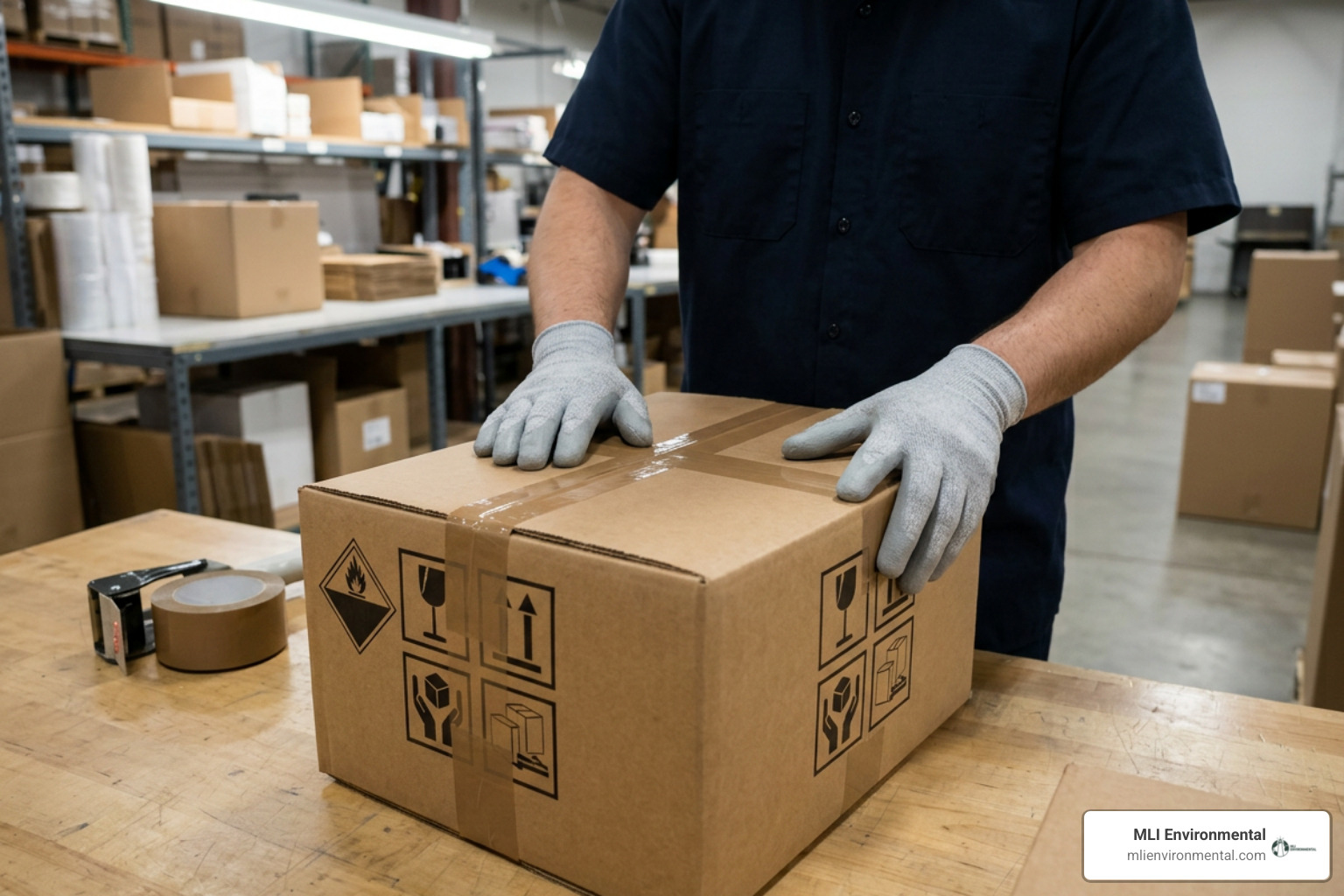
Following a structured preparation sequence helps ensure every shipment meets DOT standards and arrives safely.
Use MLI Environmental’s guide on how to ship hazardous materials alongside DOT’s Check the Box guidance for getting started with hazmat shipping to build a compliant shipping process.
- Classify the material: Match the product’s chemical makeup and physical state to the Hazardous Materials Table in 49 CFR 172.101.
- Select packaging: Match the required performance level to an authorized UN specification container, such as a 4G fiberboard box or 4GV variation box.
- Assemble and pack: Follow the packaging manufacturer’s closure notification sheet, secure inner containers, add absorbent and cushioning material, eliminate void space, and seal the box as tested.
- Mark, label, and document: Apply required hazard labels, proper shipping name markings, UN ID numbers, orientation arrows, and shipping papers when required.
Marking and Hazard Warning Labeling Protocols
Every hazmat box functions as a visual safety warning for transport workers, truck drivers, and emergency responders.
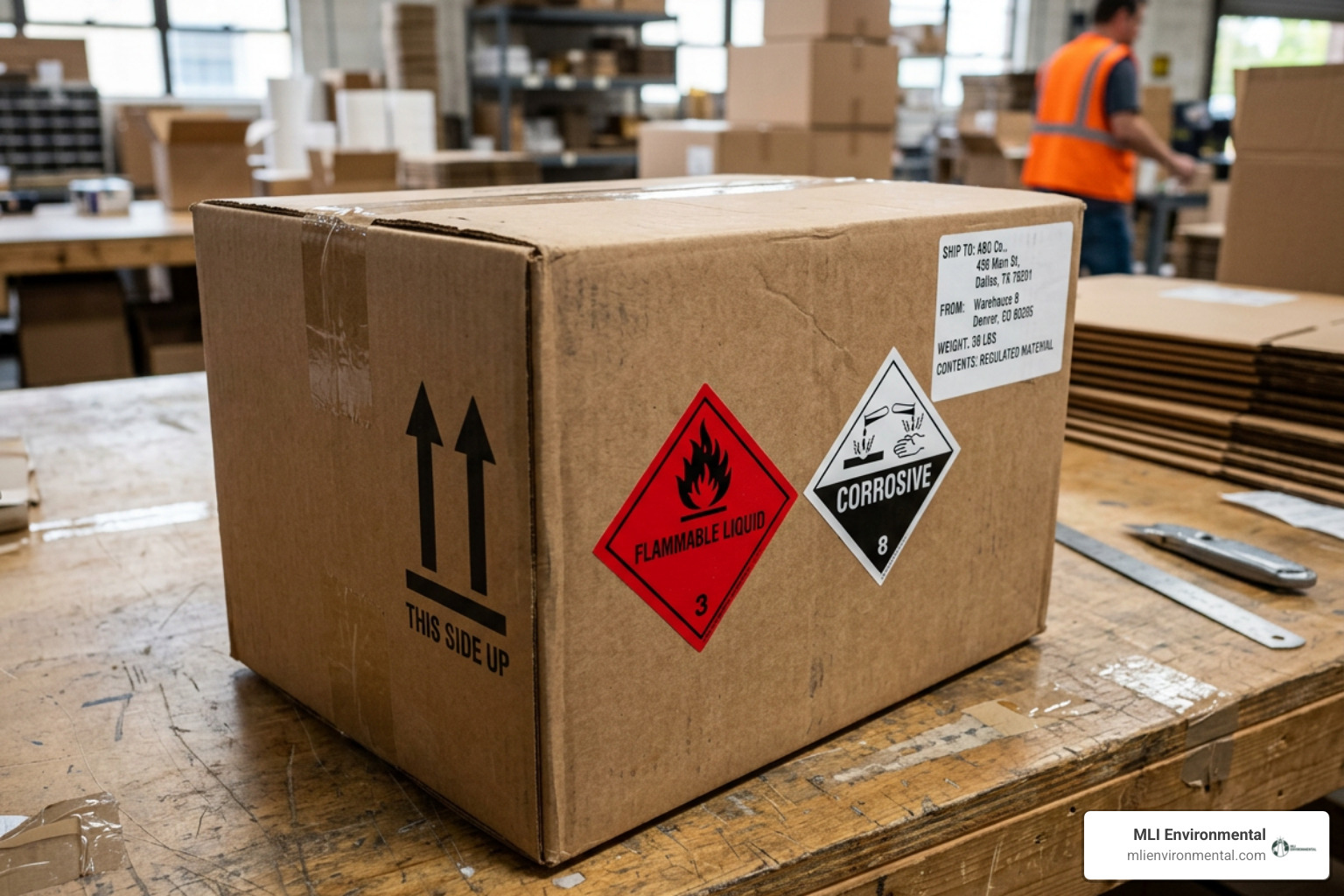
For detailed placement rules, read MLI Environmental’s guide to mastering hazmat shipping labels from DOT to delivery. Standard marking and labeling may require the proper shipping name and UN number, 100 mm x 100 mm DOT diamond hazard labels, package orientation arrows on two opposing sides for liquid combination packages, and removal of obsolete markings if a box is reused.
Hazmat Shipping Papers and Emergency Response Information
Most dangerous goods shipments must travel with a formal shipping paper, such as a bill of lading, hazardous waste manifest, or dangerous goods declaration. MLI Environmental’s guide to hazmat shipping papers explains documentation workflows in more detail.
Shipping papers must list the basic description in the required sequence with no intermediate text, along with total quantity and package count, a 24/7 emergency response phone number, the shipper’s certification, and proper record retention. Shippers must keep hazmat shipping papers for at least one year, or three years for hazardous waste manifests.
Modal Carrier Variations and Shipping Exceptions
Transportation rules change by mode. Highway trucking under 49 CFR allows some flexibilities, such as the 1,001-pound aggregate gross weight placarding exception for Table 2 materials, that may not apply to air cargo governed by IATA and ICAO rules.
Common carrier exemptions that simplify packaging include Materials of Trade allowances for service technicians, agricultural exceptions for certain local fertilizer and pesticide transport, and lab pack provisions for compatible laboratory waste chemicals under 49 CFR 173.12.
Carrier Rules: USPS vs. UPS Hazmat Box Requirements
Major parcel carriers often enforce operational rules stricter than baseline DOT requirements:
- United States Postal Service (USPS): Governed by USPS Publication 52, USPS accepts only limited categories of hazardous, restricted, and perishable mail. Many accepted hazmat parcels must qualify as surface-only Limited Quantity shipments.
- Commercial ground carriers, including UPS: These carriers often require a hazardous materials agreement and compliant dangerous goods software. Automated parcel networks also demand packages that can survive sorting hubs, and air shipments involving liquids may require pressure differential testing.
Limited Quantity and Excepted Quantity Shipping Provisions
Small quantities of everyday consumer products can often use the Limited Quantity exception under 49 CFR 173.150–173.156.
This exception can eliminate the need for a UN specification box when the shipper uses strong, rigid outer packaging capable of passing a 1.2-meter drop test. It may also provide label, placard, and highway shipping-paper relief. Limited Quantity boxes use the square-on-point Limited Quantity mark, with a central “Y” added for air transport, and must still meet applicable inner receptacle and gross-weight limits. The older ORM-D consumer commodity marking was phased out at the end of 2020.
Hazmat Employee Training and Non-Compliance Penalties
Under 49 CFR 172.700–172.704, anyone who directly affects hazardous materials transportation safety is a hazmat employee. This includes workers who select boxes, pack chemicals, seal containers, mark or label parcels, and prepare shipping papers.
For training strategy, see MLI Environmental’s definitive guide to hazmat safety training options. Federal rules require general awareness, function-specific, safety, and security awareness training.
Initial training must be completed within 90 days of employment or job reassignment, under direct supervision until complete. DOT recurrent training is required every three years, while IATA recurrent certification is required every two years.
Federal Enforcement and Penalty Exposures
PHMSA, FMCSA, FAA, and the U.S. Coast Guard regularly conduct roadside inspections and facility audits. Enforcement data shows why box compliance matters: hazmat incidents can cause cargo spills, sorting facility fires, chemical exposures, delivery delays, and regulatory scrutiny.
Civil penalties can apply per violation per day, and severe injury, illness, or death can increase exposure. Willful or reckless violations may also trigger criminal fines and imprisonment.
Frequently Asked Questions About Hazmat Box Requirements
Can you reuse a standard box for shipping hazardous materials?
Yes, but only under strict conditions outlined in 49 CFR 173.28. The box must be a certified UN specification container that is clean, structurally intact, and free from gouges, creases, moisture damage, or compromised inner flaps. Old labels, barcodes, and hazard markings must be removed or obliterated. Standard single-use 4G fiberboard boxes are generally not recommended for reuse with high-hazard materials.
What is the difference between UN 4G and UN 4GV packaging boxes?
A standard 4G box is certified as a complete combination packaging unit tested with specific inner bottles, cans, or jars. Shippers cannot change inner containers without invalidating the UN certification. A 4GV variation box allows a wider variety of inner containers when the shipper follows the required cushioning and absorption rules.
Who is legally liable for incorrect hazmat box packaging?
Under 49 CFR 173.1, the shipper or offeror is primarily responsible for classifying the chemical, selecting an authorized UN box, assembling the package according to manufacturer specifications, and declaring all hazards. Carrier acceptance does not shield the shipper from federal liability.
Ship Hazmat Safely With the Right Packaging Partner
Compliant hazmat packaging protects transportation workers, emergency responders, and your organization from avoidable delays, spills, and enforcement risk. Across Maine and New England, MLI Environmental provides dangerous goods logistics support, hazardous waste management, compliance training, and turnkey packaging solutions.
Equip your shipping department with certified Hazmat DG Shipping Kits from MLI Environmental to keep dangerous goods moving safely and compliantly.