

Why Hazmat Labels Are Critical for Safe Shipping
Hazmat shipping labels are required warning placards that identify the specific hazards of dangerous goods during transport, ensuring safe handling and regulatory compliance throughout the supply chain.
Key Facts About Hazmat Shipping Labels:
- Purpose: Communicate hazards to handlers, emergency responders, and transport personnel
- Regulation: Mandated by DOT (49 CFR Part 172), IATA, and IMDG regulations
- Design: Diamond-shaped, minimum 4″ x 4″ (100 mm), with specific colors for each hazard class
- Placement: Must be visible, durable, on contrasting background, and not on package bottom
- Classes: Nine primary hazard classes, each with distinct visual identifiers
- Consequences: Improper labeling can result in fines, shipment rejection, and serious safety risks
Millions of packages containing hazardous materials move through our transportation networks yearly. Without proper identification, these shipments pose serious risks to workers, emergency responders, and the public.
Hazmat shipping labels serve as the universal language of dangerous goods transportation. These distinctive diamond-shaped placards instantly communicate critical hazard information, regardless of language barriers. They tell handlers whether a package contains explosives, poisonous gases, or corrosive materials—information that can mean the difference between safe delivery and a catastrophic incident.
The regulatory landscape is complex, with the Department of Transportation (DOT), International Air Transport Association (IATA), and International Maritime Dangerous Goods (IMDG) Code each maintaining specific requirements. Labels must meet precise specifications for design, size, color, and placement. They work with markings like UN identification numbers and proper shipping names to create a complete hazard communication system.
For businesses shipping hazardous materials, understanding these requirements isn’t optional—it’s a legal obligation. The consequences of improper labeling extend beyond regulatory fines. Mislabeled shipments can be rejected by carriers, delayed, or worse, contribute to accidents. As defined in hazardous materials regulations, even common industrial products may require specialized labeling.
This guide breaks down everything you need to know about hazmat shipping labels, from understanding the nine hazard classes to mastering placement requirements and avoiding costly compliance failures.
The Foundation: Understanding Labels, Markings, and Their Purpose
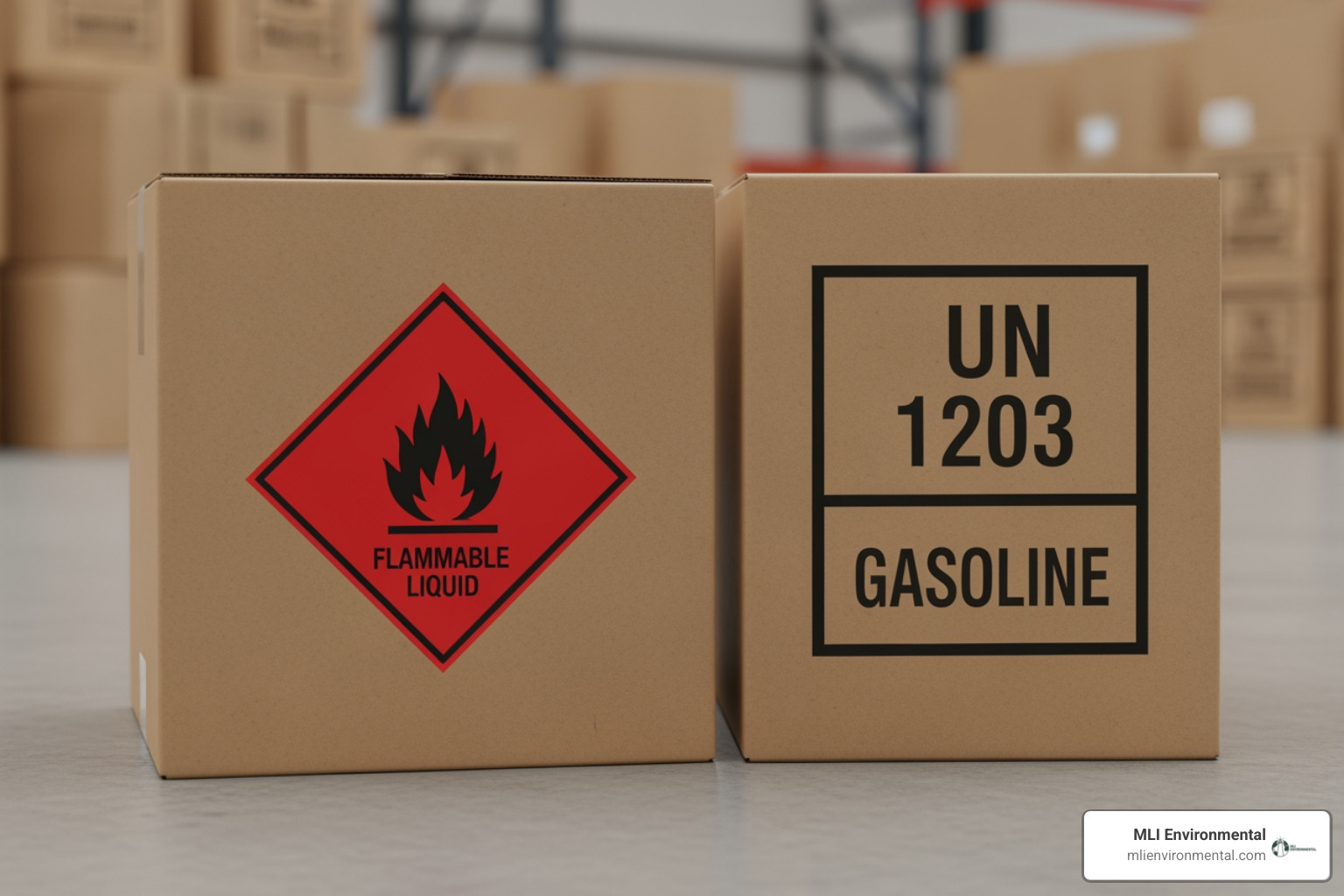
Shipping hazardous materials requires understanding the distinction between hazmat labels and markings. While both are crucial for safety and compliance, they serve different, yet complementary, purposes.
What Are the Primary Purposes of Hazmat Shipping Labels?
Hazmat shipping labels are vital communication tools that convey immediate and critical information about the dangers within a package. Their primary purposes include:
- Hazard Identification: To instantly identify the primary and subsidiary hazards of the materials inside. The distinct colors, symbols, and class numbers on these diamond-shaped labels allow anyone—from warehouse staff to emergency responders—to quickly understand the risk. For example, a red label with a flame symbol signals a flammable substance.
- Emergency Response Guidance: In an accident or spill, labels provide crucial initial clues for emergency personnel. They help responders assess the situation, take appropriate precautions, and implement correct procedures to prevent harm or environmental damage.
- Proper Handling Instructions: The visual cues on labels dictate how a package should be handled. A corrosive label, for instance, warns handlers to wear personal protective equipment (PPE) and avoid contact, ensuring the shipment is handled safely.
- Regulatory Compliance: Adhering to labeling requirements from the DOT, IATA, and IMDG Code is a legal obligation. Proper labeling ensures shipments meet all safety standards, avoiding penalties, delays, and carrier rejections.
Key Differences: Hazmat Markings vs. Hazmat Labels
While often used interchangeably, “hazmat markings” and “hazmat labels” have distinct definitions under hazardous materials regulations.
Hazmat Labels are the standardized, diamond-shaped graphics that visually communicate the hazard class or division. They are primarily concerned with the type of hazard. For DOT purposes, labels are specific to bulk-packaging and measure at least 4″ x 4″ (100 mm).
Hazmat Markings include all other descriptive information required on the outer packaging, such as text, identification numbers, and instructions. Markings are generally concerned with the specifics of the material and its handling. According to the DOT, everything else applicable to non-bulk packaging is considered a “marking.”
Here’s a table summarizing their key differences:
| Feature | Hazmat Markings | Hazmat Labels |
|---|---|---|
| Purpose | Provides specific details about the material, shipper, and handling instructions | Visually communicates the hazard class/division of the material |
| Appearance | Text, identification numbers (e.g., UN/NA), arrows, names, addresses | Diamond-shaped graphic with symbols, colors, and hazard class numbers |
| Information | Proper Shipping Name, UN/NA Identification Number, Shipper’s Name & Address, Consignee’s Name & Address, Orientation Arrows, Weight, Special Handling Instructions | Hazard Class Symbol (e.g., flame, skull, trefoil), Hazard Class Number, Color-coded background |
| Location | Often on the same surface as the label, or other prominent locations on the package | Affixed to a surface (other than the bottom) of the package, near the proper shipping name marking |
| Regulatory Basis | 49 CFR, Part 172, Subpart D (for general marking requirements) | 49 CFR, Part 172, Subpart E (for general labeling requirements) |
| Application | Required for both bulk and non-bulk packaging | Typically for bulk packaging, but also for non-bulk packages to identify hazards |
Both markings and labels must be durable, clearly visible, written in English, and displayed on a contrasting background, not obscured by other labels or attachments. Specific marking requirements also apply to radioactive materials, poisonous goods, and dangerous goods in limited quantities.
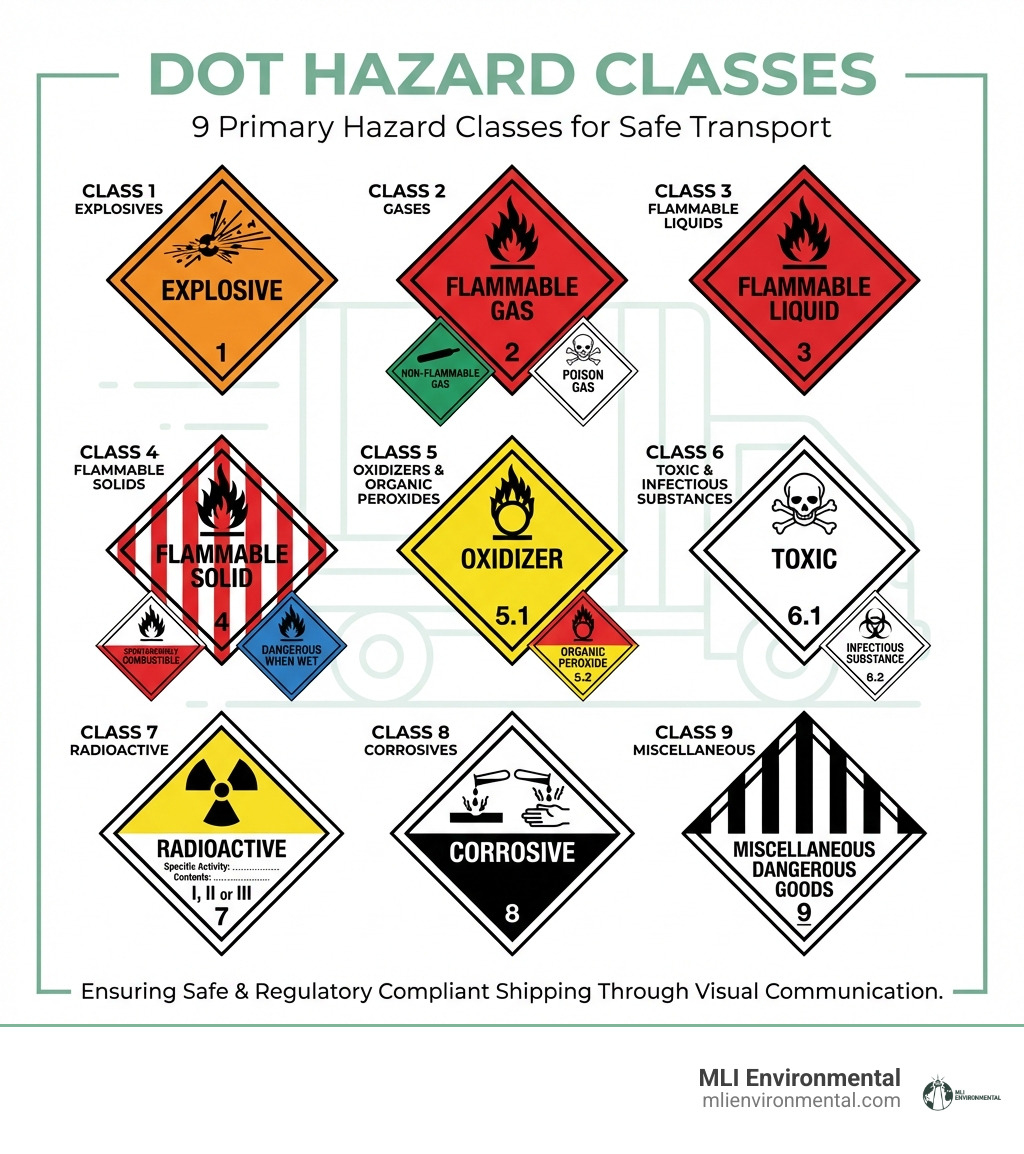
A Visual Guide to Hazmat Labels by Hazard Class
Understanding the various hazmat shipping labels is paramount for anyone involved in the transportation of dangerous goods. Each of the nine hazard classes has a unique label design, featuring specific colors, symbols, and numbers that communicate the inherent risks.
Class 1: Explosives
Explosives can detonate or deflagrate, posing a significant blast, fragmentation, or fire hazard. Their labels are designed to be highly conspicuous.
- Description: Class 1 labels are orange and often feature an exploding bomb symbol. The division number (1.1, 1.2, 1.3, 1.4, 1.5, or 1.6) and a compatibility group letter are also displayed.
- Color: The background color on the EXPLOSIVE 1.1, EXPLOSIVE 1.2, and EXPLOSIVE 1.3 labels must be orange.
Class 2: Gases
Gases are substances entirely gaseous at 20°C (68°F) and 101.3 kPa (14.7 psi), categorized into three divisions.
- Division 2.1 Flammable Gas: These labels are red with a flame symbol. The background color on the FLAMMABLE GAS label must be red.
- Division 2.2 Non-Flammable, Non-Toxic Gas: These labels are green. The background color on the NON-FLAMMABLE GAS label must be green.
- Division 2.3 Poison Gas: These labels are white with a skull and crossbones symbol. The background on the POISON GAS label and the symbol must be white, with the upper diamond’s background being black. For more on this class, see our guide on Hazardous Waste Materials Guide: Compressed Natural Gases.
Class 3: Flammable Liquids
Flammable liquids have a flash point of not more than 60°C (140°F) and pose a significant fire hazard.
- Description: These labels are red with a flame symbol.
- Color: The background color on the FLAMMABLE LIQUID label must be red. Learn more about their classification in our Hazardous Waste Materials Guide: Flammable Liquids Classification.
Class 4: Flammable Solids
Class 4 covers solids that are readily combustible, prone to spontaneous combustion, or dangerous when wet. It has three divisions.
- Division 4.1 Flammable Solid: These labels feature a flame symbol. The background on the FLAMMABLE SOLID label must be white with vertical red stripes equally spaced on each side of a central red stripe.
- Division 4.2 Spontaneously Combustible: These labels show a flame symbol. The background color on the lower half of the SPONTANEOUSLY COMBUSTIBLE label must be red, and the upper half must be white.
- Division 4.3 Dangerous When Wet: These labels have a flame symbol over a droplet. The background color on the DANGEROUS WHEN WET label must be blue. For a deeper dive, refer to our Hazardous Waste Materials Guide: Flammable Solids.
Class 5: Oxidizing Substances & Organic Peroxides
This class includes substances that yield oxygen, contributing to the combustion of other material, or are thermally unstable.
- Division 5.1 Oxidizer: These labels are yellow with a flaming ‘O’ symbol. The background color on the OXIDIZER label must be yellow.
- Division 5.2 Organic Peroxide: These labels are red and yellow with a flaming ‘O’ symbol. The background on the ORGANIC PEROXIDE label must be red in the top half and yellow in the lower half. Learn more in our Hazardous Waste Guide: Class 5 Common Oxidizers.
Class 6: Toxic & Infectious Substances
These materials are poisonous or infectious, posing a risk to human health.
- Division 6.1 Toxic (Poison): These labels are white with a skull and crossbones symbol. The background on the POISON label must be white. The word “TOXIC” may be used in lieu of “POISON”.
- Division 6.1 Poison Inhalation Hazard: These labels are white and black with a skull and crossbones. The background on the POISON INHALATION HAZARD label and symbol must be white, and the upper diamond’s background must be black.
- Division 6.2 Infectious Substance: These labels are white with a biohazard symbol. The background on the INFECTIOUS SUBSTANCE label must be white. For a comprehensive look, consult our Hazardous Waste Materials Guide: Poison.
Class 7: Radioactive Materials
Radioactive materials emit ionizing radiation and are categorized based on their radiation levels and transport index (TI).
- Radioactive White-I: This label is white with a black trefoil symbol and text, except for the ‘I’ which must be red. It’s for packages with very low external radiation levels.
- Radioactive Yellow-II: This label has a yellow top half and white bottom half, with a black trefoil symbol and text, except for the ‘II’ which must be red. It’s for packages with low external radiation levels and a transport index between 0 and 1.
- Radioactive Yellow-III: Similar to Yellow-II but for packages with higher external radiation levels and a transport index greater than 1. The ‘III’ is red.
- Fissile: This label is white and is for packages containing fissile materials.
- Details: The proper label for a Class 7 package is based on the radiation level and transport index. For example, a package with a transport index of 0.8 and a maximum surface radiation level of 0.6 mSv/h must bear a RADIOACTIVE YELLOW-III label. A package with a transport index of 20 and a radiation level <= 0.005 mSv/h requires a RADIOACTIVE WHITE-I label. Two labels are typically required on opposite sides.
- Resources: Explore more in our Hazardous Waste Guide: Radioactive Materials and the official 49 CFR § 172.403 Class 7 (radioactive) material.
Class 8: Corrosives
Corrosive substances cause severe damage upon contact with living tissue or other materials.
- Description: These labels feature a symbol of liquid pouring from two test tubes onto a hand and a metal block.
- Color: The background on the CORROSIVE label must be white in the top half and black in the lower half. Our Hazardous Waste Materials Guide: Corrosive Liquids provides further details.
Class 9: Miscellaneous Hazardous Materials & Lithium Batteries
This class covers hazardous materials that don’t fit into other classes but still pose a risk during transport.
- Description: The CLASS 9 label features seven black vertical stripes on the top half of a white background.
- Lithium Batteries: A specific LITHIUM BATTERY label exists, which is white with seven black vertical stripes on the top half. This label is critical due to the unique fire hazards of these batteries.
- Resources: Find more in our Hazardous Materials Guide: Class 9 Hazardous Materials. For specifics on shipping lithium batteries, refer to our Hazardous Waste QA: Can You Ship Lithium Batteries? and the FAA Interactive Guide to Shipping Lithium Batteries.
Mastering Compliance: How to Use Hazmat Shipping Labels Correctly
Applying hazmat shipping labels correctly is as important as selecting the right ones. Incorrect placement, obscured labels, or non-compliant dimensions can lead to serious regulatory violations, fines, and safety risks.
General Requirements for Hazmat Shipping Labels
Compliance starts with understanding the fundamental specifications for all hazmat shipping labels:
- Size: Each diamond-shaped hazard label must measure at least 4″ x 4″ (100 mm) on each side, square-on-point. This size ensures visibility.
- Durability and Weather Resistance: Labels must be durable enough to withstand a 30-day exposure to transport conditions without deteriorating or substantially changing color. They should be printed on or affixed to the package surface and remain legible.
- Visibility: Labels must be clearly visible and displayed on a contrasting background. They must not be obscured by other labels, attachments, or advertising.
- Language: All text on labels must be in English.
- Quantity: Non-bulk packages require at least one label for each hazard class. Certain larger packages or materials (e.g., radioactive) may need duplicate labels on at least two sides or ends.
For a comprehensive overview, refer to the general labeling requirements under Title 49 of the Code of Federal Regulations.
Label Placement and Orientation
The physical application of hazmat shipping labels is critical for their effectiveness:
- Placement: Labels must be affixed to a surface (other than the bottom) of the package. Ideally, place them on the same surface near the proper shipping name marking to consolidate information.
- No Wrapping Corners: Hazard labels cannot be bent or wrapped around corners. They must lie flat on a single surface.
- Multiple Labels: If more than one label is necessary, place them next to each other with six inches of space between them.
- Primary and Subsidiary Placement: The primary hazard label should be placed above and to the left of subsidiary hazard labels.
- Aircraft Shipments: For air transport, all required labels should ideally appear on one side of the package.
Proper placement ensures that handlers and emergency personnel can quickly identify hazards. For more practical advice, see our guide on 5 Hazardous Waste Label Requirements for Shipping.
Subsidiary Hazards and Mixed Packaging
Many hazardous materials pose multiple risks (e.g., flammable and corrosive). In these cases, hazmat shipping labels must reflect all significant hazards:
- Subsidiary Hazard Labels: A material with multiple risks requires a primary hazard label (for the main danger) and one or more subsidiary hazard labels for additional dangers. All labels must meet the same general requirements.
- Placement of Subsidiary Labels: The primary hazard label goes above and to the left of subsidiary labels. If space is limited, subsidiary labels can be on an adjacent side, within 6 inches of the primary label (per DOT regulations).
- Mixed Packaging: If compatible materials of different hazard classes are in the same container or overpack, it must be labeled for each class to communicate all potential hazards.
Navigating these complexities requires careful attention to detail. Our guide on How to Ship Hazardous Materials offers additional insights.
Special Handling Labels: ‘Cargo Aircraft Only’
Certain hazardous materials are too dangerous for passenger aircraft and are restricted to cargo aircraft only, requiring a specific label:
- Description: The ‘CARGO AIRCRAFT ONLY’ label immediately signals this restriction.
- Color and Design: This label must be black on an orange background, featuring the text “CARGO AIRCRAFT ONLY” and a cargo plane symbol.
- When Required: Packages prepared for ‘cargo aircraft only’ (CAO) quantities must always have a CAO label. This is a critical air transport requirement to ensure high-risk shipments are handled with care and segregated from passenger flights.
Navigating Regulations and Avoiding Penalties
The world of hazmat shipping labels is deeply intertwined with a complex web of regulations. Understanding these rules, from domestic DOT requirements to international standards, is crucial for safe and compliant shipping.
The Role of the Safety Data Sheet (SDS)
The Safety Data Sheet (SDS) is your foundational document for identifying, classifying, and safely handling hazardous materials. It is the first place you should look to determine the correct hazmat shipping labels and markings.
- Section 14: Transport Information: This is the most critical section for shipping. Section 14 of the SDS provides guidance on classification information for shipping and transporting hazardous materials by road, air, rail, or sea. Here, you’ll find the product’s United Nations (UN) number or North American (NA) number, the proper shipping name, and the hazard class(es) – all essential for selecting the correct labels.
- Other Relevant Sections: While Section 14 is primary, other sections of the SDS can provide additional crucial information. Section 3 (Composition/Information on Ingredients) details content identification and concentrations, which can be key for corrosive materials. Section 9 (Physical and Chemical Properties) includes physical properties such as flash points for flammable or combustible liquids, and pressures for aerosols and compressed gases, which directly impact hazard classification.
Always locate Section 14: Transport information on your product’s SDS first. For more in-depth guidance, refer to Finding Transport Information in the SDS and our guide on How to Properly Understand Safety Data Sheet.
US DOT vs. International Regulations (IATA & IMDG)
While the core principles of hazard communication are harmonized globally, specific requirements for hazmat shipping labels can vary depending on the mode of transport and international destination.
- US DOT (49 CFR): The U.S. Department of Transportation (DOT) sets the standards for hazardous materials transportation within the United States. These regulations, found in 49 CFR Parts 100-185, dictate everything from classification to packaging, labeling, and placarding for ground, rail, and domestic air shipments.
- IATA (International Air Transport Association): For air shipments, especially international ones, the IATA Dangerous Goods Regulations (DGR) are the governing standard. These rules often incorporate and build upon the International Civil Aviation Organization (ICAO) Technical Instructions. Hazardous materials packages prepared for transport in commerce must be labeled according to 49 CFR or IATA requirements.
- IMDG Code (International Maritime Dangerous Goods): For sea transport, the IMDG Code, developed by the International Maritime Organization (IMO), is the primary international regulation.
While these regulations share commonalities due to global harmonization efforts (like the UN Recommendations on the Transport of Dangerous Goods), shippers must ensure compliance with the specific rules applicable to their chosen mode of transport and destination. For instance, UPS has specific requirements for Division 6.1, Packing Group III materials for both domestic (US DOT) and international (IATA) shipments.
Consequences of Improper Hazmat Labeling
Failing to correctly apply hazmat shipping labels can lead to severe repercussions, impacting safety, finances, and operational efficiency:
- Fines and Penalties: Regulatory bodies like the DOT impose substantial fines for non-compliance. These penalties can range from thousands to tens of thousands of dollars per violation, per day, depending on the severity and whether it endangered lives.
- Shipment Delays and Rejection: Carriers will refuse to transport improperly labeled packages. This leads to costly delays, reshipment expenses, and potential damage to customer relationships.
- Safety Risks: Most critically, improper labeling endangers workers, emergency responders, and the public. Misidentified hazards can lead to incorrect handling procedures, accidental exposure, fires, explosions, or spills, with potentially catastrophic consequences.
- Legal Liability: In the event of an incident, the shipper can face significant legal liability, including lawsuits for damages, injuries, or environmental contamination.
The consequences of incorrectly managing hazardous waste extend beyond mere inconvenience; they can be financially devastating and pose existential threats to a business. Our blog post on the Consequences of Incorrectly Managing Hazardous Waste digs deeper into this.
Exceptions to Labeling Requirements
While stringent, there are specific situations where hazmat shipping labels might not be required:
- Limited Quantities: Many limited quantity shipments are exempt from hazard labeling requirements under certain conditions, particularly within the US 48 contiguous states or into Canada. However, they typically still require a specific ‘limited quantity’ marking.
- Excepted Quantities: Very small quantities of certain hazardous materials may be transported under “excepted quantity” provisions, which have minimal labeling requirements.
- Certain Cylinders and Dewar Flasks: Specific types of cylinders containing Division 2.1, 2.2, or 2.3 material, and Dewar flasks, may be durably and legibly marked in accordance with CGA C-7 standards instead of requiring a label.
- Overpacks: If an overpack contains packages that are already correctly labeled, and those labels are clearly visible through the overpack, additional labeling on the overpack itself might not be required. If labels are not visible, the overpack must be labeled for each class contained within.
- Bulk Packaging: Some bulk packaging (e.g., portable tanks, freight containers) may not require labels if they are correctly placarded according to DOT regulations.
- Military Explosives: Under specific conditions, certain military explosives may have exceptions.
- Special Permit Packaging: Packaging designed under a special permit may have exemptions from standard labeling requirements, as outlined in the permit.
It is crucial to consult the ‘Special Provisions’ and ‘Exceptions’ columns of the relevant chemical table in the regulations (e.g., 49 CFR Part 172.101) to determine if an exception applies to your specific shipment. Never assume an exception applies without verifying the regulatory text.
Your Partner in Hazmat Shipping Compliance
Properly navigating the complexities of hazmat shipping labels is non-negotiable for safety and compliance. From understanding the difference between markings and labels to correctly applying them according to DOT, IATA, and IMDG regulations, every step is crucial. For businesses that need to ensure their shipments are always safe and compliant, partnering with a certified expert is the smartest choice. MLI Environmental provides comprehensive support for all your hazardous material shipping needs.