

When it comes to transporting materials that could potentially cause harm to humans or animals, there is no room for error. Whether it is a routine blood sample being sent to a lab in Boston or a highly contagious viral culture moving through Manchester, the integrity of the container is the only thing standing between a safe delivery and a public health crisis. Infectious substance packaging is a specialized field governed by strict international and domestic regulations designed to ensure that even if a package is dropped, crushed, or subjected to extreme pressure changes, the dangerous contents remain sealed inside.
Safely moving these materials is not just about following a checklist; it is about understanding the science of containment. From the primary vial to the rigid outer box, every layer serves a specific purpose. Because the stakes are so high, organizations like the Department of Transportation (DOT) and the International Air Transport Association (IATA) have harmonized their rules to create a fail-safe system known as triple packaging.
The first step in any shipment is determining exactly what is inside the box. In infectious substances, materials are divided into two main categories based on the level of risk they pose to the public if an exposure occurs.
Category A Infectious Substances
Category A represents the highest risk level. These are substances transported in a form that, if an exposure occurs, are capable of causing permanent disability or life-threatening or fatal disease in otherwise healthy humans or animals. Because of this, they are subject to the most stringent packaging and documentation requirements.
There are two primary UN numbers for Category A:
- UN2814 (Infectious substance, affecting humans): This includes pathogens like Ebola virus, Bacillus anthracis (anthrax) cultures, and Mycobacterium tuberculosis cultures.
- UN2900 (Infectious substance, affecting animals only): This includes pathogens like Foot and Mouth Disease virus or African Swine Fever.
Category B Infectious Substances
Category B substances are infectious materials that do not meet the criteria for Category A. While they still contain pathogens, they are generally diagnostic specimens or samples where the risk of a life-threatening event during transport is significantly lower.
- UN3373 (Biological substance, Category B): This is the most common classification for clinical samples, such as blood or tissue being tested for Hepatitis B, HIV, or routine influenza.
According to scientific research on infectious substance classification, the distinction often depends on whether the material is a “culture” (intentionally propagated) or a “patient specimen.”
Table: Risk Level Comparison
| Feature | Category A (UN2814/UN2900) | Category B (UN3373) |
|---|---|---|
| Risk Level | High (Life-threatening) | Moderate (Diagnostic/Clinical) |
| Packaging Instruction | PI 620 | PI 650 |
| UN Specification Mark | Required | Not Required (but must be sturdy) |
| Shipper’s Declaration | Required | Not Required |
| Drop Test Standard | 9 Meters (30 Feet) | 1.2 Meters (4 Feet) |
Examples of Category A Pathogens:
- Ebola Virus
- Lassa Virus
- Bacillus anthracis (Cultures)
- Brucella melitensis (Cultures)
- Monkeypox Virus (Cultures)
Regulatory Requirements for Infectious substance packaging
Shipping a dangerous pathogen is not as simple as calling a local courier and handing over a box. Shippers must navigate a complex web of regulations, including the IATA Dangerous Goods Regulations for air travel and the DOT 49 CFR (specifically parts 173.196 and 173.199) for ground transport in the United States.
For those managing facilities in New England, from Burlington, Vermont, to Worcester, Massachusetts, understanding these rules is vital for legal compliance. Failure to comply can lead to massive fines and, more importantly, safety hazards. You can find more information about medical waste and how it intersects with these regulations to ensure your facility remains compliant.
Shipper Responsibilities
The responsibility for the shipment rests entirely on the person who offers the package for transport. This includes:
- Classification: Correctly identifying if the substance is Category A, B, or Exempt.
- Identification: Assigning the Proper Shipping Name (e.g., “Infectious substance, affecting humans”).
- Packaging: Using the correct triple packaging system.
- Marking and Labeling: Ensuring the UN number and hazard labels are clearly visible.
- Documentation: Preparing the Air Waybill and, for Category A, the Shipper’s Declaration for Dangerous Goods.
Triple Packaging for Infectious Substance Packaging
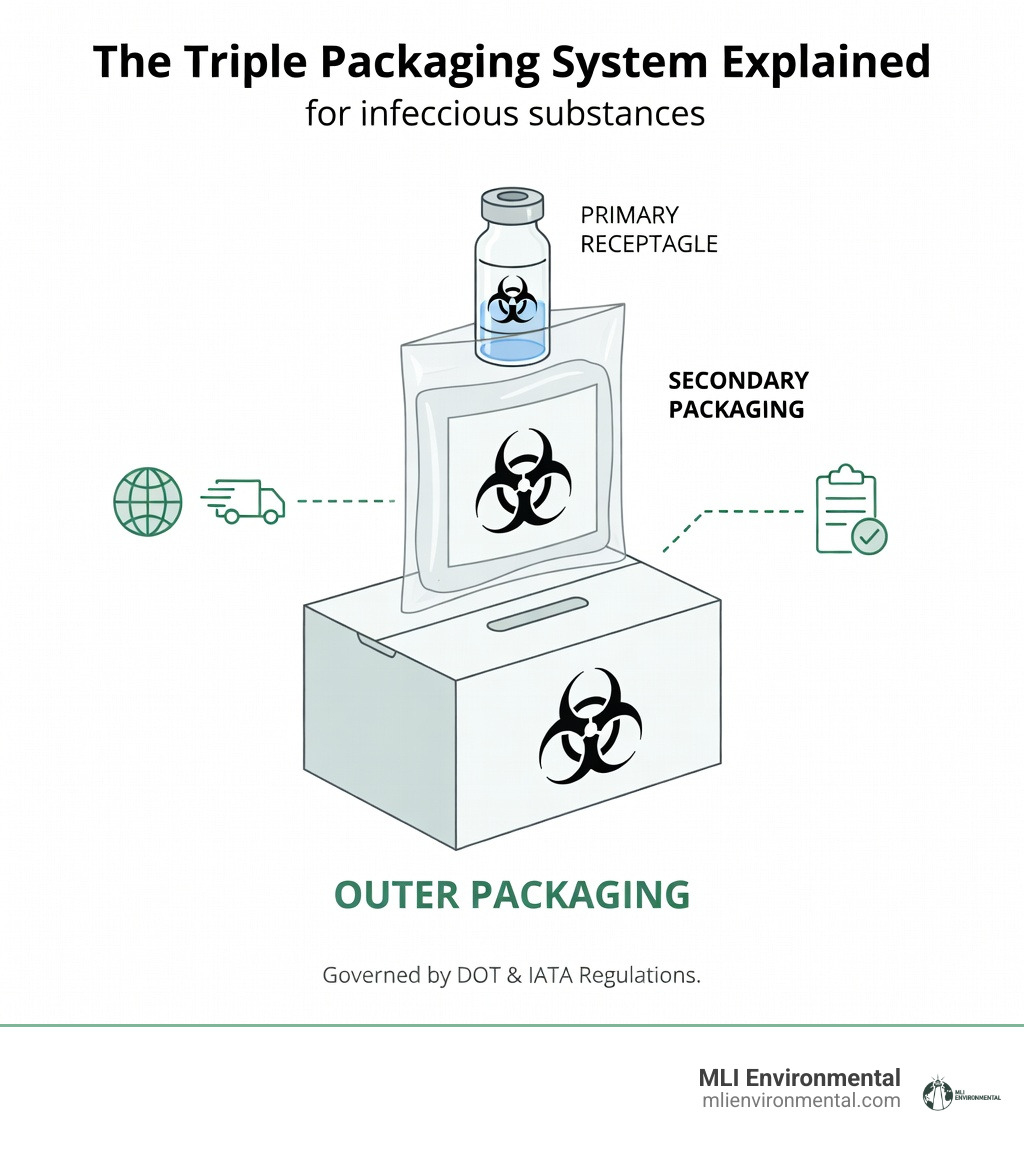
The gold standard for safety is the triple packaging system. This design ensures that even if one layer fails, the others will contain the material.
- Primary Receptacle: This is the innermost container (e.g., a vial or tube) that holds the substance. It must be leak-proof and sift-proof. For liquids, the closure must be held in place by a positive means, such as tape or a screw cap.
- Secondary Packaging: A second leak-proof layer that encloses the primary receptacle. If multiple fragile primary receptacles are used, they must be wrapped individually to prevent contact.
- Absorbent Material: For liquids, an absorbent material (like cellulose wadding or specialized pads) must be placed between the primary and secondary layers. There must be enough absorbent to soak up 100% of the liquid contents.
- Rigid Outer Packaging: The final layer must be a rigid box or drum. For Category A, this must be a UN-certified container (e.g., a 4G fiberboard box) that has passed specific performance tests.
Scientific research on packing instructions indicates that, out of nearly 5 million containers shipped in a single year, only 106 primary containers were reported to be broken—and in every case, the absorbent material and secondary packaging prevented any leaks from reaching the outside.
Training for Infectious Substance Packaging
You can’t just “wing it” when shipping biohazards. Any “hazmat employee”—someone who packages, labels, or signs documentation for these shipments—must receive formal training.
- Initial Training: Must be completed within 90 days of employment.
- Recurrent Training: Required every three years for DOT (ground) and every two years for IATA (air).
- Certification: The employer must maintain a training record and certify that the employee is competent.
For facilities dealing with high-risk “select agents,” a formal security plan is also required to prevent the materials from falling into the wrong hands. You can find more info about biohazardous waste disposal to see how training integrates into broader waste management strategies.
Performance Testing and Safety Standards
Before a box can be labeled with a UN specification mark for Category A, it must undergo what is essentially a “crash test” for packages. These tests are grueling because they simulate the worst-case scenarios of global transport.
The 9-Meter Drop Test
Category A packaging must be able to survive a drop from 9 meters (about 30 feet) onto a hard, unyielding surface. To make it even tougher, fiberboard boxes are often subjected to a “water spray test” for an hour before the drop to simulate heavy rain.
Pressure and Temperature Standards
Because air pressure changes in the cargo hold of a plane, the primary or secondary packaging must be able to withstand an internal pressure differential of 95 kPa (13.8 psi) without leaking. Furthermore, the materials must remain effective in temperatures ranging from -40°C to +55°C (-40°F to +131°F).
Puncture Tests
For Category A, a 15-pound steel rod is dropped from a height of one meter onto the package. If the rod penetrates the outer packaging and hits the secondary container, the package fails.
In contrast, Category B packaging has a lower threshold, requiring a 1.2-meter (4-foot) drop test to ensure it is sturdy enough for general handling. These standards are outlined in scientific research on packaging standards, which harmonizes Canadian and U.S. safety protocols.
Handling Refrigerants and Regulated Medical Waste
Many infectious substances must be kept cold to remain viable. This introduces a second layer of danger: the refrigerant itself.
Dry Ice (UN1845)
Dry ice is a popular choice for shipping frozen specimens. However, because it releases carbon dioxide gas as it sublimates, it can be an explosion hazard if placed in a sealed container.
- Venting: The outer packaging must allow gas to escape.
- Labeling: The package must have a Class 9 Miscellaneous Dangerous Goods label, the UN1845 mark, and the net weight of the dry ice in kilograms.
Liquid Nitrogen (UN1977)
For ultra-low temperatures, liquid nitrogen is used in “dry shippers.” These are specialized vacuum flasks that contain an absorbent material to keep the nitrogen from sloshing around as a liquid.
Regulated Medical Waste (UN3291)
It is important to distinguish between “infectious substances” (samples for testing) and “medical waste” (waste from treatment or research). Many major carriers, such as UPS, flatly refuse to carry Regulated Medical Waste (UN3291). This material requires specialized waste haulers who comply with state-specific rules in Maine, New Hampshire, and Massachusetts.
For those in areas like Portland, Maine, or Concord, New Hampshire, managing this waste requires a partner who understands the “cradle-to-grave” responsibility mandated by the RCRA. You can learn more through more info about biomedical waste disposal.
Spill Response and Incident Reporting
If a package is damaged during transit, immediate action is required:
- Isolate the area: Keep people away from the package.
- Notify Authorities: In the U.S., any release of an infectious substance during transport must be reported to the DOT via form F 5800.1.
- Disinfection: Use appropriate PPE and disinfectants (such as 10% bleach) with sufficient contact time (typically 15-20 minutes).
Frequently Asked Questions about Infectious Substances
What are exempt human or animal specimens?
Exempt specimens are those for which there is a minimal likelihood that pathogens are present. Examples include blood or urine tests for cholesterol levels, blood glucose, or pregnancy. These do not require the full “infectious substance” labeling but must still be shipped in triple packaging (leak-proof primary, leak-proof secondary, and a sturdy outer box) and marked as “Exempt human specimen” or “Exempt animal specimen.”
Why is Medical Waste (UN3291) restricted by some carriers?
Carriers like UPS do not accept medical waste because it often contains sharps (needles) and large volumes of potentially infectious materials that their sorting systems are not designed to handle. Shipping medical waste requires specialized environmental services that can provide the necessary tracking and disposal certificates.
How often is hazmat training required for shippers?
For ground shipments (DOT), training is required every three years. For air shipments (IATA), it is required every two years. If regulations change significantly between those times, additional “bridge” training may be necessary to stay compliant.
Contact the Professionals at MLI Environmental
Navigating infectious substance packaging can feel like walking through a regulatory minefield. However, these rules exist for a very good reason: they work. By adhering to the triple packaging system, ensuring proper classification, and maintaining rigorous training standards, we protect the lab technicians, the delivery drivers, and the general public.
Whether you are shipping from a hospital in Springfield, Massachusetts, or a research lab in Bangor, Maine, compliance is the key to safety. MLI Environmental is a trusted leader in this industry, providing the expertise needed for domestic and international dangerous goods shipping. If you need assistance with the logistics of hazardous materials or are looking for more info about hazmat shipping kits, professional support is just a call away. Stay safe, stay compliant, and always double-check your seals!