

Hazmat safety training is a federal requirement for any employee who handles, transports, or manages hazardous materials or waste. Without proper training, your organization faces serious penalties—minimum fines of $601 per violation, with maximums reaching $99,756 for knowing violations and $232,762 if violations result in death or serious injury.
Key Training Requirements at a Glance:
| Requirement | Details |
|---|---|
| Who Needs Training | Anyone loading, unloading, handling, preparing shipments, operating vehicles, or responsible for safe transport |
| Initial Training Timeline | Within 90 days of hire or job change (can work under supervision during this period) |
| Recurrent Training | Every 3 years for DOT/ground shipping; every 24 months for air shipping (IATA) |
| Required Training Categories | General awareness, function-specific, safety, security awareness, and modal-specific training |
| Record Retention | 3 years plus 90 days after employment ends |
| Minimum Penalty | $601 per day per employee for training violations |
If you’re shipping hazardous materials by ground, air, or vessel—or managing hazardous waste under RCRA—you’re subject to overlapping regulations from DOT, OSHA, EPA, and potentially other agencies. Each has specific training mandates.
The complexity doesn’t stop there. Training requirements vary based on your role (shipper vs. transporter), the mode of transport (highway vs. air vs. vessel), and the type of material (lithium batteries vs. infectious substances). Large quantity generators need specialized training within six months. Emergency responders need HAZWOPER certification at 24-hour or 40-hour levels.
More than 200 million workers make up the U.S. workforce, and any employee whose job “directly affects hazardous materials transportation safety” falls under these rules. That includes not just drivers and warehouse staff, but also office personnel preparing shipping papers.
This guide breaks down exactly who needs training, what regulations apply, how to stay compliant, and what your documentation must include.
Understanding DOT Hazmat Safety Training Requirements
When it comes to the transportation of dangerous goods, the U.S. Department of Transportation (DOT) is the primary authority. Under the Hazardous Materials Regulations (HMR), specifically 49 CFR 172.704, every “hazmat employer” is legally obligated to ensure their “hazmat employees” are trained, tested, and certified.
A hazmat employer is any person or entity that uses at least one employee in connection with transporting hazardous materials in commerce, causing them to be transported, or manufacturing/repairing containers used for such transport. It is not enough to simply hand an employee a manual; the employer must actively verify that the employee understands the Hazardous Materials Training Requirements and can perform their duties safely.
To stay compliant, businesses must learn the Basics of Compliant Hazardous Waste Training to understand how these regulations intertwine with daily operations.
Who Qualifies as a Hazmat Employee?
The definition of a hazmat employee is broader than many realize. It isn’t just the person behind the wheel of a truck carrying chemicals. According to the HMR, a hazmat employee is anyone who, in the course of their employment, directly affects the safety of hazardous materials transportation. This includes:
- Loading and Unloading: Personnel who move hazmat packages onto or off of vehicles or into warehouses.
- Handling and Preparing: Workers who pack materials, label boxes, or mark containers for shipment.
- Shipment Preparation: Office staff or managers who prepare or sign shipping papers and manifests.
- Vehicle Operation: Drivers and train crews who physically move the materials.
- Safety Responsibility: Anyone responsible for the security and safety of the hazardous materials while they are in the “transportation stream.”
Essentially, if an employee touches the package, the paperwork, or the vehicle, they likely need hazmat safety training.
Mandatory Categories of Hazmat Safety Training
The DOT mandates five specific categories of training to ensure a well-rounded understanding of safety and compliance. You can find more info about training services that cover these areas comprehensively:
- General Awareness/Familiarization: This provides a high-level overview of the HMR, helping employees recognize and identify hazardous materials using the Hazmat Table.
- Function-Specific Training: This is the “how-to” portion. It covers the specific tasks an employee performs, such as packaging, marking, labeling, or placarding.
- Safety Training: This is required for those who physically handle or transport hazmat and may be exposed during an accident. It covers emergency response information, self-protection measures, and accident prevention.
- Security Awareness: Every hazmat employee must receive training on security risks associated with hazmat transportation and methods to enhance security.
- In-Depth Security Training: If a facility is required to have a formal security plan (based on the types and quantities of materials handled), employees with specific responsibilities under that plan must receive detailed training.
Comparing Regulatory Standards: DOT, OSHA, and RCRA
Navigating hazmat safety training often feels like swimming in alphabet soup. While the DOT focuses on materials in transit, OSHA (Occupational Safety and Health Administration) and the EPA (Environmental Protection Agency) focus on workplace safety and waste management, respectively.
OSHA HAZWOPER vs. RCRA Waste Management
One of the most common points of confusion is the difference between Hazardous Waste Operations and Emergency Response (HAZWOPER) and RCRA (Resource Conservation and Recovery Act) training.
OSHA HAZWOPER (29 CFR 1910.120): This standard protects workers involved in cleanup operations at uncontrolled hazardous waste sites and those responding to emergency releases.
- Initial Training: Usually involves a 40-hour or 24-hour course depending on the level of exposure risk.
- Refresher: Requires an 8-hour annual refresher to maintain certification.
- Focus: Personal protective equipment (PPE), decontamination, and site safety.
RCRA Waste Management (40 CFR): The EPA’s RCRA regulations govern “cradle to grave” management of hazardous waste. Training requirements depend heavily on your “generator size.”
- Large Quantity Generators (LQG): Must provide specialized training to all personnel involved in waste management within six months of hire.
- Small Quantity Generators (SQG): Must ensure employees are “thoroughly familiar” with proper waste handling and emergency procedures.
- Focus: Waste identification, accumulation time limits, and manifesting.
While there is some overlap, having a DOT certificate does not exempt a worker from HAZWOPER requirements if they are responding to a spill, nor does it satisfy RCRA mandates for waste generators.
Specialized Hazmat Safety Training for High-Risk Materials
Certain materials are so common or so dangerous that they require their own specific training modules. For instance, shipping lithium batteries has become a major compliance hurdle due to their tendency to catch fire if damaged. Similarly, infectious substances (such as medical samples) and “limited quantities” (smaller consumer-sized goods) have unique packaging and labeling requirements. Understanding What Does It Mean to Be Certified? is vital for those handling these high-risk categories to ensure they are meeting the specific technical nuances required by law.
Modal-Specific Training: Ground, Air, and Vessel
The rules change depending on how a package travels. If you ship a box of chemicals from Portland, Maine to Boston, Massachusetts via truck, you follow DOT rules. If that same box needs to fly to London, you must also comply with IATA (International Air Transport Association) standards.
Ground, Air, and Vessel Requirements
- Ground (DOT/49 CFR): Focuses on highway segregation (keeping incompatible chemicals apart), driver requirements, and domestic placarding.
- Air (IATA DGR): These are the strictest regulations. Because you cannot easily pull over an airplane at 30,000 feet, the packaging and quantity limits are much tighter. Notably, IATA requires recurrent training every 24 months, which is more frequent than the DOT’s 3-year cycle.
- Vessel (IMDG Code): For international ocean freight, the International Maritime Dangerous Goods (IMDG) Code applies. This emphasizes stowage and segregation on ships to prevent fires at sea.
Before shipping, you must ask: Transporting Hazardous Materials: Are You Qualified? because holding a ground certification does not legally allow you to sign off on an air or vessel shipment.
State-Specific and Advanced Certifications
While federal rules provide the baseline, some states have additional requirements. For example, emergency responders often seek technician- or specialist-level certifications that meet higher standards for incident command. In the Northeast, agencies often look for training that aligns with regional safety initiatives. You can find information on Where We Train to see how regional programs support these advanced needs.
Compliance Timelines and Recordkeeping Essentials
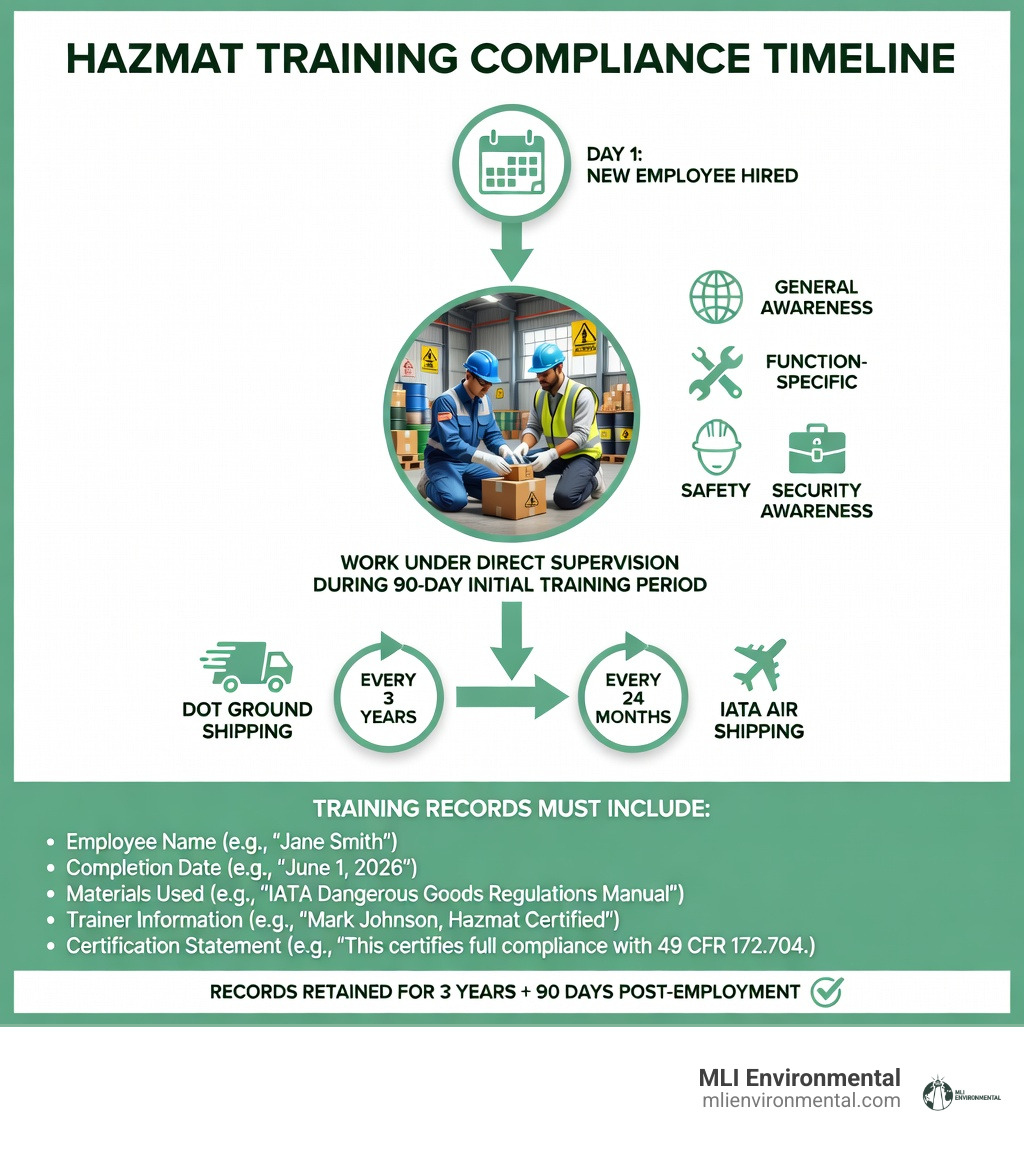
Compliance is not a “one-and-done” event. It is a continuous cycle of training and documentation. The “90-day rule” is the most important timeline for new hires: a new hazmat employee may perform hazmat functions for up to 90 days before being fully trained, provided they are under the direct supervision of a properly trained and certified employee.
Consequences of Non-Compliance and Penalties
The DOT does not take training lightly. Since “human error” is cited as the leading cause of hazmat incidents, training is viewed as the primary defense.
- Civil Penalties: Knowing violations can cost up to $99,756 per day, per violation.
- Training Violations: Even a simple paperwork error in a training record can carry a minimum penalty of $601.
- Criminal Penalties: In extreme cases involving reckless disregard for safety, criminal charges and jail time are possible.
For businesses in Lewiston, Maine or Manchester, New Hampshire, the cost of a single violation often far exceeds the cost of professional onsite training services.
Documentation and Self-Training Rules
To prove compliance during an audit, you must have a training record for every hazmat employee. According to Hazardous Materials Training guidelines, these records must include:
- The employee’s name.
- The most recent training completion date.
- A description, copy, or the location of the training materials used.
- The name and address of the person providing the training.
- A certification statement that the employee has been trained and tested.
Can employees self-train? Yes, the DOT allows self-instruction, online courses, and use of previous employer records, provided the current employer verifies that the training is accurate and relevant to the employee’s new job functions. However, the employer remains the one who must ultimately “certify” the employee.
Frequently Asked Questions about Hazmat Training
Can hazmat employees self-train using online courses?
Yes. The DOT explicitly authorizes online, computer-based, and virtual training. However, the training must still be followed by a test, and the employer must certify that the training was effective. For hands-on tasks such as palletizing or securing loads, online training is often supplemented by practical demonstrations.
How often is recurrent training required for air shippers?
While the DOT ground requirement is every three years, the IATA Dangerous Goods Regulations mandate recurrent training every 24 months. If you ship via air, you must follow the more frequent 24-month cycle to remain compliant with international carrier standards.
Is a CDL hazmat endorsement sufficient for HMR training?
No. While a Commercial Driver’s License (CDL) with a hazmat endorsement (H) is a legal requirement for driving the vehicle, it does not satisfy the employer’s obligation to provide function-specific, safety, and security awareness training under 49 CFR 172.704. The CDL is a license; hazmat training is a job-specific certification.
Stay Compliant with Expert Hazmat Safety Training Support
Hazmat safety training is the backbone of a safe and compliant shipping operation. Whether you are a small manufacturer in Burlington, Vermont or a large warehouse in Springfield, Massachusetts, the rules are clear: you must train your people, test their knowledge, and keep meticulous records.
At MLI Environmental, they understand that navigating these regulations can be overwhelming. As a trusted leader in hazardous materials and waste management, they specialize in helping businesses across New England—from Portland to Worcester—stay ahead of the curve. By fostering a strong safety culture and utilizing professional training services, you protect your employees, your community, and your bottom line.
Don’t wait for an audit or an accident to find out your training is out of date. Get started with professional training services today and ensure your team is qualified, certified, and safe.