
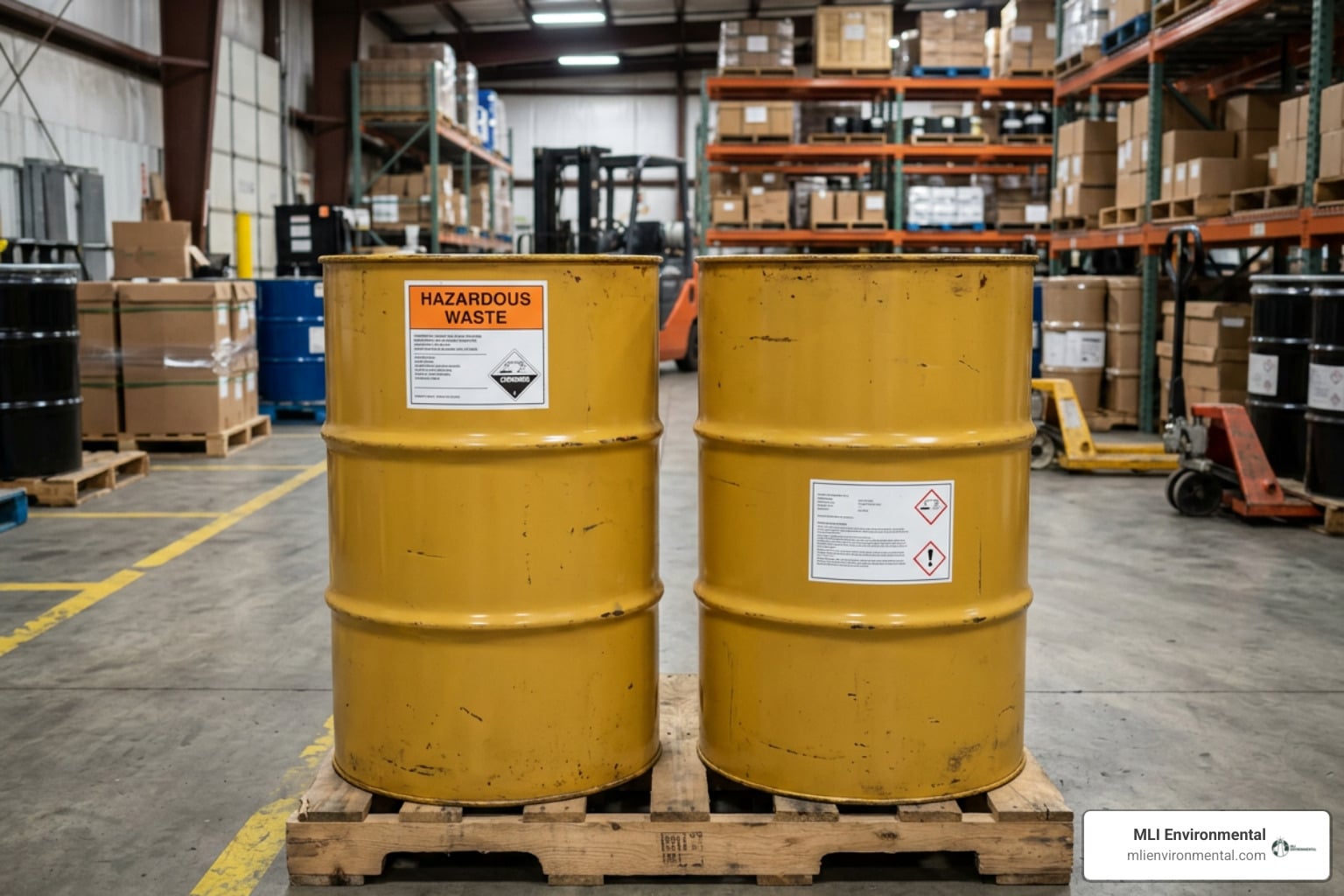
Core Federal and State Requirements for Hazardous Waste Labels
Under RCRA regulations in 40 CFR Part 262, the EPA requires facilities to identify containers holding regulated waste. Meeting hazardous waste label requirements helps workers, inspectors, and emergency responders understand container contents, hazards, generator details, and accumulation timelines at a glance.
A compliant label should identify the waste, show the accumulation start date when required, and include the generator name, physical address, and EPA Identification Number. State agencies may add local requirements, such as state waste codes alongside federal codes.
| Regulatory Feature | EPA Accumulation Marking (On-Site Storage) | DOT Transport Label (Off-Site Shipping) |
|---|---|---|
| Governing Regulation | 40 CFR Part 262 (RCRA) | 49 CFR Parts 172 & 173 (HMR) |
| Primary Purpose | On-site identification, accumulation tracking, emergency response | Public transit safety and emergency hazard response |
| Mandatory Phrasing | “Hazardous Waste” or state-required equivalent | Proper Shipping Name |
| Time Tracking | Accumulation start date required in CAAs | No accumulation date required |
| Hazard Indication | Characteristic hazards or GHS pictograms | DOT class diamonds |
| Tracking Codes | EPA Waste Codes | UN/NA Identification Number |
Mandatory Information Fields and Warning Phrasing
Compliant primary accumulation labels generally need:
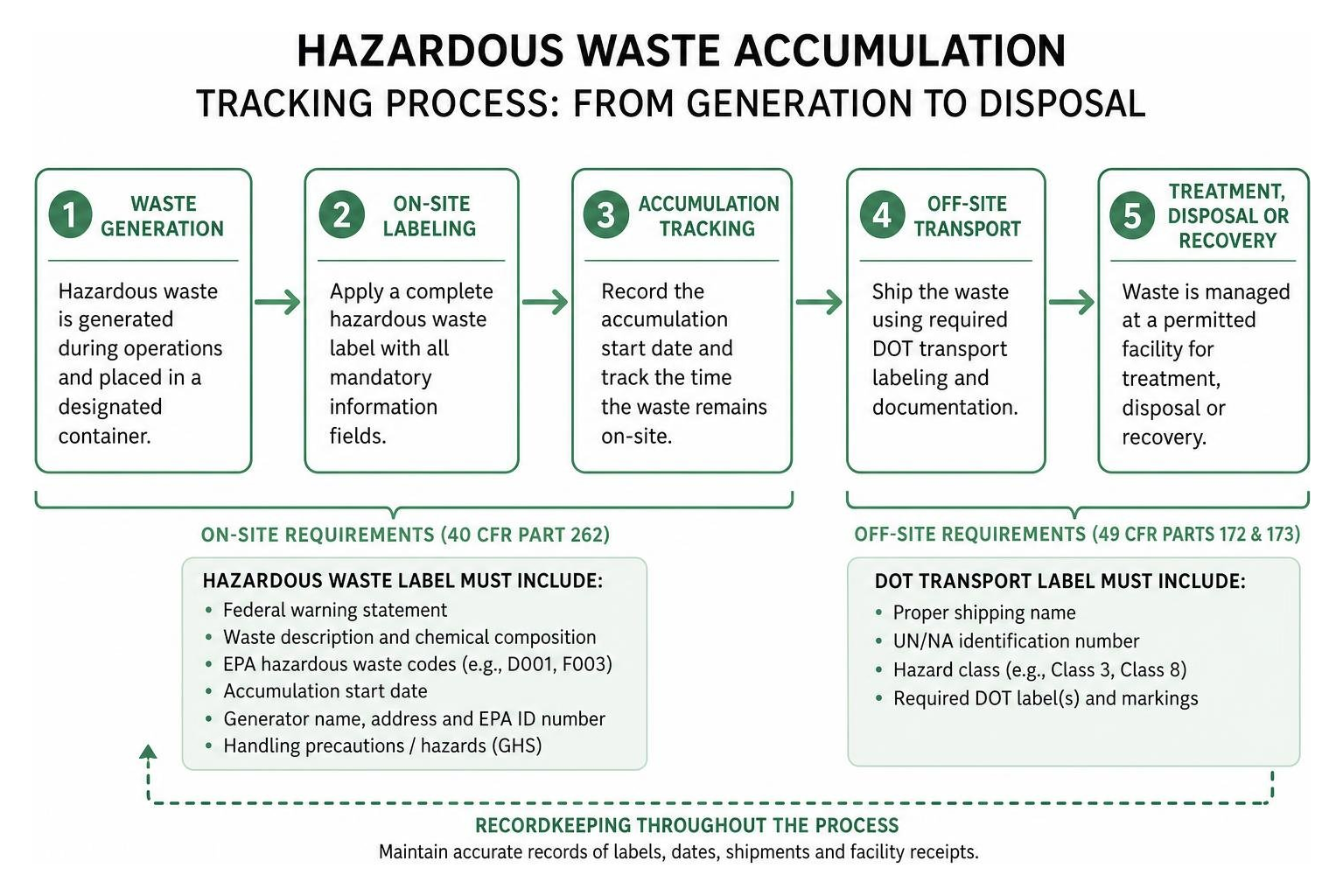
- Federal Warning Statement: “HAZARDOUS WASTE – Federal Law Prohibits Improper Disposal. If found, contact the nearest police or public safety authority or the U.S. Environmental Protection Agency.”
- Waste Description: Common chemical names or clear physical descriptions instead of vague trade names.
- EPA Waste Codes: Codes such as D002 for corrosivity or F005 for spent non-halogenated solvents.
- Accumulation Start Date: The date the container began accumulating waste in a central storage area.
- Generator Identification: Company name, address, and EPA ID number.
- Handling Precautions: Physical or health hazards, using EPA GHS chemical label guidelines for clear risk communication.
Sizing and Physical Specifications for Hazardous Waste Labels
Labels must be legible and sized for the container. Standard 55-gallon drums often use 6″ x 6″ or 4″ x 6″ adhesive labels, while smaller containers, totes, and tanks may need scaled labels or placards.
When choosing right hazardous waste containers, plan for label visibility and durability:
- Small Containers: Reduced-size tags are acceptable if “Hazardous Waste” and hazard statements remain readable.
- Drums and IBCs: Use high-contrast labels on visible vertical sides.
- Bulk Tanks: Use enlarged placards or stenciled markings visible from normal approach paths.
Use coated paper or durable adhesive vinyl with UV-resistant inks and permanent adhesives so labels hold up against moisture, temperature shifts, and chemical fumes.
OSHA/GHS Hazard Communication vs. EPA and DOT Transport Labeling
Hazardous materials may fall under OSHA, EPA, and DOT rules at different points. OSHA governs worker chemical safety, EPA regulates hazardous waste storage, and DOT controls public safety during transit.
Understanding everything you need to know about dangerous goods markings helps waste managers avoid mixing agency requirements. Facilities should also review state hazard communication guidelines when local worker-safety programs apply.
GHS Pictograms and Signal Word Allocations
OSHA-aligned GHS labels use standardized pictograms, signal words, and hazard statements. Each pictogram places a black symbol on a white background inside a red diamond border.
Key OSHA Hazard Communication Appendix C rules include:
- Signal Word Precedence: Use only one signal word. If “Danger” applies, do not also use “Warning.”
- Blank Frame Prohibition: Do not print empty red diamonds; black out or omit unused frames.
- Pictogram Suppression: More severe pictograms can replace less severe ones to prevent conflicting hazard signals.
DOT Hazmat Markings and Placarding for Off-Site Shipping
Once waste leaves the facility, DOT requirements under Title 49 CFR apply. Shippers must satisfy 5 hazardous waste label requirements shipping standards before transport.
DOT hazard class labels are diamond-shaped and measure at least 100 mm x 100 mm. They correspond to the 9 classes of dangerous goods, including Class 3 flammable liquids, Class 6 toxic substances, Class 8 corrosives, and Class 9 miscellaneous hazardous materials.
Shipped containers must show the Proper Shipping Name, UN/NA identification number, generator details, and Uniform Hazardous Waste Manifest tracking number.
Accumulation Area Labeling Rules: SAA, CAA, and Universal Waste
Accumulation labeling depends on whether the container is at the initial generation point or in a central storage area. Avoiding the top 4 issues hazardous waste containers starts with consistent labeling, closed containers, sound drum condition, and accurate date tracking.
Satellite Accumulation vs. Central Accumulation Area Protocols
Satellite Accumulation Areas (SAAs) collect waste at or near the point of generation under operator control.
- SAA Labeling Standards: Mark containers with “Hazardous Waste” or state-required language and clearly indicate the hazards.
- Accumulation Start Date Exception: A start date is not required while the SAA container is below volume limits.
- The 55-Gallon Threshold: Once an SAA container reaches 55 gallons of standard hazardous waste, or 1 quart / 2.2 pounds of acutely hazardous waste, date it immediately and move it to a Central Accumulation Area within three calendar days.
In a Central Accumulation Area, the accumulation start date is required when the container arrives. Understanding what you need to know hazardous waste stickers helps managers track these generator limits:
- VSQGs: Follow basic container identification standards; local volume limits may still apply.
- SQGs: May accumulate waste for up to 180 days, or 270 days if shipping more than 200 miles.
- LQGs: Must ship accumulated hazardous waste off-site within 90 days.
Specific Labeling Standards for Universal Waste Streams
Universal waste uses designated phrasing instead of standard hazardous waste labels:
- Batteries: “Universal Waste—Battery(ies),” “Waste Battery(ies),” or “Used Battery(ies).”
- Pesticides: “Universal Waste—Pesticide(s)” or “Waste Pesticide(s).”
- Mercury-Containing Equipment: “Universal Waste—Mercury-Containing Equipment,” “Waste Mercury-Containing Equipment,” or “Used Mercury-Containing Equipment.”
- Lamps: “Universal Waste—Lamp(s),” “Waste Lamp(s),” or “Used Lamp(s).”
Universal waste containers must also show or document accumulation time through a date, inventory log, or designated storage-area tracking system proving storage has remained under one year.
Preventing Compliance Violations and Implementing Durability Best Practices
Labeling citations are avoidable when facilities standardize storage and shipping workflows. Following the process from DOT to delivery mastering hazmat shipping labels helps maintain compliance through storage, transport, and disposal.
Common pitfalls include:
- Missing Accumulation Dates: Forgetting to date drums moved to a CAA.
- Vague Descriptions: Using shop slang instead of chemical descriptions and waste codes.
- Illegible Entries: Writing with pens that smear or fade.
- Peeling Labels: Using paper stickers outdoors or in harsh environments.
- Conflicting Marks: Displaying duplicative GHS pictograms and DOT diamonds for the same shipped hazard.
Creating DIY Hazardous Waste Labels vs. Commercial Stock
Facilities may print custom labels or buy pre-printed stock. Either approach can comply with federal RCRA rules if the label includes all mandatory fields and remains legible.
When designing in-house labels, review mandatory label allocation elements and keep the layout disciplined:
- Typography: Print “HAZARDOUS WASTE” in bold, readable lettering on standard drum labels.
- Marker Selection: Use industrial-grade, fade-resistant permanent markers for handwritten fields.
- No Empty Diamonds: Avoid unused hazard diamonds or bracket placeholders.
Surface Preparation and Application Standards
Even a durable label can fail if applied to oil, dust, moisture, rust, or chemical residue.
- Clean the Application Area: Wipe the drum exterior before applying the label.
- Ensure Dry Surfaces: Remove condensation, especially in unheated warehouses.
- Apply Firm Pressure: Smooth from the center outward to activate the adhesive.
- Keep Labels Visible: Place labels on the upper drum body facing inspection aisles, not on removable lids.
Frequently Asked Questions About Hazardous Waste Labels
Can you make your own hazardous waste labels for containers?
Yes. Facilities may design and print their own hazardous waste labels using workplace printers, templates, or blank vinyl stock. DIY labels must include the words “Hazardous Waste,” generator details, EPA waste codes, chemical composition, accumulation start date, and clear hazard warnings. They must also remain legible, smudge-proof, and durable.
When must you add an accumulation start date to a satellite waste container?
A start date is not required while a satellite accumulation area container is actively collecting waste below volume limits. Once it reaches 55 gallons of standard hazardous waste, or 1 quart / 2.2 pounds of acutely toxic waste, mark the date immediately and move the container to a Central Accumulation Area within three calendar days.
What is the difference between GHS and DOT hazard labels on shipped drums?
OSHA/GHS labels identify workplace chemical hazards using red diamond pictograms, signal words, and hazard statements. DOT labels govern transportation and use diamond-shaped class labels, numeric hazard classes, and UN identification numbers. During off-site transit, DOT labels control; matching GHS pictograms should not duplicate the same hazard signal on shipped containers.
Need Help Keeping Hazardous Waste Labels Compliant?
Clear, accurate hazardous waste labels protect workers, support emergency response, and keep shipments moving without compliance delays. MLI Environmental helps industrial, commercial, and research facilities across Maine, Massachusetts, New Hampshire, and Vermont with waste profiling, container labeling protocols, and certified transportation logistics. For hands-on support, partner with experienced specialists for expert dangerous goods shipping and waste management services.