
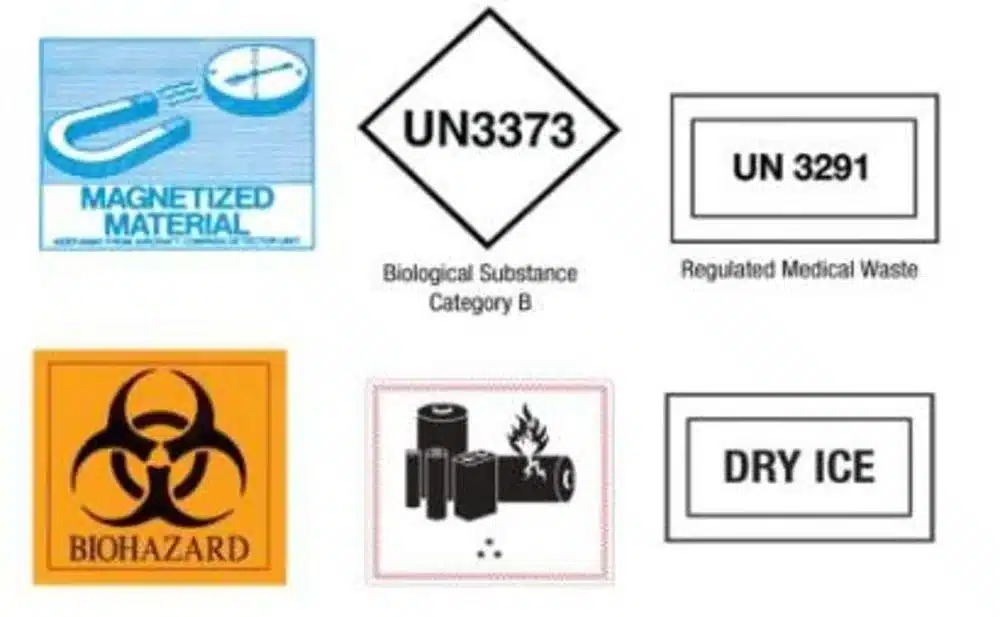
IATA dangerous goods labels are standardized, diamond-shaped warning signs required on packages containing hazardous materials shipped by air. These labels use specific colors, symbols, and numbers to quickly communicate the type of hazard to handlers, carriers, and emergency responders.
Key facts about IATA dangerous goods labels:
- Purpose: Identify hazards and ensure safe handling during air transport
- Standard size: 100mm x 100mm, set at a 45° angle (diamond orientation)
- 9 hazard classes: Each class has distinct colors and symbols (explosives, gases, flammables, corrosives, etc.)
- Regulatory body: International Air Transport Association (IATA) sets the standards
- Compliance requirement: Mandatory for all dangerous goods shipped by air
- Additional marks: Handling labels like “Cargo Aircraft Only” or orientation arrows may also be required
You’ve probably seen a truck on the highway with colorful diamond-shaped signs, or noticed bold warning labels on packages at a cargo facility. These aren’t just decorative—they’re critical safety tools. Over 1.25 million dangerous goods shipments travel by air each year, and each one requires precise labeling to prevent accidents, delays, and regulatory penalties.
The right label tells a cargo handler that a package contains corrosive acid, a firefighter that water will make a lithium battery fire worse, or a pilot that certain materials cannot fly on passenger aircraft. Get it wrong, and you’re not just facing fines—you’re putting lives at risk.
Whether you’re shipping flammable liquids, toxic substances, or lithium batteries, understanding IATA dangerous goods labels isn’t optional. It’s the foundation of compliant, safe air cargo operations.
Decoding the 9 Classes and Their IATA Dangerous Goods Labels
Imagine a world where every package looks the same, regardless of whether it holds a harmless teddy bear or a highly corrosive chemical. Chaos, right? That’s why the system for classifying and labeling dangerous goods exists. It’s a universal language for hazards, ensuring that everyone in the supply chain, from the shipper in Maine to the cargo handler in Boston, understands exactly what they’re dealing with.
At the heart of this system are the nine classes of dangerous goods, established by the United Nations Recommendations on the Transport of Dangerous Goods. These recommendations provide the foundational framework that IATA adapts for air transport. Each class represents a distinct type of hazard, and often, these classes are further broken down into divisions to specify the risk even more. A substance might have a primary hazard (its main danger) and a subsidiary risk (a secondary danger). Both must be communicated clearly on the package.
Understanding these classes is the first step in correctly applying IATA dangerous goods labels. For a deeper dive into the broader categories of hazardous materials, explore our guide on More on the Classes of Hazardous Materials.
Class 1: Explosives & Class 2: Gases
When we talk about dangerous goods, explosives often come to mind first. Class 1 covers these volatile materials, ranging from fireworks to demolition charges. They’re categorized into six divisions (1.1 to 1.6) based on the type of explosive hazard they present, such as mass explosion risk, projection hazard, or fire hazard with minor blast. For example, a Class 1.3 explosive might present a fire hazard with minor blast or projection, while a 1.4S is considered a substance with no significant hazard. Each division has its own specific label, ensuring that the exact level of danger is clearly communicated.
Next up, we have Class 2: Gases. These aren’t just the air we breathe; they include flammable gases (like propane or acetylene), non-flammable and non-toxic gases (such as compressed oxygen in a fire extinguisher or helium balloons), and highly toxic gases (like chlorine). Think of those aerosols you use daily – many are Class 2.1 flammable gases! Getting the right label on a cylinder of compressed natural gas is vital, as improper handling could lead to explosions or asphyxiation. For more on this, check out our Hazardous Materials Guide: Compressed Natural Gases.
Class 3: Flammable Liquids & Class 4: Flammable Solids
Class 3, Flammable Liquids, includes substances like gasoline, paints, and many types of alcohol. These materials are defined by their flashpoint – the lowest temperature at which their vapors ignite in air. A lower flashpoint means a higher flammability risk. Imagine the risk of shipping a drum of paint from Worcester, Massachusetts, if it wasn’t properly labeled! The red diamond label with a flame symbol is instantly recognizable, signaling extreme caution. For a comprehensive look at how these liquids are classified, refer to our Hazardous Materials Guide: Flammable Liquids Classification.
Class 4, Flammable Solids, is a fascinating category. It includes substances that are easily ignited (like matches or sulfur), those liable to spontaneous combustion (such as phosphorus or oily rags), and materials that, when wet, emit flammable gases (like magnesium or sodium). Each of these sub-risks has a distinct label to warn handlers. For example, a blue label with a flame indicates danger when wet. Ensuring these materials are correctly identified and labeled prevents accidental fires and dangerous reactions, especially when transported by air. Learn more about these tricky materials in our Hazardous Materials Guide: Flammable Solids.
Class 5: Oxidizers & Organic Peroxides & Class 6: Toxic and Infectious Substances
Class 5 is split into two dangerous divisions: Oxidizing Agents (5.1) and Organic Peroxides (5.2). Oxidizers, like hydrogen peroxide or calcium hypochlorite, can cause or contribute to the combustion of other materials, even in the absence of air. Organic peroxides, such as methyl ethyl ketone peroxide, are thermally unstable and can undergo exothermic self-accelerating decomposition. Both are represented by a yellow diamond label, often with a flaming ‘O’ symbol, screaming “fire hazard!” to anyone who sees them. Understanding these can be a lifesaver, as detailed in our Hazardous Materials Guide: Class 5 Common Oxidizers.
Class 6 encompasses Toxic and Infectious Substances. This is a class that demands immediate respect. Toxic substances (6.1), like arsenic or pesticides, can cause serious injury or death upon inhalation, ingestion, or skin contact. Infectious substances (6.2), such as lab samples containing viruses (think UN 3373 for diagnostic specimens) or bacteria, are materials known or reasonably expected to contain pathogens. The skull and crossbones for toxic substances and the biohazard symbol for infectious substances are universally recognized warnings. Proper labeling here is not just about compliance; it’s about public health and safety. For more on the dangers lurking in this class, consult our Hazardous Materials Guide: Poison.
Class 7: Radioactive Materials, Class 8: Corrosives, & Class 9: Miscellaneous
Class 7, Radioactive Materials, includes substances that spontaneously emit ionizing radiation. These are categorized into three levels: Category I (white), Category II (yellow), and Category III (yellow), based on their radiation level and transport index. Even “excepted packages” of radioactive material, with very low levels of radiation, require specific markings. These labels are crucial for protecting handlers and preventing exposure.
Class 8, Corrosives, covers materials like hydrochloric acid, sulfuric acid, and sodium hydroxide solutions. These substances can cause severe damage to living tissue or other materials upon contact. The black and white label with two test tubes corroding a hand and a surface is a clear warning. Mishandling corrosives without proper identification could lead to chemical burns or damage to aircraft structure. Our Hazardous Materials Guide: Corrosive Liquids offers more insights.
Finally, Class 9, Miscellaneous Dangerous Goods, is the catch-all category for substances that don’t fit neatly into the other eight classes but still pose a hazard during transport. This includes crucial items like lithium batteries (both lithium-ion and lithium metal), magnetized material that could interfere with aircraft navigation, environmentally hazardous substances, and even dry ice (solid carbon dioxide), which can cause asphyxiation or frostbite. The Class 9 label (black and white stripes on the top, white on the bottom) is a clear indicator that special handling is required. Without these labels, shipping items like lithium batteries from New Hampshire or Vermont could become a significant safety risk. Dive deeper into this diverse category with our Hazardous Materials Guide: Class 9 Hazardous Materials.
Beyond the Diamond: Understanding Label Specifications and Handling Marks
When it comes to shipping dangerous goods, it’s not just about slapping on a pretty diamond. There’s a subtle but important distinction between “markings” and “IATA dangerous goods labels,” and both are vital for compliance and safety. Markings generally refer to text-based information like the UN number, proper shipping name, shipper and consignee details, and net quantity. Labels, on the other hand, are the pictorial diamond-shaped hazard warnings we’ve been discussing. Both must be durable, legible, and placed on a contrasting background to ensure they are easily visible, even in less-than-ideal conditions. These requirements are paramount whether you’re shipping from a busy port in Portland, Maine, or a smaller facility in rural New Hampshire. For a deeper understanding of these requirements, check out our article on More on hazardous waste label requirements.
Key Specifications for IATA Dangerous Goods Labels
Think of IATA dangerous goods labels as the uniform of safety, and like any good uniform, they have strict specifications. These aren’t just suggestions; they are regulatory mandates designed to ensure universal recognition and readability across the globe.
Here are some key specifications:
- Standard Size: The standard size for an IATA hazard label is 100 mm x 100 mm. This consistent sizing ensures that all labels are easily identifiable regardless of their specific hazard class.
- Diamond Orientation: Labels must be square set at 45°, creating that iconic diamond shape. This specific orientation is part of the visual language that signals “caution, dangerous goods!”
- Material Requirements: Labels must be made of durable material that can withstand various environmental conditions encountered during air transport. This includes resistance to fading, moisture, and tearing. America’s Finest Labels, for example, offers IATA Dangerous Goods labels printed on gloss paper or vinyl with permanent pressure-sensitive adhesive, designed to stay in place and withstand elements. They are printed with UV inks on scratch-resistant material, ensuring longevity and legibility.
- Adhesive Quality: The labels must have a permanent pressure-sensitive adhesive to ensure they remain securely affixed to the package throughout the entire journey.
- BS 5609 Standard: Many compliant labels and placards, especially those offered by IATA itself, conform to BS 5609 standards. This British Standard specifies the performance requirements for pressure-sensitive, adhesive-coated labels used for marine and other harsh environments, a testament to the durability expected for air cargo as well.
- Clear Design: Labels must feature bold colors and clear designs, with the hazard symbol and class number prominent. The symbols and colors must match ICAO Technical Instructions illustrations.
MLI Environmental understands the critical importance of these specifications. We offer solutions to help ensure your shipments are equipped with compliant and high-quality labels. Learn more about MLI Environmental’s compliant label solutions.
Essential Handling Labels and Marks
Beyond the primary hazard diamonds, several other handling labels and marks are crucial for safe air transport. These aren’t about the intrinsic danger of the goods themselves, but rather about specific handling instructions or transport limitations.
- Cargo Aircraft Only (CAO): This distinctive white label with black text and a small plane symbol is used when a package contains dangerous goods that are forbidden on passenger aircraft and can only travel on cargo aircraft. It’s a critical safety measure, preventing incompatible materials from being loaded onto passenger flights.
- Orientation Arrows: For packages containing liquids, especially combination packagings and overpacks, orientation arrows are often required. These two arrows, pointing upwards on at least two opposite sides of the package, ensure the package is kept upright, preventing leaks and spills.
- Cryogenic Liquids: For refrigerated liquefied gases, a specific label indicates the presence of extremely cold substances, warning handlers of potential frostbite and the need for ventilation.
- Magnetized Material: Instead of a general Class 9 label, magnetized material (which can interfere with aircraft compasses) uses a specific label to indicate its presence and alert pilots.
- Keep Away from Heat: This label is mandatory for packages containing self-reactive substances or organic peroxides that are susceptible to heat, warning handlers to maintain a cool environment to prevent dangerous reactions.
Properly applying these handling labels is just as important as the hazard labels. They provide crucial information for personnel at every stage, from loading in Springfield, Massachusetts, to unloading in Burlington, Vermont. For comprehensive guidance on preparing your packages, consult our Information on proper hazmat packaging.
Special Provisions: Limited and Excepted Quantity IATA Dangerous Goods Labels
Not all dangerous goods shipments are created equal. For very small quantities, regulations offer “special provisions” that can simplify the shipping process, provided strict conditions are met. This is where Limited Quantity and Excepted Quantity IATA dangerous goods labels come into play.
- Limited Quantity (LQ): This provision allows for smaller amounts of certain dangerous goods to be transported with reduced regulatory requirements, such as simplified marking and labeling (often a diamond with a ‘Y’ in the center for air transport) and no requirement for a Shipper’s Declaration. However, there are still specific packaging requirements and strict gross weight limits (e.g., maximum 30kg or 66lb gross weight for packages).
- Excepted Quantity (EQ): This provision applies to even smaller quantities than limited quantities, with even fewer regulations. Packages must bear an “E” mark within a square or rectangle. While simplified, these still have very specific inner and outer packaging limits and require careful attention to detail.
These provisions are designed to balance safety with the practicalities of shipping small, often everyday, hazardous items. However, the reduced requirements do not mean reduced responsibility. Shippers in Rhode Island or any of our service areas must still ensure full compliance with the specific conditions for these provisions. For more on navigating air shipping regulations, see our guide on Shipping dangerous goods by air.
Staying Compliant: Regulations, Penalties, and Resources
The world of dangerous goods shipping is highly regulated, and for good reason. Safety is paramount. The shipper bears the primary responsibility for accurately classifying, packaging, marking, labeling, and documenting dangerous goods. However, carriers also play a crucial role, verifying compliance before accepting shipments. This rigorous oversight ensures that hazardous materials move safely through the air cargo network, whether from a small airport in Central Maine or a major hub like Boston Logan. For an overview of the essential documentation, refer to our Guide to Hazmat Shipping Papers.
The IATA Dangerous Goods Regulations (DGR)
The International Air Transport Association (IATA) is the global authority for dangerous goods regulations in air transport. The IATA Dangerous Goods Regulations (DGR) manual is the industry’s go-to guide, updated annually to reflect the latest safety standards and operational practices. Currently, it’s in its 67th Edition, a testament to its continuous evolution.
The DGR harmonizes with the technical instructions published by the International Civil Aviation Organization (ICAO), ensuring a consistent global standard. It covers everything from classification and identification to packing instructions, marking, labeling, and documentation requirements, including the critical Shipper’s Declaration for Dangerous Goods (DGD). This comprehensive manual is essential for anyone involved in preparing or handling dangerous goods for air freight. IATA offers a wide variety of fully compliant labels and markings that may be required, including DGR Hazard labels, handling labels, limited and excepted quantity labels, and Time & Temperature Sensitive Labels. You can find more information on IATA Dangerous Goods Documentation resources.
Consequences of Non-Compliance
Ignoring or misunderstanding IATA dangerous goods labels and regulations can have severe repercussions. The implications of using incorrect or non-compliant labels extend far beyond a minor inconvenience.
- Shipment Delays and Rejection: Incorrect labeling is a leading cause of shipment delays or outright rejection by carriers. This can disrupt supply chains and incur significant costs.
- Civil Penalties and Fines: Regulatory bodies impose hefty fines for non-compliance. These penalties can be substantial, impacting a business’s bottom line. For example, enforcement agencies have tightened their oversight with more audits, inspections, and automated flagging of non-compliant documents.
- Safety Risks: The most serious consequence is the increased risk to safety. Incorrectly labeled packages can lead to improper handling, accidental spills, fires, or even explosions, endangering personnel, aircraft, and the public.
- Damaged Reputation: A company found in violation of dangerous goods regulations can suffer significant reputational damage, eroding trust with customers and partners.
These consequences underscore why compliance isn’t just about avoiding penalties; it’s about ensuring safety and maintaining operational integrity. To learn more about common pitfalls, read our article on How companies fail DOT hazmat regulations.
Where to Find Help and Compliant Labels
Navigating the complex world of IATA dangerous goods labels and regulations can feel daunting, but you don’t have to go it alone. Expert help and compliant resources are readily available.
MLI Environmental is a trusted leader in hazardous materials and waste management, specializing in international and domestic dangerous goods shipping. Our certified professionals are equipped to guide you through the intricacies of IATA requirements, ensuring your shipments are compliant and safe. We understand the specific needs of businesses in New England, from the coastal towns of Maine to the busy cities of Massachusetts.
When it comes to purchasing compliant IATA dangerous goods labels, it’s crucial to source them from reputable providers. MLI Environmental can assist in identifying the correct labels and ensuring they meet all IATA specifications, including the standard 100mm x 100mm size, material durability, and adhesive quality. IATA itself offers compliant handling labels in rolls of 150 or 1,000, conforming to BS 5609 standards, with volume discounts available for larger orders.
Furthermore, proper training is essential for anyone involved in the dangerous goods supply chain. Our DOT IATA Compliance Support services can help ensure your team is fully trained and certified, minimizing risks and maximizing compliance. Whether you’re in Bangor, Maine, or Manchester, New Hampshire, we’re here to help you stay ahead of the curve.
Frequently Asked Questions about Dangerous Goods Labeling
What is the difference between a marking and a label?
The terms “marking” and “label” are often used interchangeably, but in the context of dangerous goods, they refer to distinct elements. A label is the diamond-shaped pictogram that visually communicates the primary (and sometimes subsidiary) hazard of the material using symbols, colors, and a hazard class number. It’s the quick visual cue. A marking, on the other hand, refers to other essential text-based information printed or affixed to the package, such as the UN number, the proper shipping name, the shipper’s and consignee’s names and addresses, and the net quantity of the dangerous goods. Both labels and markings are required for compliance and together provide a complete picture of the package’s contents and handling requirements.
Can I print my own IATA labels?
Yes, you can print your own IATA dangerous goods labels, but they must strictly adhere to IATA’s precise specifications outlined in the IATA Dangerous Goods Regulations (DGR). This isn’t just about the correct symbol and class number; it includes exact dimensions (100 mm x 100 mm for hazard labels), specific colors (which must be durable and not fade), material quality, and adhesive strength. Any deviation can render the label non-compliant. Using non-compliant, self-printed labels is a serious offense that can lead to shipment rejection, significant delays, and hefty fines. It’s often safer and more reliable to purchase pre-printed, certified labels from reputable suppliers to ensure full compliance.
What happens if I use the wrong label on my package?
Using the wrong label on your package is a serious compliance failure with potentially severe consequences. Firstly, your shipment will likely be stopped, delayed, or even returned by the carrier or regulatory authorities. This can lead to significant logistical headaches and financial penalties. More critically, using an incorrect label poses a major safety risk. It misinforms handlers, ground crew, and emergency responders about the true nature of the hazardous material inside. In an incident, this misinformation could lead to improper handling, the use of inappropriate emergency response techniques (e.g., using water on a chemical fire that reacts violently with water), or a lack of necessary protective equipment, endangering lives and causing greater environmental damage. It’s a risk no business in Concord, New Hampshire, or anywhere else should ever take.
Ensuring Safe and Compliant Shipments with MLI Environmental
In the complex ecosystem of air cargo, IATA dangerous goods labels are more than just stickers; they are the silent guardians of safety, communication, and compliance. From the vibrant diamonds signaling explosive hazards to the subtle orientation arrows guiding careful handling, each label plays a critical role in protecting personnel, aircraft, and the environment.
Understanding these labels, their precise specifications, and the rigorous regulations set forth by IATA is not merely a bureaucratic hurdle. It’s a commitment to a robust safety culture and a fundamental pillar of efficient, responsible air transport. The implications of non-compliance—ranging from costly delays and fines to catastrophic accidents—underscore the absolute necessity of getting it right, every single time.
For businesses shipping hazardous materials across New England, ensuring regulatory adherence is paramount. MLI Environmental stands as your expert partner, providing certified professionals and comprehensive solutions for dangerous goods shipping, hazardous materials logistics, and waste disposal. We’re here to help you steer the intricacies of IATA regulations, ensuring your shipments are not just delivered, but delivered safely and compliantly.
Ready to secure your hazardous materials shipments with confidence? Request a quote for your Dangerous Goods Shipping needs today.