

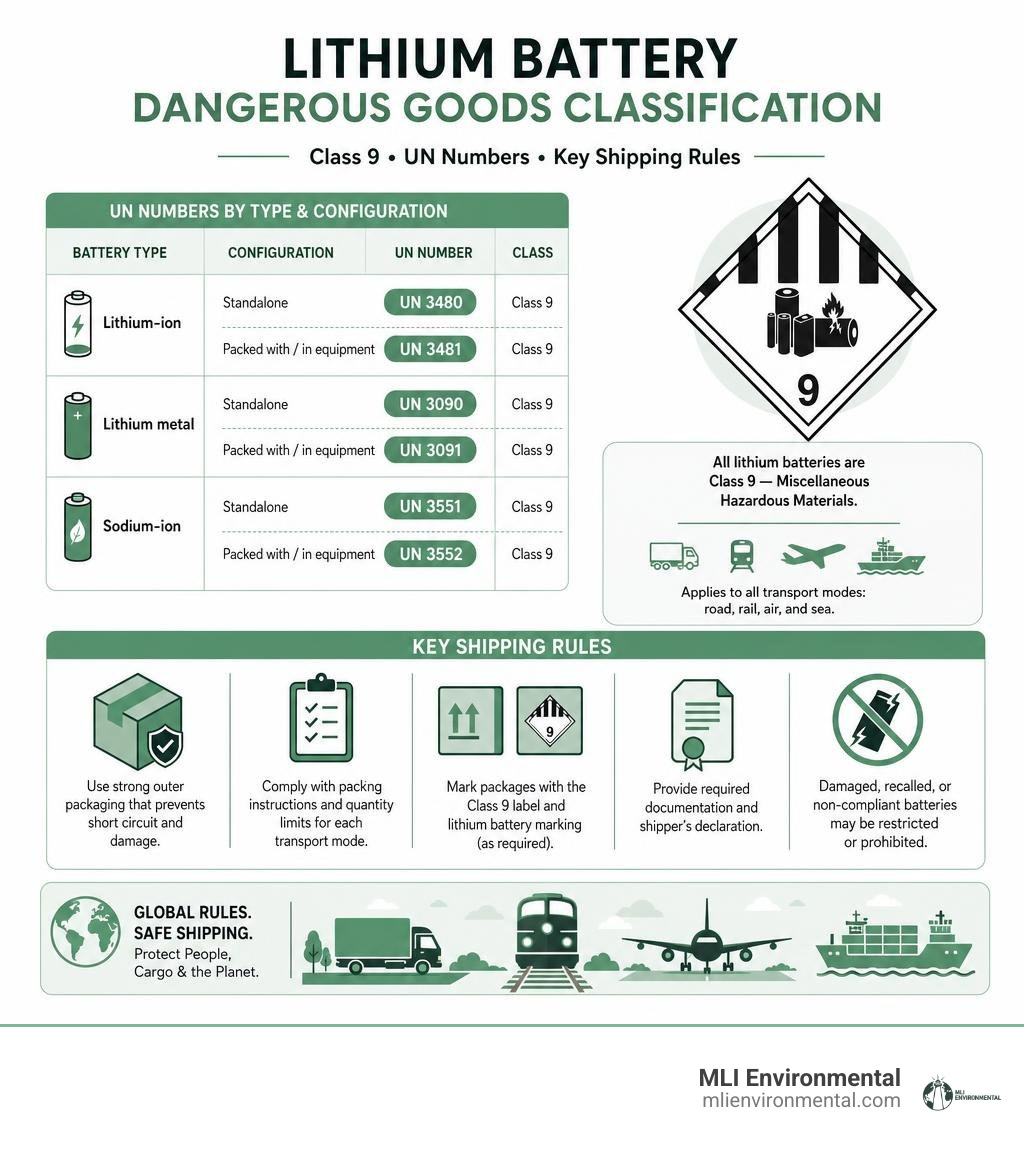
The lithium battery dangerous goods class is Class 9 — Miscellaneous Hazardous Materials under DOT, 49 CFR, and international transport rules.
Use up and down arrow keys to resize the meta box pane.
| Battery Type | Configuration | UN Number | Class |
|---|---|---|---|
| Lithium-ion | Standalone | UN 3480 | Class 9 |
| Lithium-ion | Packed with / in equipment | UN 3481 | Class 9 |
| Lithium metal | Standalone | UN 3090 | Class 9 |
| Lithium metal | Packed with / in equipment | UN 3091 | Class 9 |
| Sodium-ion | Standalone | UN 3551 | Class 9 |
| Sodium-ion | Packed with / in equipment | UN 3552 | Class 9 |
Lithium batteries power phones, laptops, EVs, medical devices, and industrial tools, but their high energy density creates fire risks in transit. If damaged, short-circuited, overcharged, or exposed to heat, they can enter thermal runaway — a chain reaction that can ignite nearby cells and become difficult to extinguish.
This guide explains the classification system, UN numbers, packaging rules, air restrictions, and special cases such as e-bike batteries and damaged cells.
Why Lithium Batteries Are Regulated as Dangerous Goods
Lithium batteries create both chemical and electrical hazards, which is why they are regulated as hazardous materials.
The main risk is thermal runaway: a chain reaction caused by short circuits, impact, defects, overcharging, or heat. Once it begins, a cell releases energy quickly, ignites flammable electrolyte, and can spread heat to nearby cells.
Lithium battery fires are difficult to control and can release toxic gases, including carbon monoxide, hydrogen fluoride, and volatile organic compounds. One MDPI study on lithium battery transportation safety requirements found that a burning battery can emit up to 11 toxic gas constituents.
Because these risks do not fit neatly into other hazard classes, lithium batteries fall under Class 9. For more context, see MLI Environmental’s Guide to the 9 Classes of Dangerous Goods.
Understanding the Lithium Battery Dangerous Goods Class
To ship, manage, or dispose of lithium batteries correctly, match the chemistry and shipping configuration to the right Class 9 UN number.
Class 9: The Official Lithium Battery Dangerous Goods Class
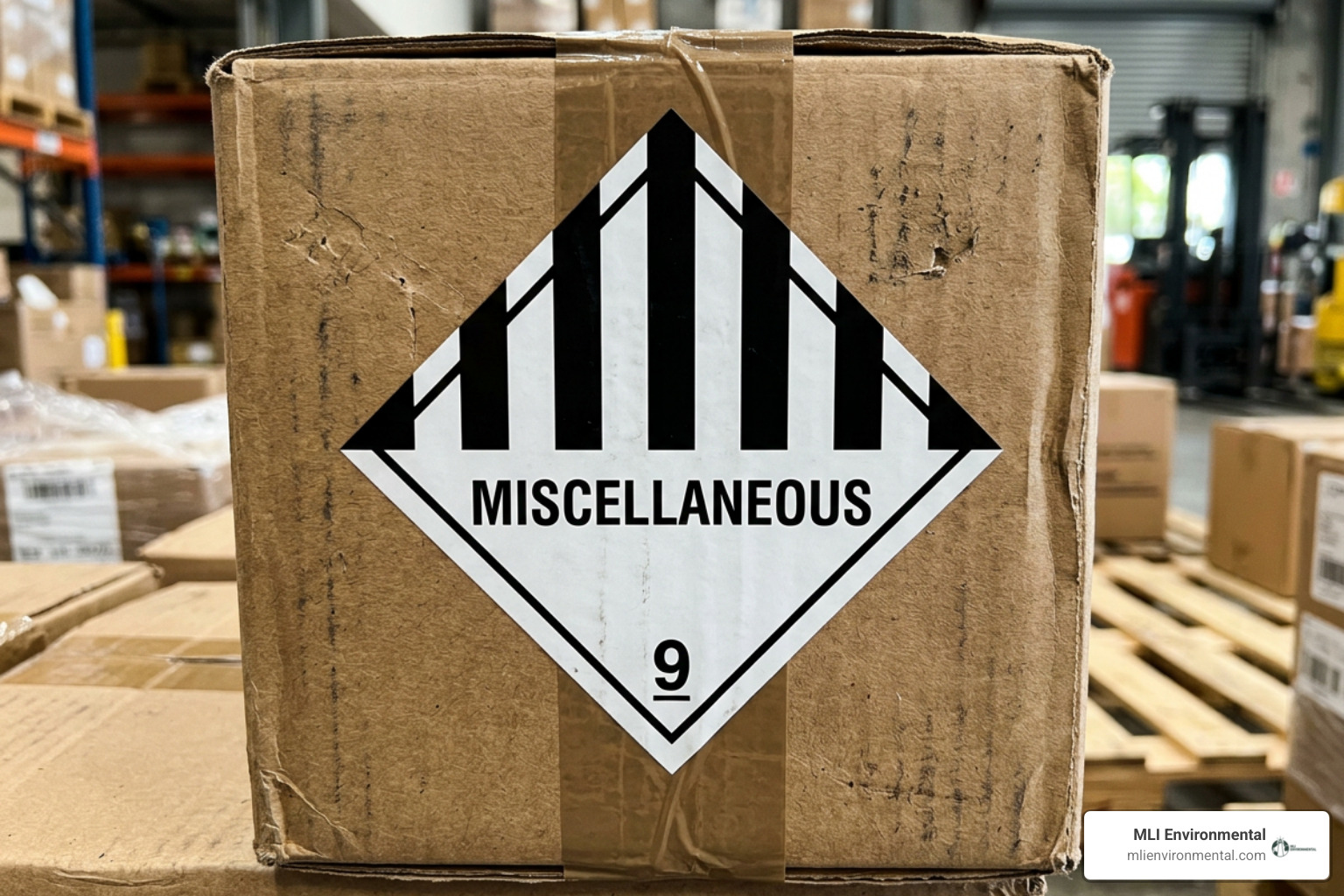
Under UN Model Regulations, U.S. Hazardous Materials Regulations, and international transport frameworks, lithium batteries are assigned to Class 9 — Miscellaneous Hazardous Materials.
Class 9 covers materials that create transport hazards but do not meet another hazard class definition. It includes lithium batteries, dry ice, magnetized materials, and environmentally hazardous substances. MLI Environmental explains this category in its Classes of Hazardous Materials overview.
Fully regulated lithium battery shipments must use the proper Class 9 lithium battery hazard label, which includes the black-and-white Class 9 design plus a battery fire graphic. MLI Environmental’s Class 9 Hazardous Materials Guide explains these labeling requirements in more detail.
How Chemistry and Configuration Affect Classification
Regulators classify lithium battery shipments by chemistry, configuration, and size.
1. Chemistry
- Lithium-ion batteries are rechargeable and measured in watt-hours (Wh).
- Lithium-metal batteries are non-rechargeable and measured by lithium content in grams.
- Sodium-ion batteries with organic electrolytes are regulated under UN 3551 and UN 3552.
2. Configuration
- Standalone: Loose batteries shipped by themselves.
- Packed with equipment: Batteries shipped in the same package as equipment but not installed.
- Contained in equipment: Batteries installed inside the device.
| Battery Chemistry | Standalone UN Number | Packed With Equipment UN Number | Contained In Equipment UN Number |
|---|---|---|---|
| Lithium-Ion | UN 3480 | UN 3481 | UN 3481 |
| Lithium-Metal | UN 3090 | UN 3091 | UN 3091 |
| Sodium-Ion | UN 3551 | UN 3552 | UN 3552 |
3. Size Thresholds
Common small-battery thresholds include 20 Wh for lithium-ion cells, 100 Wh for lithium-ion batteries, 1.0 g lithium for lithium-metal cells, and 2.0 g lithium for lithium-metal batteries.
Batteries above these limits are fully regulated and require stricter packaging, labeling, and documentation.
Shipping Configurations and Packaging Requirements
Safe lithium battery shipping starts with correct packaging. A mistake can cause shipment rejection, fines, or a fire in transit.
The core rule is short-circuit protection. Battery terminals must be protected from contact with other batteries, metal objects, or conductive surfaces. Common methods include non-conductive inner packaging, terminal tape, protective caps, or recessed terminal designs.
After terminals are protected, batteries must go into strong, rigid outer packaging. Fully regulated shipments typically require UN specification packaging that meets Packing Group II performance standards and can pass a 1.2-meter drop test without battery damage or content shifting.
For a preparation checklist, see MLI Environmental’s Complete Lithium Battery Shipping Guide. If you are unsure whether your shipment can move through standard carriers, MLI Environmental also explains Can You Ship Lithium Batteries?.
Special Rules for E-Bikes, Damaged Batteries, and Recycling
High-capacity micromobility batteries, damaged cells, and end-of-life batteries often fall outside simplified shipping exceptions.
E-Bike and Micromobility Batteries
E-bikes, scooters, and hoverboards use large lithium-ion packs that usually exceed 100 Wh, making them fully regulated Class 9 dangerous goods.
Because micromobility fires have increased in many U.S. cities, these shipments require trained handling, UN packaging, and strict weight limits. MLI Environmental offers practical guidance on Shipping Electric Bike Batteries Safely, E-Bike Battery Safety, and Electric Bike Lithium Battery Shipping.
Damaged, Defective, or Recalled (DDR) Batteries
Swollen, cracked, leaking, deeply discharged, or recalled lithium batteries are extreme hazards. DDR batteries are forbidden from air transport.
For ground or vessel transport, they must be packaged under strict rules such as Packing Instruction P908 or LP904, often using fire-resistant containers and non-combustible insulating cushioning.
Disposal and Recycling
Lithium batteries should never go in household trash or standard recycling bins because they can ignite in trucks, transfer stations, and recycling facilities.
Households should use hazardous waste collection events or retail take-back programs and tape terminals before drop-off. Commercial generators, EV fleets, and industrial facilities can review MLI Environmental’s Guide to Recycling EV Batteries.
Compliance, UN 38.3 Testing, and Air Transport Restrictions
Lithium battery shippers must follow domestic and international rules, including IATA DGR for air, IMDG Code for sea, ADR/RID for road and rail, and U.S. 49 CFR requirements from the Pipeline and Hazardous Materials Safety Administration.
The UN 38.3 Test Summary Requirement
Before a lithium cell or battery can be transported commercially, the manufacturer must show that it passed the UN Manual of Tests and Criteria, Part III, Subsection 38.3. These tests simulate altitude, thermal cycling, vibration, shock, short circuit, impact/crush, overcharge, and forced discharge.
Manufacturers and distributors must make a UN 38.3 Test Summary available to the supply chain, and shippers should verify it before transport. For updated checklists, refer to the 2025 Lithium Battery Guidance Document.
Air Transport Restrictions and the 30% State of Charge Limit
Air transport is the strictest mode because an in-flight lithium battery fire can be catastrophic. Key rules include:
- Passenger aircraft restrictions: Standalone lithium-ion (UN 3480) and lithium-metal (UN 3090) batteries are forbidden as cargo on passenger aircraft.
- 30% state of charge limit: Standalone lithium-ion batteries (UN 3480) must ship at no more than 30% rated capacity.
- 2026 SoC expansion: As of June 2026, the 30% SoC limit also applies to lithium-ion batteries packed with equipment (UN 3481) by air unless specific approvals apply.
- Package limits: Air shipments must follow strict quantity and weight limits. The Lithium-Ion Battery Shipping Guidelines outline common limits by configuration.
Mandatory Hazmat Training
Anyone who packages, labels, documents, or offers lithium batteries for transport is a “hazmat employee” under 49 CFR § 172.704 and must receive required hazmat training. Air shippers also need recurrent IATA training every 24 months.
Frequently Asked Questions About Lithium Battery Shipping
Why are lithium batteries classified as dangerous goods?
Lithium batteries contain flammable electrolytes and store significant electrical energy. If damaged, overheated, short-circuited, or poorly manufactured, they can enter thermal runaway and cause severe fires.
Can I ship lithium batteries that are damaged or recalled?
Yes, but never by air. Damaged, defective, or recalled batteries must move by ground or vessel in specialized, fire-resistant packaging with non-combustible insulation.
What is the difference between lithium-ion and lithium-metal batteries?
Lithium-ion batteries are rechargeable and measured in watt-hours. Lithium-metal batteries are non-rechargeable and measured by lithium content in grams.
Ship Lithium Batteries Safely With Certified Dangerous Goods Experts
Understanding the lithium battery dangerous goods class is essential for safe, compliant shipping. From choosing the right UN number to applying the 30% state of charge rule and using UN-certified packaging, every detail matters.
If your business operates in Maine, New Hampshire, Massachusetts, Vermont, or Rhode Island, MLI Environmental can help you manage these requirements with confidence.
MLI Environmental’s certified dangerous goods specialists support international and domestic dangerous goods shipping, hazardous materials logistics, and safe waste disposal. Protect your team and supply chain by contacting MLI Environmental about its dangerous goods shipping services.