

E-bike lithium battery packs power your ride, and understanding them is key for safety, performance, and longevity.
Quick Answer: What You Need to Know
- What it is: A rechargeable lithium-ion battery that stores electrical energy for your e-bike motor
- Typical capacity: 400-750 Wh (watt-hours), providing 30-50+ miles of range per charge
- Key safety features: Battery Management System (BMS), UL 2849 or EN 15194 certification
- Lifespan: 2-10 years or 300-5,000 charge cycles depending on quality and care
- Safety priority: Always use certified batteries and original chargers to prevent fire risk
- End of life: Must be recycled as hazardous waste, never thrown in regular trash
E-bikes offer a popular blend of exercise and convenience, powered by a battery that transforms a regular bicycle into an electric-assist powerhouse. Most use lithium-ion technology, packing impressive energy into a compact package. This allows for ranges of 30-70 miles on a single charge.
With that power comes responsibility. Proper care, handling, and disposal are crucial. While safe when managed correctly, mishandled or uncertified batteries pose serious fire risks.
This guide covers how your battery works, what specs mean, safe charging and storage, and end-of-life disposal. Understanding battery safety and maintenance is essential for all e-bike owners.
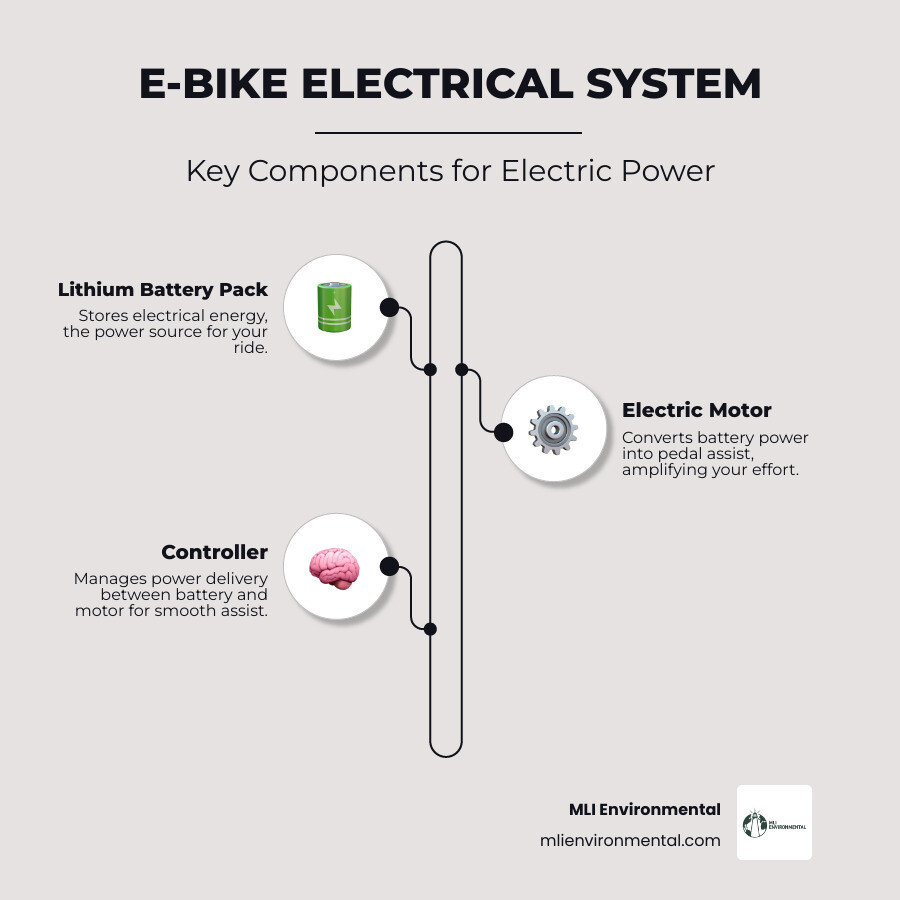
Understanding Your E-Bike Battery: Types, Capacity, and Design
While early e-bikes used heavy lead-acid batteries, today’s models are overwhelmingly powered by lithium-ion technology. It has become the undisputed champion due to its superior power-to-weight ratio, reliability, and longevity.
What is an E-Bike Lithium Battery?
At its core, an e-bike lithium battery is a rechargeable device using lithium ions to store and move electrical energy. It consists of an anode, a cathode, an electrolyte, and a separator. When discharging (powering your bike), lithium ions move from the anode to the cathode, creating an electrical current. When charging, the process reverses.
This process gives lithium-ion batteries a high energy density, packing significant power into a small space. This is a major advantage over older, heavier battery types like lead-acid batteries, making them ideal for e-bikes.
Decoding Battery Specs: Volts, Amps, and Watt-Hours (Wh)
Understanding your battery’s specs is key to knowing your bike’s capabilities.
- Voltage (V): The electrical “pressure” of the battery, typically 36V or 48V. Higher voltage can mean more power.
- Amp-hours (Ah): Indicates how much charge the battery can deliver over time. A 10 Ah battery can deliver 10 amps for one hour.
- Watt-hours (Wh): The total energy stored, directly correlating to your e-bike’s potential range. It’s calculated by multiplying Voltage by Amp-hours (V x Ah = Wh). A 36V 10Ah battery has 360 Wh.
Standard capacities often range from 400Wh to 750Wh. Some systems offer dual-battery setups for massive capacities up to 1250Wh, while lightweight folding bikes might use smaller batteries (200-300Wh) for portability.
Where It Sits Matters: Battery Mounting Positions
The battery’s placement significantly impacts the bike’s handling and balance.
- Rear Rack: Common on commuter bikes. Convenient for removal but can make steering feel lighter and less stable due to a high, rearward center of gravity.
- Frame-Mounted (Downtube): Places weight lower and more centrally, offering a more balanced and stable ride similar to a traditional bicycle.
- Frame-Integrated: The modern standard, offering the cleanest look and best weight distribution. The battery is built into the downtube, improving handling and protecting it from the elements.
What to Look for in a Warranty
An e-bike battery is a significant investment and a “wearing part” that degrades over time. Most warranties are based on two factors:
- Charge Cycles: The number of full charge/discharge cycles before capacity significantly drops. For example, a warranty might guarantee at least 60% capacity after 1000 cycles.
- Time-Based Guarantees: A specified period, such as two years, during which the battery is covered. Often, this is combined with a cycle count (e.g., 60% capacity after two years or 500 cycles, whichever comes first).
A strong warranty from a reputable brand indicates confidence in the product’s quality.
The Critical Importance of E-Bike Lithium Battery Safety
The power of e-bike batteries comes with a critical caveat: safety. While rare, the potential for fires from thermal runaway makes adhering to safety protocols paramount.
Why Do Lithium Batteries Catch Fire?
The primary risk is thermal runaway, where a battery cell heats up uncontrollably. Common causes include:
- Internal Short Circuits: Often from manufacturing defects or physical damage that breaches the internal separator, causing a rapid discharge and immense heat.
- Overheating During Charging: Using an incompatible charger or charging on flammable surfaces can cause excessive heat buildup.
- Physical Damage: Dropping or crushing the battery can compromise its internal structure, leading to short circuits. An incident in South Portland, Maine, highlighted this when a homemade e-bike battery sparked a fire.
- Manufacturing Defects: Poorly made batteries are more prone to internal faults.
- Overcharging/Deep Discharging: Pushing the battery to extreme charge levels can stress the cells and increase fire risk.
During thermal runaway, the battery releases flammable gases that can ignite and burn at extremely high temperatures.
The Unsung Hero: Your Battery Management System (BMS)
Quality lithium-ion batteries include a Battery Management System (BMS), an electronic circuit board that acts as the battery’s brain and guardian.
The BMS performs several critical safety functions:
- Prevents Overcharging and Over-Discharging: It stops charging at full capacity and cuts power before the battery is fully depleted, protecting the cells.
- Monitors Temperature: If it detects unsafe heat levels, it can shut down the battery.
- Balances Cells: It ensures all cells in the pack charge and discharge evenly, maximizing lifespan and safety.
- Protects from Short Circuits: It detects and prevents dangerous power surges.
A well-designed BMS is a non-negotiable safety feature.
The Dangers of Aftermarket and Uncertified Batteries
Cutting corners on battery price is a dangerous gamble. Aftermarket and uncertified batteries pose significant risks because they often:
- Lack a Proper BMS: This leaves the battery vulnerable to overcharging and overheating.
- Use Poor Quality Cells: Substandard components and assembly increase the risk of internal defects and failure.
- Are Paired with Incompatible Chargers: Using a generic charger can cause overcharging and damage.
- Void Your Warranty: Using non-original parts will almost certainly void your e-bike’s warranty.
Always stick to the battery and charger designed for your specific e-bike model from the original manufacturer.
Look for the Label: Key Safety Certifications
To ensure your battery meets rigorous safety standards, look for third-party certifications. These labels are your assurance of independent safety testing.
The two most important certifications are:
- UL 2849: The gold standard for e-bike safety in North America, this certifies the entire electrical system (battery, motor, controller) has been tested for electrical, fire, and mechanical hazards.
- EN 15194: The European standard for e-bikes, covering safety requirements for the bike and its electrical components.
Choosing a certified battery is a fundamental step toward ensuring your safety.
Best Practices for Charging, Storage, and Maintenance
Your e-bike battery’s performance and lifespan are directly linked to how you treat it. Adopting best practices not only extends its life but also drastically reduces safety risks.
Safe Charging Habits to Maximize Safety
Charging is when most battery-related fires occur. Following these simple habits significantly improves safety:
- Use the Original Charger: It’s designed to provide the correct voltage and current for your battery. Incompatible chargers can cause dangerous overheating.
- Plug Directly into a Wall Outlet: Avoid using extension cords or power strips to ensure stable power delivery.
- Charge in a Well-Ventilated Area: Good airflow helps dissipate heat. Avoid confined spaces.
- Charge on a Non-Flammable Surface: Use a concrete floor or ceramic tile. Never charge on carpets or near curtains.
- Do Not Charge Unattended or Overnight: If something goes wrong, no one is there to intervene. If the battery gets hot, unplug it immediately and move it to a safe outdoor spot.
- Monitor for Heat: A battery should only feel slightly warm during charging, never hot.
- Charge at Room Temperature: Ideal ambient temperature is between 0°C and 40°C (32°F and 104°F).
- Allow Battery to Cool Down: After a long ride, let your battery cool to room temperature before charging.
Extending Your E-Bike Lithium Battery Lifespan
Proper care can significantly extend your battery’s life. Lithium-ion batteries degrade from both time (calendar aging) and use (cyclical aging). Here’s how to slow the process:
- Optimal Storage Charge (30-60%): For long-term storage (e.g., over winter), keep the charge level between 30% and 60%. Storing at full or empty can stress the cells.
- Ideal Storage Temperature (Room Temperature): Store your battery in a dry room around 10°C to 20°C (50°F to 68°F), away from direct sunlight and heat sources.
- Avoid Deep Discharge: Regularly running your battery completely flat puts more stress on it. Recharge before it gets critically low.
- Partial Charging is Fine: Lithium-ion batteries don’t have a “memory effect.” Frequent partial charges are better than waiting for a full discharge before recharging.
Following these tips can help your battery last anywhere from 2 to 10 years or 300 to 5,000 charge cycles, depending on its quality and your care.
Protecting Your Battery from Damage and Extreme Conditions
An e-bike battery is robust but not indestructible. Protecting it from physical and environmental harm is key to its longevity and safety.
- Avoid Drops and Impacts: Handle your battery with care. A drop can cause internal damage that may lead to a short circuit.
- Inspect for Damage: Regularly check for cracks, swelling, or deformation. If you notice any, stop using the battery immediately and consult a professional.
- Use Neoprene Covers in Cold: In sub-zero temperatures, a neoprene cover helps insulate the battery and maintain its efficiency. Bring it indoors to warm up before charging.
- Avoid Extreme Heat: Never leave your battery in direct sunlight or a hot car. High temperatures accelerate degradation.
- Protect from Water: Most systems are water-resistant, not waterproof. Avoid high-pressure jets and full immersion. Keep contacts clean and dry, and consider lightly greasing plug poles with technical Vaseline.
The End of the Road: E-Bike Battery Recycling and Disposal
E-bike batteries don’t last forever. When yours reaches the end of its life, responsible recycling is a legal and environmental necessity, as improper disposal creates serious fire and contamination hazards.
Why You Can’t Just Throw It Away: Batteries as Hazardous Waste
E-bike lithium batteries are classified as hazardous waste and cannot be put in regular trash or recycling. Under the Resource Conservation and Recovery Act (RCRA), they are considered hazardous for several reasons:
- Toxic Components: They contain heavy metals like cobalt and nickel that can contaminate soil and water.
- Reactive Components: Lithium metal is highly reactive and can react violently with water or air if exposed.
- Ignitable Electrolyte Solvents: The electrolyte solution can contain flammable solvents.
If a battery ends up in a landfill, its casing could be breached, allowing these hazardous components to leach into the environment, harming ecosystems and human health.
The Recycling Process: Recovering Valuable Materials
The good news is that e-bike batteries are highly recyclable, playing a key role in the circular economy. The process recovers valuable materials and prevents toxins from entering the environment.
Recycling typically involves collection, sorting, discharging, shredding, and then separating materials like plastics, copper, and aluminum. Advanced pyrometallurgical or hydrometallurgical processes are then used to extract valuable raw materials like lithium, cobalt, and nickel from the remaining “black mass.” This process can recover nearly 71% of the raw materials in a used battery.
To find a recycling location, check with your local household hazardous waste program or search online for a recycling location. Many e-bike dealers also offer take-back programs.
How to Properly Dispose of and Ship Your Old Battery
Disposing of and shipping e-bike batteries requires specific protocols due to their hazardous nature.
- Do Not Mail via Standard Post: Private individuals generally cannot mail these batteries through standard postal services due to strict hazardous goods regulations.
- Contact Your Dealer or Manufacturer: This is the best first step. They often have take-back programs or can direct you to an authorized collection site.
- Use Designated Collection Sites: Take your old battery to a specialist dealer or a local household hazardous waste facility.
- Prepare Damaged Batteries Safely: If a battery is damaged (cracked, swollen, smoking), do not touch it with bare hands. Move it to a safe outdoor location away from flammable materials. Tape over the connection contacts to prevent short circuits, then contact a hazardous waste professional for guidance.
- Follow Shipping Regulations: For businesses, shipping e-bike batteries falls under hazardous materials (hazmat) regulations, requiring specialized packaging, labeling, and documentation. Professional handling is required to ensure compliance and safety.
For complex disposal or shipping needs, partnering with a certified hazardous materials specialist like MLI Environmental is crucial. They have the expertise to ensure safe, compliant handling from collection to disposal.
Ship with the Professionals at MLI Environmental
Your e-bike lithium battery is an incredible piece of technology. By understanding its inner workings, respecting its power, and adhering to best practices, you can ensure a safe, enjoyable, and long-lasting riding experience.
To recap the essentials:
- Choose Certified: Opt for e-bikes and batteries that meet safety standards like UL 2849 or EN 15194.
- Charge Safely: Use the original charger in a safe, ventilated, non-flammable area. Never leave a charging battery unattended.
- Maintain Properly: Store your battery at a 30-60% charge level at room temperature. Protect it from damage and extreme temperatures.
- Dispose of Responsibly: E-bike batteries are hazardous waste and must be recycled at designated facilities, not thrown in the trash.
By following these guidelines, you’re not just caring for your e-bike; you’re contributing to a safer environment. For complex disposal or shipping needs, especially for businesses, partnering with a certified hazardous materials specialist like MLI Environmental is crucial. Their expertise ensures that hazardous materials are handled, transported, and disposed of safely and in full compliance with regulations. Learn more about dangerous goods shipping services.