

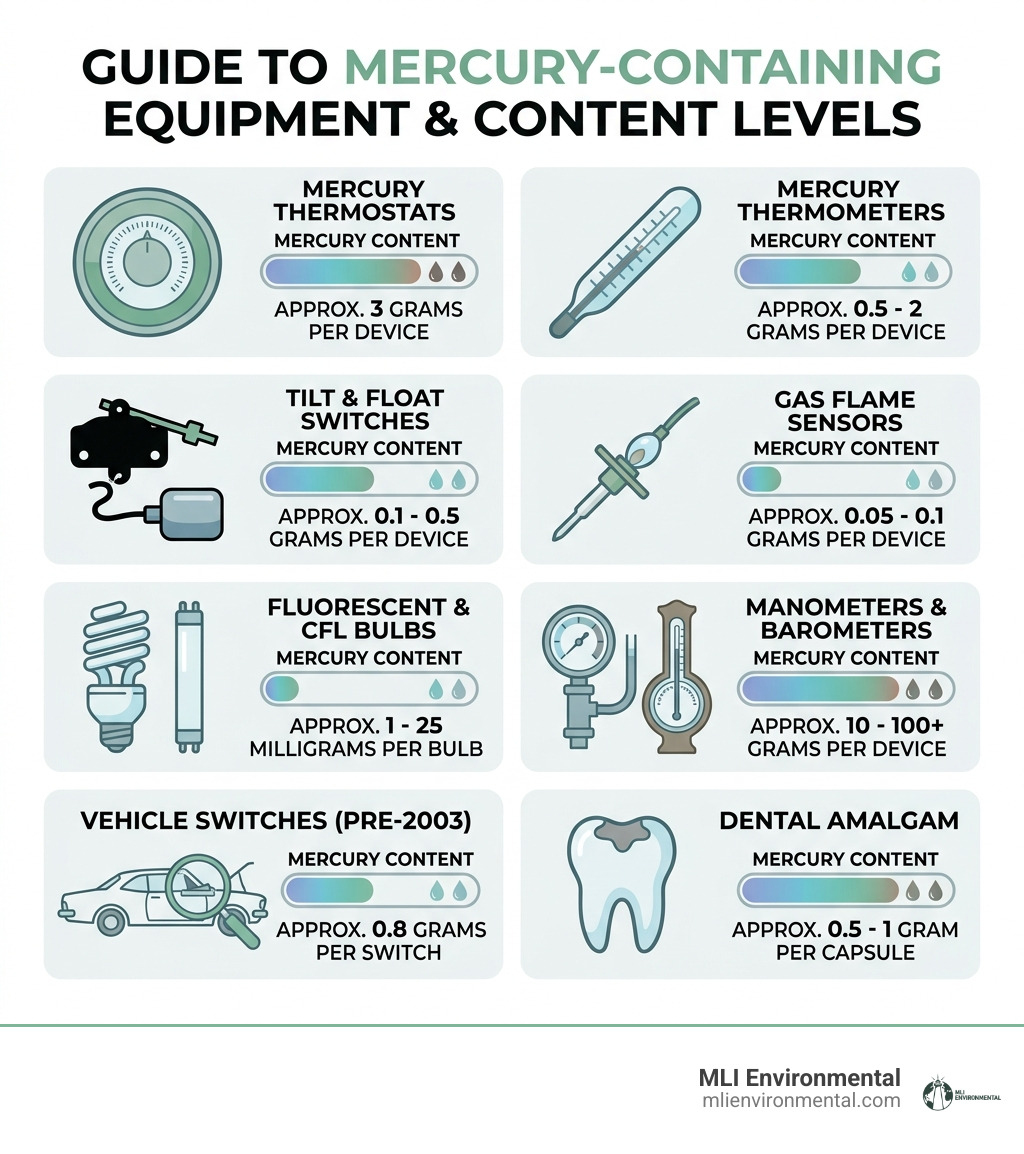
Mercury-containing equipment is any device that uses elemental mercury to operate. These items still appear in homes, hospitals, vehicles, labs, and industrial facilities—often in older equipment that has not been replaced.
Common examples include:
| Equipment Type | Where You’ll Find It |
|---|---|
| Mercury thermostats | HVAC systems, older buildings |
| Mercury thermometers | Medical, lab, and household use |
| Fluorescent and CFL bulbs | Offices, warehouses, homes |
| Tilt and float switches | Appliances, sump pumps |
| Manometers and barometers | Industrial and weather equipment |
| Dental amalgam | Dental offices |
| Vehicle switches | Pre-2003 cars, hoods, trunks, ABS systems |
| Gas flame sensors | Ovens, furnaces, water heaters |
Because mercury is classified as hazardous waste, throwing these items in the trash is illegal in most jurisdictions. A single gram of mercury can contaminate a 20-acre lake; a standard mercury thermostat contains about 3 grams.
For businesses, mishandling mercury-containing equipment can lead to regulatory violations, cleanup liability, and environmental harm. This guide explains how to identify, label, store, and dispose of these items correctly.
Why Mercury Is Classified as a Hazardous Material
Mercury is the only metal that remains liquid at room temperature, but its usefulness comes with serious risks. When released, elemental mercury can evaporate, travel through the air, and settle into waterways.
Once in the environment, bacteria can convert mercury into methylmercury, a highly toxic form that bioaccumulates in fish and moves up the food chain. Human exposure can damage the nervous system and contribute to developmental, vision, and hearing problems.
That persistence is why mercury is regulated as hazardous waste, especially under toxicity criteria. Facility managers who need a broader compliance foundation can review MLI Environmental’s guides to defining hazardous materials, the four characteristics of hazardous waste, and toxic waste.
New England states such as Maine and Vermont often apply stricter mercury rules to protect local watersheds and public health.
How to Identify Mercury-Containing Equipment in Your Facility
Identifying mercury-containing equipment takes careful inspection. The clearest sign is a glass ampule or tube containing a heavy, silver liquid. Newer products may also display the “Hg” symbol, but older facilities across New Hampshire, Massachusetts, and Maine often contain unlabeled legacy devices.
Common commercial and industrial items to check include:
- Tilt switches: Thermostats and silent wall switches manufactured before 1991.
- Float sensors: Sump pumps and water tanks that signal high or low water levels.
- Manometers and barometers: Gauges that may contain 100 to 500 grams of mercury or more.
- Gas flame sensors: Older ovens, furnaces, and water heaters that use mercury safety valves.
Use this quick comparison to distinguish mercury thermometers from safer alternatives:
| Feature | Mercury Thermometer | Gallium/Spirit Alternative |
|---|---|---|
| Bulb Color | Always silver | Red, blue, or silver if gallium |
| Markings | Often unmarked | Usually marked “Mercury-Free” |
| Liquid Behavior | Breaks into distinct beads | Spirit-filled liquid flows like water |
| Safety | High risk if broken | Low to no mercury toxicity |
For broader product examples, the EPA’s mercury in consumer products resource is a helpful identification reference.
Medical and Automotive Mercury-Containing Equipment
Hospitals and clinics may still have legacy mercury devices in storage closets or older wings. NEWMOA’s mercury legacy products guide notes that esophageal dilators and gastrointestinal tubes can contain roughly 2 to 3 pounds of mercury, while traditional sphygmomanometers may contain up to 100 grams.
In vehicles manufactured before 2003, mercury was commonly used in hood and trunk light switches and some anti-lock braking sensors.
Labeling Mercury-Containing Equipment as Universal Waste
After identifying the equipment, complete a hazardous waste determination. MLI’s guide to the 5 steps of a hazardous waste determination explains how to classify waste correctly before disposal.
If the equipment is intact, it is often managed under universal waste rules. Containers or devices should be labeled with one of these phrases:
- Universal Waste – Mercury-Containing Equipment
- Waste Mercury-Containing Equipment
- Used Mercury-Containing Equipment
For thermostats, use Universal Waste – Mercury Thermostat(s). Store items in closed, structurally sound containers that prevent ampules from breaking.
Universal Waste Rules for Mercury-Containing Equipment
The EPA’s Universal Waste Rule (40 CFR Part 273) streamlines requirements for common hazardous items that can be recycled or safely disposed of. Mercury-containing equipment often qualifies when it remains intact and is handled properly.
When managing universal waste, businesses should follow four core rules:
- Storage limits: Universal waste can generally be stored on-site for up to one year from the generation date.
- Containerization: Devices must be kept in closed, compatible containers that prevent leaks and breakage.
- Training: Employees who handle universal waste must know proper handling and emergency procedures.
- Accumulation tracking: Containers should be dated so you can prove how long the waste has been stored.
Rules can vary by state. MLI’s overview of universal waste disposal regulations in New England explains regional differences, including stricter landfill restrictions and product stewardship requirements.
Your hazardous waste generator status also affects accumulation limits and paperwork. If you are unsure whether you are a VSQG, SQG, or LQG, review MLI’s hazardous waste generator guidance and confirm whether a hazardous waste manifest is required for your shipment.
Safe Handling, Spill Response, and Modern Alternatives
The safest way to manage mercury-containing equipment is to keep the mercury sealed inside its original housing or ampule. If a device breaks, treat the situation as a spill response—not routine disposal.
Never use a vacuum cleaner on a mercury spill. Vacuuming can atomize mercury into toxic vapor and spread contamination through the air. Use a mercury spill kit with sulfur powder or specialized absorbents, and report larger spills as required by federal and state rules.
For small spills, such as a broken thermometer:
- Isolate the area and turn off HVAC systems that could spread vapor.
- Wear gloves, eye protection, and other appropriate PPE.
- Use stiff paper or cardboard to gather mercury beads.
- Seal mercury and cleanup materials in an airtight glass or plastic container.
Whenever possible, replace mercury equipment with safer alternatives:
- Thermostats: Programmable digital models.
- Thermometers: Spirit-filled or digital thermometers.
- Lighting: LED fixtures instead of fluorescent tubes or CFLs.
- Medical gear: Aneroid or digital blood pressure devices.
When you are ready to remove old inventory, MLI’s guide on how to choose a hazardous waste disposal company can help you evaluate a qualified partner.
Frequently Asked Questions About Mercury-Containing Equipment
Is it illegal to throw mercury-containing equipment in the trash?
Yes. In Maine, Massachusetts, New Hampshire, Vermont, and Rhode Island, mercury-containing devices generally cannot go in regular trash or solid waste landfills. Businesses should follow RCRA hazardous waste definitions to avoid improper disposal and potential fines.
How do I identify a mercury thermometer vs. a mercury-free one?
Look at the bulb and liquid. Silver liquid usually indicates mercury, while red or blue liquid is typically alcohol-based. Some mercury-free gallium thermometers are also silver, but they are usually marked “Mercury-Free” on the device or packaging.
What should businesses do with old mercury thermostats?
HVAC contractors and businesses can use programs such as the Thermostat Recycling Corporation, and many Northeast wholesalers serve as collection points. For larger volumes of mercury-containing equipment, work with a professional waste management firm and use a hazardous waste inspection checklist to keep storage areas ready for regulatory review.
Keep Mercury-Containing Equipment Out of the Waste Stream
Mercury-containing equipment is common in older buildings, vehicles, hospitals, and industrial facilities—but it cannot be handled like ordinary trash. Correct identification, labeling, storage, and universal waste disposal protect your facility from violations while helping keep mercury out of local air, soil, and water.
MLI Environmental helps businesses across Maine and New England manage hazardous materials safely and efficiently. From hazardous waste management to universal waste services, our certified professionals handle the logistics so your team can stay compliant.
Need help removing mercury-containing equipment from your facility? Contact MLI Environmental to schedule safe, compliant universal waste collection.