

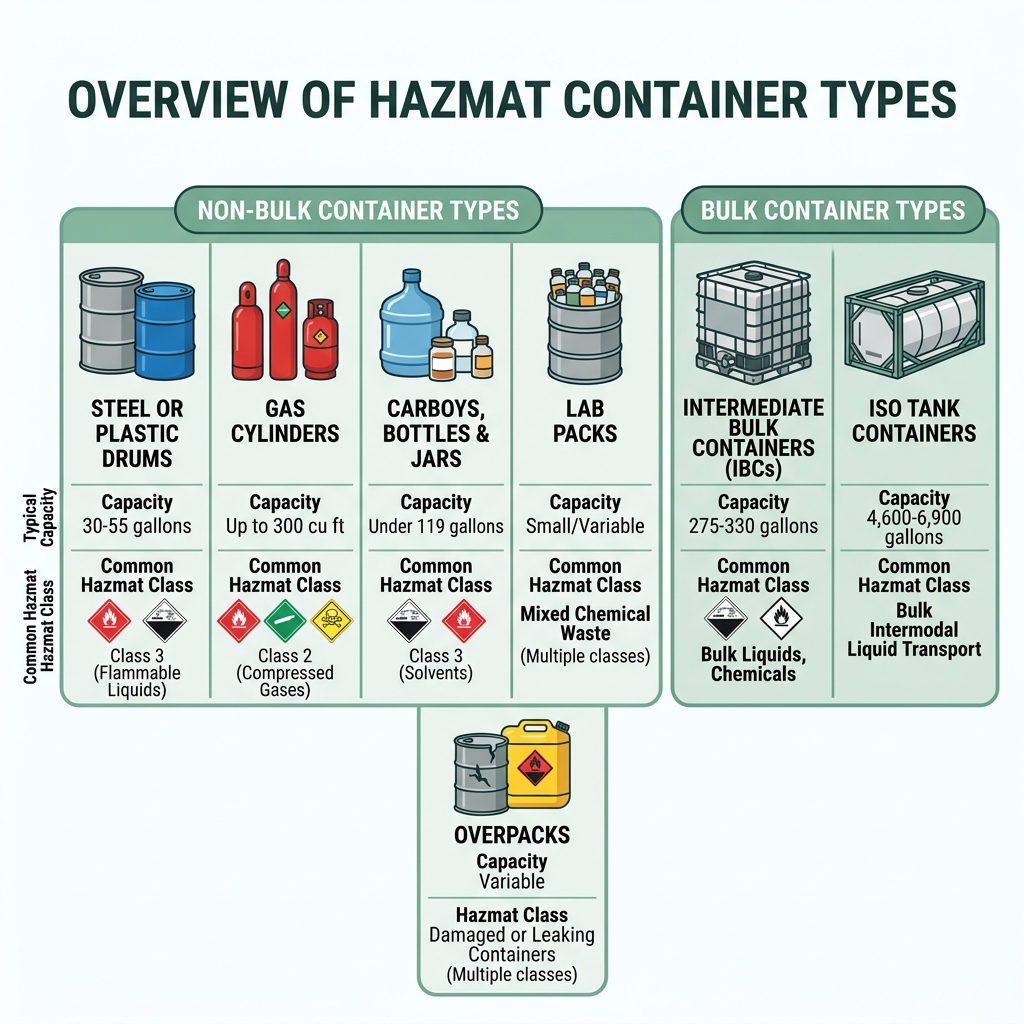
Hazmat container types fall into two broad categories — bulk and non-bulk — with several distinct formats used across both groups:
| Container Type | Typical Capacity | Common Use |
|---|---|---|
| Steel or plastic drums | 30–55 gallons | Flammable liquids, corrosives |
| Intermediate Bulk Containers (IBCs) | 275–330 gallons | Bulk liquids, chemicals |
| Gas cylinders | Up to 300 cu ft | Compressed gases (propane, oxygen) |
| ISO tank containers | 4,600–6,900 gallons | Bulk intermodal liquid transport |
| Lab packs | Small/variable | Mixed chemical waste |
| Overpacks | Variable | Damaged or leaking containers |
| Carboys, bottles, jars | Under 119 gallons | Smaller volumes of corrosives, solvents |
Hazardous materials come in many forms: flammable liquids, corrosive acids, compressed gases, radioactive substances, and more. Each one behaves differently, reacts differently, and requires a container built specifically for it.
The DOT classifies hazardous materials into nine distinct hazard classes, and each class has packaging requirements tied directly to the material’s physical and chemical properties.
Getting this right matters — for your workers, your community, and your regulatory standing.
Hazmat container types terminology:
- Infectious substance packaging
- Hazardous materials shipping kit
Understanding Hazmat Container Types: Bulk vs. Non-Bulk
When it comes to managing hazardous materials in regions like New England, from the bustling labs of Boston to the industrial sites in Lewiston, Maine, the first step is understanding how the Department of Transportation (DOT) draws the line between “bulk” and “non-bulk.” This isn’t just a matter of semantics; it dictates everything from labeling to the type of vehicle required for transport.
A bulk container is defined by its high capacity. Specifically, it is any packaging that can hold more than 119 gallons of liquid, more than 882 pounds of solids, or a gas volume equivalent to more than 1001 pounds of water. Think of these as the “heavy hitters” of the industry — the large tanks and totes that move massive quantities of chemicals.
On the flip side, non-bulk packages are the workhorses of daily operations. These are defined as containers holding 119 gallons or less of liquid, 882 pounds or less of solids, or a gas volume equivalent to 1001 pounds or less of water. This category includes the familiar 55-gallon drums, pails, and boxes seen in many facilities across New Hampshire and Vermont.
The Department of Transportation lists categories to help shippers identify which of the nine hazard classes their material falls into. Once the class is known, Choosing Right Hazardous Waste Containers becomes a much simpler task of matching the material’s properties to the container’s design.
Common Non-Bulk Hazmat Container Types
Non-bulk containers are incredibly versatile, but they require careful selection to ensure material compatibility. Using a metal drum for a highly corrosive acid, for example, is a recipe for a very bad (and leaky) day.
- Steel Drums: Often used for flammable liquids like gasoline or solvents. They are durable and can withstand significant internal pressure.
- Plastic Drums and Pails: These are the preferred choice for corrosives. High-density polyethylene (HDPE) is resistant to many acids and bases that would eat right through steel.
- Fiberboard Boxes: Often used for solid hazardous materials or as outer packaging for smaller glass or plastic bottles.
- Glass Bottles: Used for high-purity chemicals or materials that might react with plastic. However, they are fragile and usually require significant cushioning inside a secondary container.
One of the Top 4 Issues Hazardous Waste Containers face is simple neglect — using a container that is too old or structurally compromised. For instance, plastic drums used for hazmat should generally be less than five years old to ensure the integrity of the material hasn’t degraded.
Gas Cylinders and Compressed Gas Containers
Compressed gases present a unique set of challenges because they are under high pressure. These containers must be able to withstand internal pressures greater than 275 kPa (absolute). Whether it’s propane for heating or chlorine for water treatment, these cylinders are built to exacting standards.
The DOT specifies various cylinder types, such as DOT 39 (non-reusable), 3AA, and 3AL (aluminum). These containers are equipped with pressure relief valves designed to prevent explosions in the event of extreme heat or fire. In the medical and research hubs of Massachusetts, you’ll also find containers for cryogenic liquids, which are gases kept in a liquid state at extremely low temperatures, requiring specialized vacuum-insulated “Dewar” flasks.
Specialty Hazmat Container Types: Lab Packs and Overpacks
Sometimes, the standard drum just won’t cut it. That’s where specialty hazmat container types come in.
- Lab Packs: In university labs in Worcester or Springfield, researchers often generate small amounts of many different chemicals. Chemical Lab Packs allow for these small containers to be placed into a larger drum filled with absorbent material (like vermiculite) for safe disposal.
- Overpacks and Salvage Drums: If a primary container starts leaking or is damaged, it can be placed inside an “overpack.” These are larger, typically plastic containers designed to hold the leaking vessel and its contents securely until they can be properly handled. They must be clearly marked with the word “OVERPACK” to alert handlers of the situation inside.
Bulk Storage and Transportation Solutions
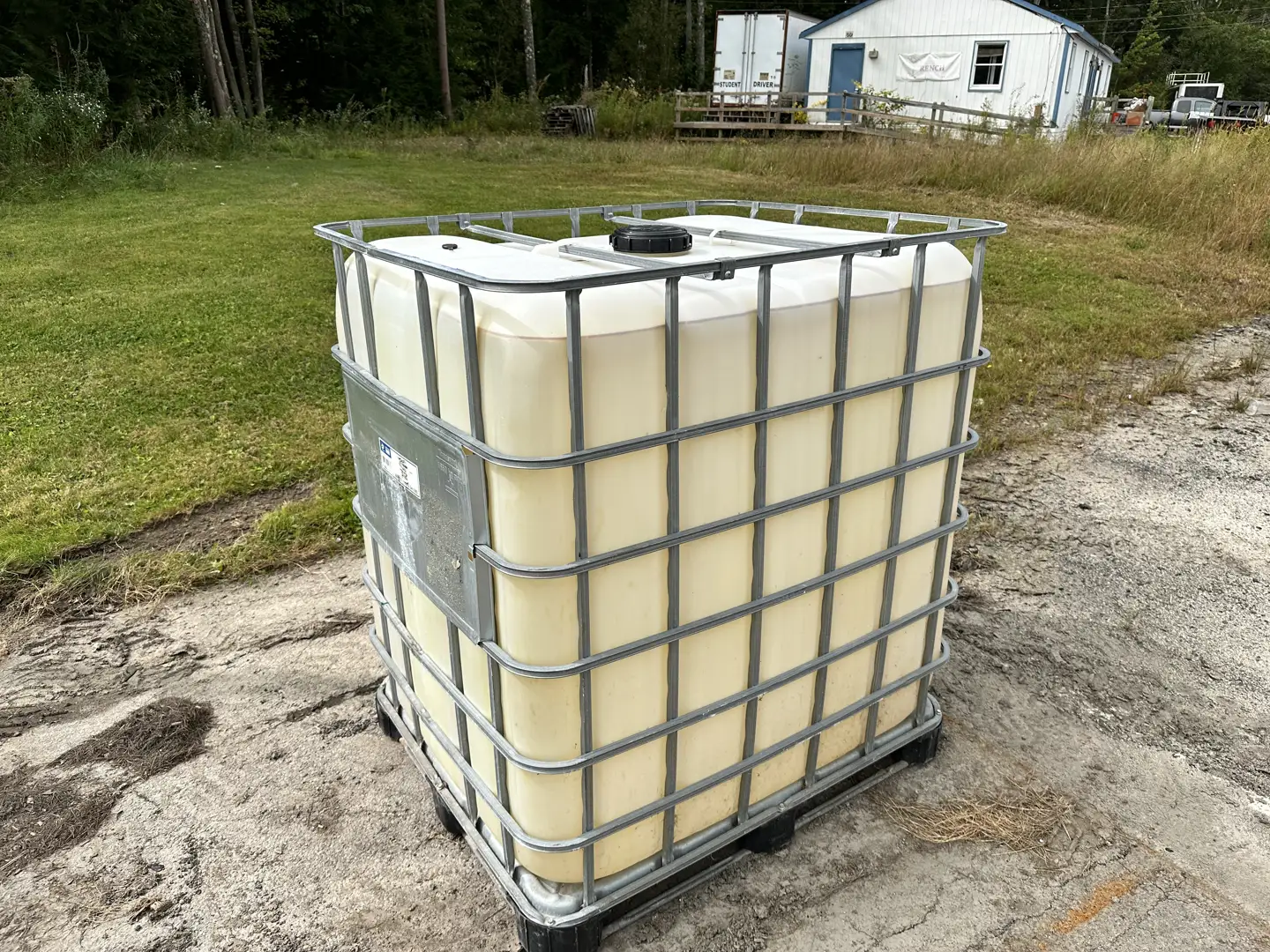
When quantities exceed the limits of non-bulk packaging, businesses turn to bulk solutions. These are designed for efficiency, often featuring built-in mechanisms for mechanical handling, like forklift channels or crane lifting points.
Intermediate Bulk Containers (IBCs), often called “totes,” are the most common bulk hazmat container types for liquid chemicals. They typically hold between 275 and 330 gallons. Most consist of a plastic inner bottle protected by a galvanized steel cage. They feature a bottom valve for easy dispensing and are stackable, which is a huge space-saver in warehouses across New England.
For outdoor storage, specialized hazardous material containers for KTC / IBC provide secondary containment and weather protection, ensuring that even if a tote leaks, the environment remains protected.
ISO Tank Containers and Intermodal Transport
For international shipping or moving massive quantities of hazardous liquids by rail and sea, ISO tank containers are the gold standard. These are stainless steel tanks held within a standard 20-foot shipping frame.
The global fleet of these containers is massive, standing at 848,400 units as of early 2024. They are classified by UN tank types:
- T11: Used for over a thousand different hazardous bulk chemicals.
- T14: Designed for hazardous acids like hydrochloric acid.
- T50: Used for liquefied petroleum gas (LPG) and anhydrous ammonia.
According to the History of the Tank Container, these units revolutionized the industry by allowing chemicals to move from truck to train to ship without ever needing to be transferred between containers, drastically reducing the risk of spills.
Regulatory Standards and Compliance Requirements
Navigating the sea of acronyms—DOT, EPA, OSHA, RCRA—can feel like a full-time job. Each agency plays a specific role in ensuring that hazmat container types are used safely.
| Agency | Primary Role | Key Focus |
|---|---|---|
| DOT | Transportation | Packaging specs, labeling, and placarding for transit. |
| EPA | Environmental | Waste accumulation, storage time, and spill prevention. |
| OSHA | Worker Safety | Employee training, Safety Data Sheets (SDS), and PPE. |
| UN | International | Standardized performance testing for containers. |
The Resource Conservation and Recovery Act (RCRA) is the backbone of hazardous waste management in the U.S. It mandates that waste be tracked “cradle to grave.” Part of this involves ensuring that the Requirements Hazardous Waste Storage Area Design are met, including proper ventilation and secondary containment.
Containers must also feature UN ratings, which tell you exactly what the container is tested to hold. For example, a “Y” rating indicates it is suitable for Packing Group II (medium danger) and III (low danger), while an “X” rating is required for Packing Group I (high danger).
Labels must be diamond-shaped and at least 4 inches by 4 inches. They use specific colors and symbols—like the flame for flammables or the skull and crossbones for toxics—to provide instant visual identification of the hazard.
Best Practices for Inspection and Maintenance
A container is only as good as its last inspection. In the variable climate of the Northeast—where humidity in the summer and road salt in the winter can wreak havoc on equipment—regular checks are vital.
Visual Inspection Checklist:
- Check for Corrosion: Look for rust on metal drums, especially around the seams and bungs.
- Look for Swelling: If a plastic drum looks “puffy,” it could indicate an internal chemical reaction or pressure buildup.
- Inspect Seals and Gaskets: Ensure that bungs and lids are tight and that gaskets aren’t cracked or missing.
- Verify Labels: Labels must be legible. If they are peeling or faded, replace them immediately.
Maintenance isn’t just about looking; it’s about testing. IBCs, for example, must undergo a leakproofness test every 2.5 years and a full internal inspection every 5 years.
Knowing the difference between a container that is Empty vs RCRA Empty is also critical for compliance. A container is only “RCRA empty” if all waste has been removed using common practices (like pouring or pumping) and no more than one inch of residue remains (with stricter rules for acute hazardous waste).
Frequently Asked Questions about Hazmat Containers
How do storage requirements differ for active vs. passive hazmat storage?
Passive storage refers to keeping chemicals in tightly closed, approved transport containers. This typically requires natural “self-ventilation.” Active storage, however, involves the opening, filling, or emptying of containers. This creates a much higher risk of vapor release, requiring “forced ventilation” systems. In active storage areas, the air should be exchanged at least five times per hour, and equipment must often be explosion-proof to prevent ignition of vapors.
What are the differences between plastic, metal, and composite containers?
- Plastic (HDPE): Excellent for corrosives and lightweight, but can be susceptible to UV damage if stored outdoors and has a shorter regulatory lifespan (usually 5 years).
- Metal (Steel/Stainless): High structural integrity and fire resistance. Best for flammables but will corrode if used with strong acids unless they have a specialized liner.
- Composite: These combine materials, like a plastic inner bottle with a steel outer cage (common in IBCs). They offer the chemical resistance of plastic with the structural strength of metal.
How do you ensure compliance during hazmat shipping across different modes?
Compliance requires following specific “books” for each mode. For road transport in the U.S., 49 CFR is the bible. For sea freight, you must follow the IMDG Code, and for air, the IATA Dangerous Goods Regulations (DGR). Every shipment must have a “Proper Shipping Name,” a “UN Number,” and the correct “Packing Group” documented on the shipping papers.
Choose the Right Hazmat Container with Confidence
Choosing the right hazmat container types is a complex but essential part of modern industry. Whether you are managing a small workshop in Concord, New Hampshire, or a large manufacturing plant in Boston, the principles remain the same: compatibility, compliance, and constant vigilance.
At MLI Environmental, we understand that safety is more than just a checkbox—it’s a culture. Our certified professionals specialize in navigating the intricate world of hazardous materials logistics and waste disposal across Maine, Massachusetts, New Hampshire, Vermont, and Rhode Island. We provide the expertise needed to reduce risk and ensure your operations remain safe and compliant.
If you’re looking for a streamlined solution for your next shipment, consider our Dangerous Goods Shipping Kits, designed to take the guesswork out of hazmat packaging. Stay safe, stay compliant, and remember that the right container makes all the difference.