

What does a laboratory relocation include? This is a question with a lot riding on the answer. Move the wrong item incorrectly, and you could damage a $500,000 instrument, lose irreplaceable samples, or face serious regulatory penalties.
A lab move is not a standard office move with extra boxes. Labs house sensitive instruments, hazardous chemicals, biological specimens, and years of irreplaceable research data. Every step of the process requires specialized knowledge, certified personnel, and strict compliance with federal and state regulations.
The stakes are high. Permit applications alone can take 4 to 6 weeks to process. One missed step can mean damaged equipment, compliance violations, or lost research continuity.
This guide breaks down exactly what goes into a professional lab relocation — so you know what to expect and what to demand from a service provider.
Why Laboratory Relocation Services Are Different from Standard Moves
If you’ve ever moved a house or an office, you know the drill: wrap the monitors in bubble wrap, toss the books in a box, and hope the pizza arrives before the moving truck leaves. In science, that approach is a recipe for disaster. Lab relocations are fundamentally different because the “cargo” isn’t just furniture—it’s the lifeblood of your organization.
High-Value and Fragile Assets
A standard office move deals with desks and chairs. A laboratory relocation involves Mass Spectrometers, HPLC, and GC, which can cost hundreds of thousands of dollars. These instruments are incredibly sensitive to vibration, tilt, and temperature changes. A single bump in the road without proper shock absorption can knock a laser out of alignment or crack a detector, leading to weeks of repair time.
Regulatory Compliance
You can’t just throw a gallon of hydrochloric acid into the back of a van. Transporting hazardous materials, biological samples, and controlled substances requires strict adherence to DOT, EPA, and IATA regulations. Professional services ensure that every chemical is properly “lab packed” and that all manifests are legally compliant. This prevents the nightmare scenario of a roadside inspection turning into a massive fine—or worse.
Research Continuity
For a business, a move might mean a day of “down” email. For a lab, a move could mean the loss of a ten-year longitudinal study if a freezer fails for just four hours. Specialized lab movers prioritize the integrity of research, using redundant power systems and real-time monitoring to ensure that specimens remain at the exact required temperature, from the old bench to the new one.
Specialized Insurance
Standard moving insurance usually covers items by the pound. If your $200,000 microscope weighs 50 pounds, a standard payout won’t even cover the lens cap. Lab relocation specialists provide high-value cargo insurance specifically tailored to scientific instrumentation and irreplaceable biological assets.
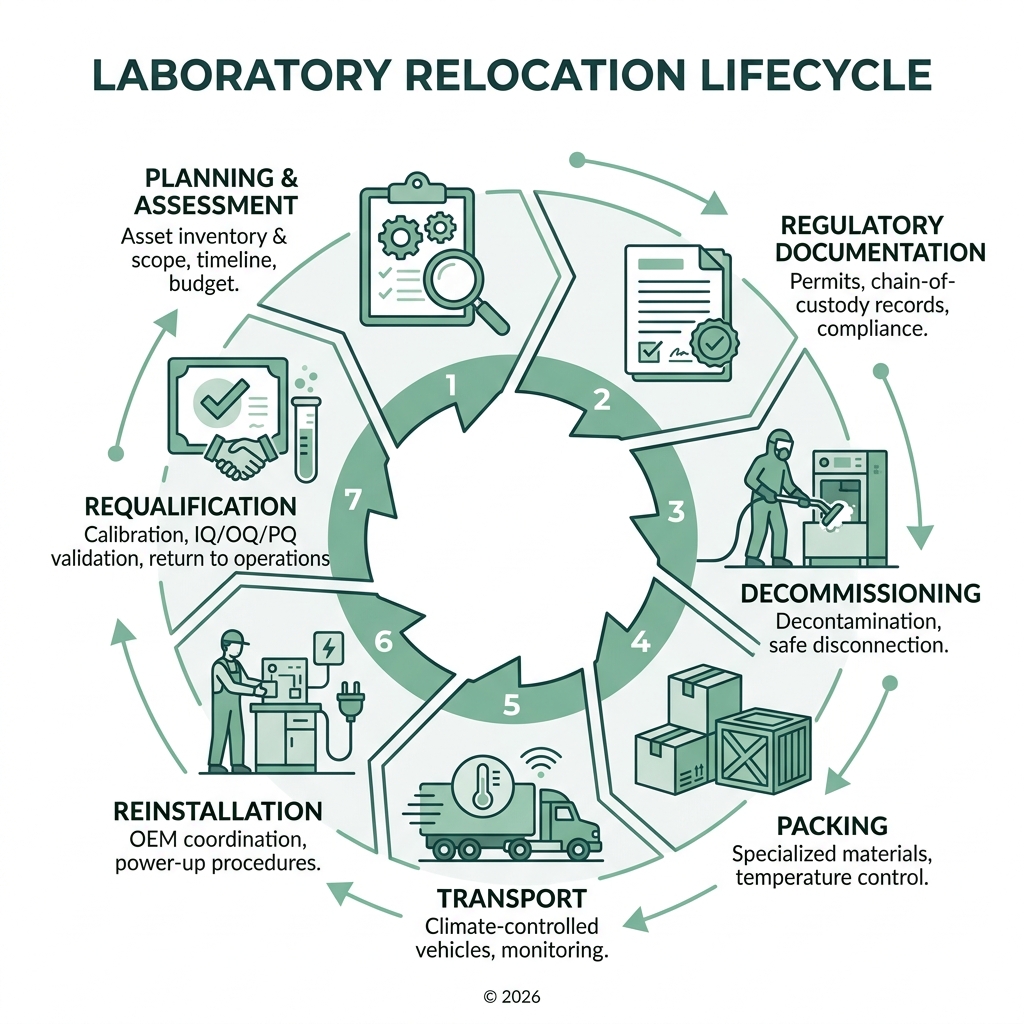
What Does a Relocation Include?
When you hire a professional team for a move in New England—whether you are moving within Boston or relocating a facility in Portland, Maine—the scope of services is vast. It isn’t just about the “trip”; it’s about the preparation and the aftermath.
Decommissioning and Decontamination
Before an instrument can move, it must be decommissioned. This involves more than just pulling the plug. It means flushing lines, securing internal moving parts (like the rotors in a centrifuge), and ensuring that all surfaces are decontaminated. You cannot bring old biohazards or chemical residues into a pristine new facility. Decontamination protocols ensure that equipment is safe for movers to handle and ready for its new home.
Comprehensive Asset Inventory
You cannot manage what you haven’t measured. A major part of the service is creating a detailed inventory. This includes:
- Manufacturer, model, and serial numbers.
- The current condition and calibration status.
- Special handling requirements (e.g., “Must remain upright,” “Keep at -80°C”).
- Planned placement in the new facility (knowing exactly which bench and which outlet the machine needs).
Lab Packing and Regulatory Documentation
One of the most critical components is compliance with lab pack regulations. This involves sorting chemicals by compatibility, cushioning them in approved containers, and creating the detailed paperwork required for transport. This “transfer packet” acts as the ID for your lab’s chemicals, ensuring they are handled safely and legally.
Technical De-installation and Re-installation
This is where the “heavy lifting” meets “high tech.” A relocation service often coordinates with Original Equipment Manufacturers (OEMs) to ensure that warranties remain intact.
- Benchmarking: Testing the equipment before the move to record its performance levels.
- Safe Disconnection: Expertly removing gas lines, specialized power connections, and data cables.
- Re-installation: Setting the equipment up at the new site and performing “power-up” testing.
- IQ/OQ/PQ Validation: For regulated labs, this is non-negotiable. Installation Qualification (IQ), Operational Qualification (OQ), and Performance Qualification (PQ) ensure the machine works exactly as it did before the move.
Specialized Transport for Laboratory Relocation Services
The truck used for a lab move is a piece of scientific equipment in its own right. Professional providers use custom-built vehicles that feature:
- Climate Control: Maintaining a steady ambient temperature to prevent condensation or heat damage.
- Shock Absorption: Air-ride suspension systems that iron out the bumps of New England’s frost-heaved roads.
- Redundancy: On-board generators and extra liquid nitrogen (LN2) supplies for cold storage units.
- Real-time Monitoring: GPS tracking and temperature sensors that alert the driver (and the lab manager) the second a parameter drifts out of range.
Navigating Regulatory Requirements and Hazardous Materials
Moving chemicals is the most legally complex part of any lab relocation. From the streets of Manchester, New Hampshire, to the labs in Worcester, Massachusetts, every mile is governed by strict safety laws.
DOT and IATA Requirements
If your move involves public roads, you must comply with Department of Transportation (DOT) permits. If any part of the move involves air travel (common for international relocations), IATA regulations apply. This requires hazmat chemical transport expertise to ensure that every container is labeled, every driver is certified, and every route is planned.
Biological Samples and Controlled Substances
Biological specimens often require specialized permits, especially if they are infectious or human-derived. Controlled substances (monitored by the DEA) require a rigorous chain-of-custody. This means a documented trail of who had the material, where it was, and who signed for it at every single minute of the journey.
The 4-6 Week Permit Window
One of the biggest mistakes lab managers make is waiting too long to start the paperwork. Permit applications for certain hazardous materials often require 4 to 6 weeks for processing. If you don’t have your permits in hand, the truck stays in the parking lot. Professional services manage this timeline for you, ensuring that lab pack disposal of unwanted chemicals happens well in advance of the move date.
Planning Your Timeline to Minimize Downtime
Downtime is the enemy of innovation. Every day your lab is in boxes is a day your research is stalled. To minimize this, you must choose between two main strategies:
| Strategy | Definition | Best For |
|---|---|---|
| Single-Phase Move | The entire lab shuts down and moves at once. | Smaller labs or those with flexible deadlines. |
| Multi-Phase Move | The lab moves in sections. Part of the lab stays operational while the other moves. | Large facilities, clinical labs, or high-output R&D. |
The 8-12 Week Countdown
A successful move starts at least three months before the first box is taped.
- Weeks 8-12: Assemble your team (IT, Safety Officers, Facility Managers). Conduct the initial inventory and apply for permits.
- Weeks 6-8: Finalize the floor plan of the new facility. Ensure the electrical and HVAC systems are ready for the specific load of your instruments.
- Weeks 2-4: Begin chemical lab packs for non-essential reagents. Dispose of expired chemicals to reduce the moving volume.
- Week 1: Perform final data backups. Conduct pre-move benchmarking on all critical instrumentation.
Frequently Asked Questions about Laboratory Relocation Services
What does a relocation include for temperature-sensitive samples?
For samples that must stay at -20°C, -80°C, or in liquid nitrogen (-190°C), the relocation includes “Cold Chain” logistics. This means the samples are moved in specialized “mobile biorepositories”—trucks equipped with redundant cooling systems and 24/7 alarmed monitoring. The goal is to maintain a seamless temperature record that complies with 21 CFR Part 11, proving that the samples never thawed during transit.
How do you select a provider for laboratory relocation services?
Don’t just look for a mover; look for a partner with technical and environmental expertise. Key criteria include:
- HAZMAT Certification: Are their technicians trained in chemical handling and spill response?
- Specialized Fleet: Do they own climate-controlled, air-ride vehicles?
- Regional Knowledge: Do they understand the specific disposal and transport laws in states like Vermont or Massachusetts?
- OEM Relationships: Can they coordinate with the people who built your machines?
What are the common challenges in a lab move?
The most common “roadblocks” include:
- Calibration Loss: Instruments often “drift” during a move. Budgeting time for recalibration is essential.
- Facility Readiness: Arriving at the new site only to find the 220V outlet is three feet too far from the machine.
- Regulatory Delays: Missing a permit that halts the entire project.
- Data Integrity: Losing the digital connection between the instrument and the server during the transition.
Ready to Move Your Lab Safely?
Relocating a laboratory is a high-stakes operation that demands precision, regulatory savvy, and a deep respect for the science involved. By choosing a comprehensive service that includes everything from chemical relocation to post-move validation, you protect your equipment, your data, and your team’s hard work.
Whether you are consolidating research space in Burlington, Vermont, or expanding a biotech startup in Boston, the right relocation strategy turns a “perilous” move into a seamless transition. At MLI Environmental, our certified professionals specialize in the hazardous materials logistics and specialized transport required to keep your lab compliant and your research on track. Contact us today!