

Hazmat shipping is the regulated process of transporting dangerous goods—materials capable of posing a risk to health, safety, property, or the environment—by air, ground, or sea. These materials include everything from industrial chemicals and lithium batteries to biological substances and flammable liquids.
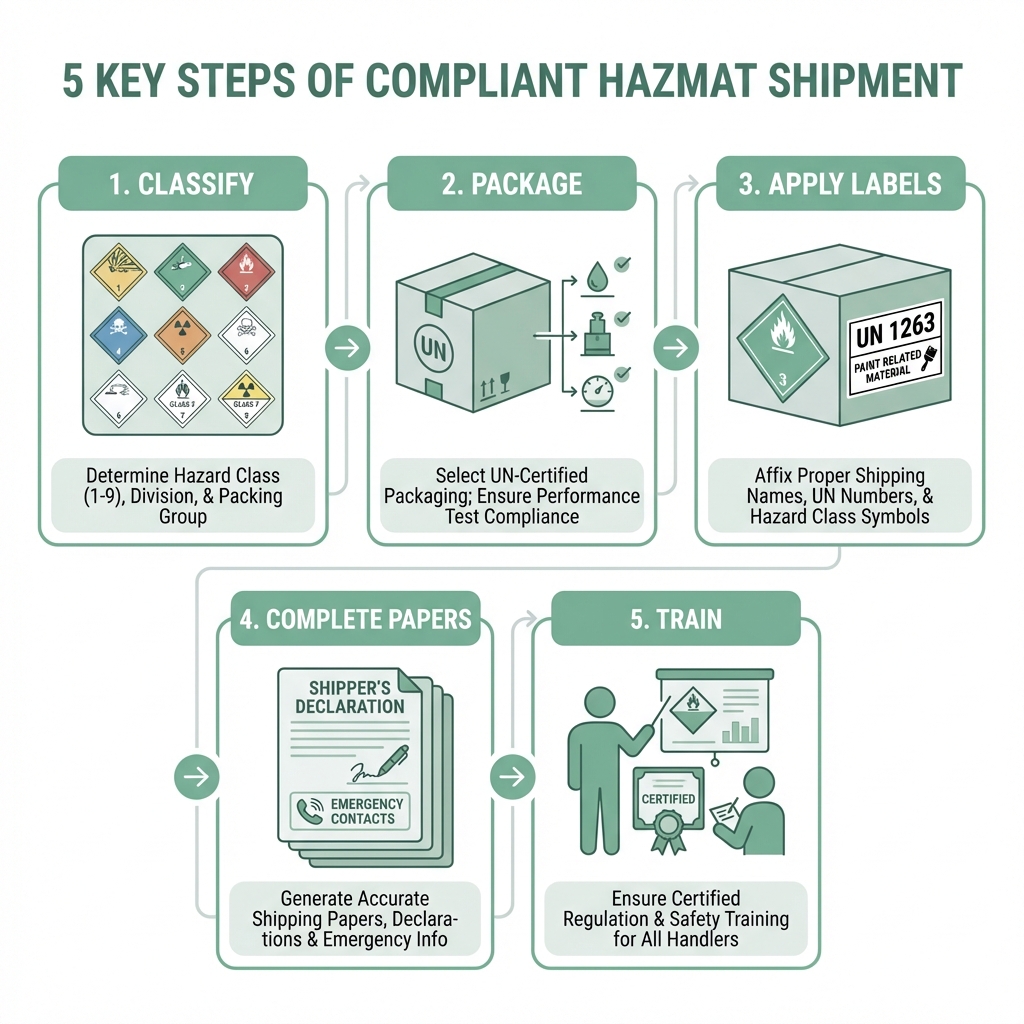
Quick Answer: The 5 Essential Steps of Compliant Hazmat Shipping
- Classify your material correctly (determine hazard class, division, and packing group)
- Package using UN-certified, tested containers appropriate for your material
- Mark and Label with proper shipping names, UN numbers, and hazard class labels
- Document with accurate shipping papers, declarations, and emergency contact info
- Train all personnel involved in handling or transporting the materials
You might have seen it on the highway—a truck passes by with large, diamond-shaped signs in bold colors like red, yellow, or black. That sign is more than just a colorful label. It’s a critical safety communication tool that tells first responders, handlers, and the public what dangerous materials are inside that vehicle.
In the United States alone, more than 11.2 billion tons of hazardous materials are transported annually. Every single shipment must comply with strict regulations from bodies like the Department of Transportation (DOT), Transport Canada, the International Air Transport Association (IATA), and the International Maritime Organization (IMO).
The stakes are high. Get it wrong, and you’re looking at hefty fines—up to $79,976 per violation for civil penalties, and up to $500,000 for corporations in criminal cases. Worse yet, mishandled hazmat can lead to accidents, environmental disasters, injuries, or even fatalities.
But compliance isn’t just about avoiding penalties. It’s about protecting your employees, your customers, the public, and the environment. Whether you’re a small business shipping lithium batteries or a large manufacturer moving industrial chemicals, understanding the regulations isn’t optional—it’s essential.
The challenge? The rules are complex, constantly changing, and vary by mode of transport. What’s acceptable for ground shipping might be forbidden on a passenger aircraft. A material that’s fully regulated in one scenario might qualify for simplified “Limited Quantity” treatment in another.
This guide breaks down everything you need to know about hazmat shipping—from understanding the regulatory framework and classifying your materials correctly, to mastering packaging requirements and avoiding common mistakes that lead to rejected shipments or worse.
Understanding the Regulatory Framework
The world of dangerous goods transport is a highly regulated one, and for good reason. Dangerous goods are articles or substances that are capable of posing a risk to health, safety, property or the environment. This inherent risk necessitates a robust framework of rules to ensure their safe movement across borders and by various modes of transport. Compliance is not merely a suggestion; it’s a legal obligation designed to prevent catastrophic incidents.
The primary regulations governing the transport of dangerous goods are multi-layered, encompassing international standards, regional agreements, and national laws. These regulations dictate everything from how materials are identified and packaged to how they are documented and handled in emergencies.
The Global Rule-Makers: ICAO, IATA, and IMDG
For international hazmat shipping, several key organizations set the global standards:
- International Civil Aviation Organization (ICAO): This United Nations agency establishes the technical instructions for the safe transport of dangerous goods by air. These instructions are the foundation for national air regulations worldwide.
- International Air Transport Association (IATA): Building on ICAO’s framework, IATA publishes the Dangerous Goods Regulations (DGR) manual. This manual is the global reference for shipping dangerous goods by air and the only standard recognized by airlines. If you’re shipping by air, compliance with IATA DGR is paramount.
- International Maritime Dangerous Goods (IMDG) Code: For sea transport, the IMDG Code provides comprehensive guidance for containerization, stowage, and segregation of dangerous goods to prevent incidents on vessels and in ports.

North American Regulations: Transport Canada and U.S. DOT
While international rules set the baseline, domestic regulations provide specific requirements within each country.
- Transport Canada (TDG): In Canada, the Transportation of Dangerous Goods (TDG) Regulations govern the ground transport of dangerous goods. These regulations ensure that shipments are prepared and handled safely within Canadian territories.
- U.S. Department of Transportation (DOT): For hazmat shipping within the United States, the U.S. DOT’s Pipeline and Hazardous Materials Safety Administration (PHMSA) is the primary regulatory body. Their rules are primarily found in Title 49 CFR, particularly Parts 100-185, which cover classification, packaging, labeling, documentation, and operational requirements. The Federal Motor Carrier Safety Administration (FMCSA) works to improve truck and bus safety, including reducing incidents involving hazardous materials on our nation’s highways in states like Maine, New Hampshire, Vermont, Massachusetts, and Rhode Island.
The U.S. DOT regulations are generally consistent with international standards like the UN Model Regulations, ICAO Technical Instructions, and IMDG Code. However, compliance with U.S. HMR (Hazardous Materials Regulations) does not automatically guarantee acceptance outside the U.S., as there may be unique national requirements.
Staying Current with Regulation Changes
Regulations are not static; they evolve constantly to address new technologies, lessons learned from incidents, and global harmonization efforts. For instance, the IATA DGR manual sees biennial updates, with significant changes often taking effect at the start of a new year. The 67th Edition of the IATA Dangerous Goods Regulations, for example, is on the horizon, bringing essential updates that take effect on January 1, 2026. Staying ahead of these changes is crucial for continuous compliance. You can Learn more about 2026 updates to IATA regulations to ensure your operations remain compliant. Regular review of regulatory publications and industry news is vital to avoid falling behind.
The Shipper’s Playbook: A Step-by-Step Guide to Compliance
As a shipper, you are the first line of defense in safe dangerous goods transport. The responsibility for correctly classifying, packaging, labeling, and documenting hazardous materials ultimately rests with you. This isn’t just about paperwork; it’s about making informed decisions that prevent accidents and protect lives.
Step 1: Correctly Classify Your Dangerous Goods
The very first and most critical step in hazmat shipping is accurate classification. This involves identifying the specific hazards of your material and assigning it to the correct hazard class, division, and, where applicable, packing group. Materials are considered dangerous goods if they pose a risk to health, safety, property, or the environment.
The U.S. DOT, in alignment with international standards, recognizes nine classes of dangerous goods:
- Class 1: Explosives (e.g., ammunition, fireworks)
- Class 2: Gases (e.g., propane, aerosols, oxygen) – Divided into flammable, non-flammable/non-toxic, and toxic gases.
- Class 3: Flammable Liquids (e.g., gasoline, paints, alcohols)
- Class 4: Flammable Solids; Substances Liable to Spontaneous Combustion; Substances Which, in Contact with Water, Emit Flammable Gases (e.g., matches, sodium, some metals) – Divided into flammable solids, spontaneously combustible, and dangerous when wet.
- Class 5: Oxidizing Substances and Organic Peroxides (e.g., hydrogen peroxide, some fertilizers) – Divided into oxidizers and organic peroxides.
- Class 6: Toxic and Infectious Substances (e.g., pesticides, medical waste, biological samples) – Divided into poisonous materials and infectious substances.
- Class 7: Radioactive Material (e.g., medical isotopes, uranium)
- Class 8: Corrosives (e.g., acids, strong bases, drain cleaner)
- Class 9: Miscellaneous Dangerous Goods (e.g., lithium batteries, dry ice, environmentally hazardous substances)
For many substances, a Packing Group (PG) further indicates the degree of danger:
- Packing Group I: High danger
- Packing Group II: Medium danger
- Packing Group III: Low danger
How do you classify your product? The most reliable source is the Safety Data Sheet (SDS), specifically Section 14, which details transport information. If an SDS is unavailable or unclear, you must consult the product manufacturer or a dangerous goods specialist for proper classification. Misclassification is a common pitfall and can lead to severe penalties and safety risks.
Step 2: Master Packaging, Labeling, and Marking
Once classified, your dangerous goods must be contained in appropriate packaging. This usually means UN-rated packaging, which has undergone rigorous performance testing (e.g., drop, leakproofness, stacking tests) to ensure it can withstand the rigors of transport. The packaging must be compatible with the hazardous material to prevent leaks, corrosion, or dangerous reactions. For liquids, adequate outage (empty space) is required to allow for thermal expansion.
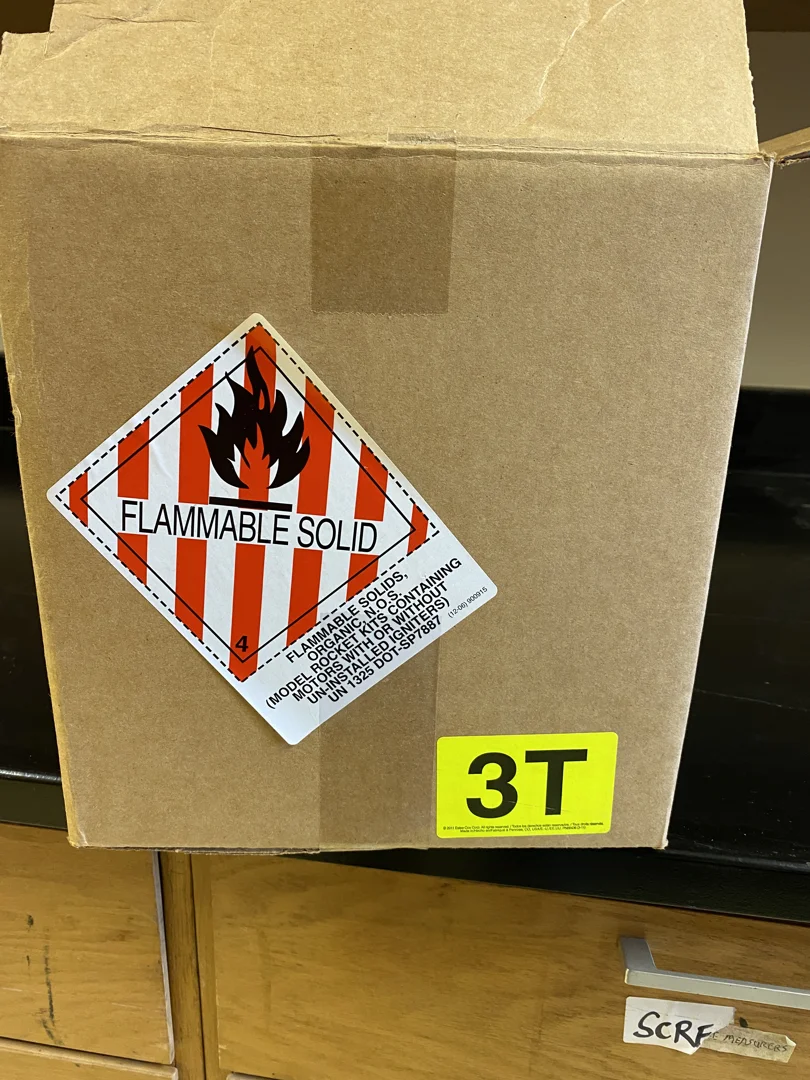
Labeling refers to the hazard class labels (the diamond-shaped placards) that visually communicate the primary and any subsidiary risks of the contents. These labels must be clearly visible, in good condition, and placed on a contrasting background. For example, a flammable liquid would require a red flame label.
Marking includes all other information placed on the package, such as the Proper Shipping Name, the UN Number (a four-digit identification number unique to each substance), the shipper’s name and address, and any special handling instructions. For instance, packages containing lithium batteries must display specific markings. For detailed requirements on placarding, including when placards are mandatory and the type required, consult the Hazardous Materials Table in 49 CFR 172.504. When reusing boxes, all former markings and labels must be completely obliterated or removed, not just crossed out, to avoid confusion and potential non-compliance.
Step 3: Acing Your Hazmat Shipping Paperwork
Accurate and complete documentation is the backbone of compliant hazmat shipping. The key documents include:
- Shipper’s Declaration for Dangerous Goods: For air shipments, this document, prepared by the shipper, provides a detailed description of the dangerous goods, including classification, quantity, packaging, and emergency response information.
- Bill of Lading (or Uniform Hazardous Waste Manifest for waste): For ground and sea shipments, this document serves as a contract between the shipper and carrier and details the contents of the shipment, including the proper shipping name, hazard class, UN number, packing group, and emergency contact information.
- Emergency Contact Information: All shipping papers must include a 24-hour emergency telephone number that is monitored by a person knowledgeable about the hazardous material and capable of providing immediate advice. In Canada, CANUTEC provides this service, but for operations in Maine, New Hampshire, Vermont, Massachusetts, and Rhode Island, shippers must ensure they have a US-based emergency response information provider.
The person signing the certification on the shipping paper must be knowledgeable about the shipment and its compliance with regulations. Keeping these documents readily accessible during transport is crucial for emergency responders.
Special Cases in Hazmat Shipping: Limited, Excepted, and Fully Regulated
Not all dangerous goods shipments are treated equally. Regulations offer different categories based on the quantity and concentration of the hazardous material, providing some relief for smaller, less risky shipments:
- Limited Quantity (LQ): These are small quantities of certain dangerous goods that pose a lower risk. They often qualify for reduced packaging, labeling, and documentation requirements. For example, some household items, when packaged in small consumer-sized containers, might qualify as LQ. For ground shipments in the U.S., limited quantity regulations are found in 49 CFR 172.315.
- Excepted Quantity (EQ): Even smaller quantities than LQ, these materials have minimal hazards and can be shipped with even further reduced requirements. They typically require specific inner and outer packaging, but often no hazard labels, only an “E” marking.
- Fully Regulated: Any shipment that does not meet the criteria for Limited Quantity or Excepted Quantity falls under the full scope of dangerous goods regulations, requiring complete adherence to all packaging, labeling, marking, and documentation rules.
Specific considerations apply to certain items like lithium batteries and biological substances. Lithium batteries (UN 3480, UN 3090) are common in electronics but present fire hazards if damaged or improperly shipped. Their transport is heavily regulated, especially by air, with specific packaging, marking, and documentation requirements, and often quantity limits. Biological substances (e.g., UN 3373) require specialized packaging to prevent leakage and ensure safety, particularly for infectious materials. Understanding these nuanced categories is vital for efficient and compliant hazmat shipping.
Navigating Different Terrains: Air, Ground, and Sea Hazmat Shipping
The mode of transport significantly influences the specific regulations and requirements for dangerous goods. Each mode presents unique risks and operational challenges, leading to custom rules.
Shipping by Air (IATA)
Air transport is often considered the most stringent mode for hazmat shipping. This is due to the inherent risks associated with carrying dangerous goods in an enclosed environment at high altitudes, where changes in pressure and temperature can affect containers.
- Strictest Regulations: Air cargo rules are designed to prevent incidents that could compromise aircraft safety.
- Passenger vs. Cargo Aircraft: Many dangerous goods are forbidden on passenger aircraft altogether or are allowed only in very limited quantities. Cargo aircraft, while having more permissive rules, still have strict limitations.
- Quantity Limitations: Maximum net quantities per package are often much lower for air transport compared to ground or sea.
- Pressure and Temperature Changes: Packaging must be designed to withstand significant variations in ambient pressure and temperature during flight.
Shipping by Ground (TDG / 49 CFR)
Ground transport, primarily by truck, is the most common mode for moving dangerous goods within countries like the U.S. (across Maine, New Hampshire, Vermont, Massachusetts, and Rhode Island) and Canada.
- Most Common Mode: It offers flexibility and door-to-door service.
- Larger Quantities: Generally, larger quantities of dangerous goods can be transported by ground compared to air, subject to specific vehicle and route restrictions.
- Placarding Requirements: Trucks carrying significant quantities of hazardous materials must display hazard placards on all four sides of the vehicle, clearly visible to emergency responders.
- Driver Training: Drivers transporting hazardous materials must hold specific endorsements on their Commercial Driver’s License (CDL) and undergo specialized training.
- U.S. Regulations: The FMCSA HazMat Regulations are crucial for ensuring safe ground transport, focusing on vehicle safety, driver qualifications, and operational procedures.
Shipping by Sea (IMDG)
Sea transport is ideal for bulk shipments and intercontinental movement of dangerous goods.
- Bulk Transport: Vessels can carry very large quantities of hazardous materials, often in specialized tanks or containers.
- Containerization: Dangerous goods are typically shipped in ISO containers, which must be properly marked, labeled, and stowed on the vessel.
- Segregation of Goods: Strict rules govern the segregation of incompatible dangerous goods to prevent dangerous reactions in case of an incident.
- Environmental Pollution Risk: Due to the potential for large-scale environmental damage from spills at sea, regulations are heavily focused on preventing pollution.
Avoiding Costly Mistakes: Compliance, Training, and Emergencies
Non-compliance with dangerous goods regulations isn’t just about paperwork; it carries significant consequences. The implications of non-compliance can range from hefty fines and penalties (both civil and criminal) to rejected shipments, costly delays, and, most critically, severe safety incidents, environmental damage, and harm to human health. Carriers like UPS, for example, have strict policies for accepting dangerous goods, requiring specific compliant shipping solutions and hazardous materials shipment preparation software. They also have specific conditions and limitations for various materials, and non-compliance can lead to refusal of service.
Common Pitfalls in Hazmat Shipping and How to Avoid Them
Even experienced shippers can sometimes stumble. Here are common mistakes and how to steer clear of them:
- Misclassification: Incorrectly identifying a material’s hazard class or packing group is a fundamental error. Always refer to the SDS (Section 14) or consult an expert.
- Undeclared Goods: Attempting to ship dangerous goods without declaring them is illegal and extremely dangerous. Many common household items (aerosols, perfumes, cleaning supplies) are dangerous goods.
- Incorrect Packaging: Using non-UN rated containers, improper inner packagings, or failing to secure closures can lead to leaks and spills. Always use packaging suitable for the material and mode of transport.
- Incomplete Paperwork: Missing emergency contact numbers, incorrect UN numbers, or unsigned declarations can cause delays and rejection. Double-check all documentation.
- Hidden Dangerous Goods: Sometimes, hazardous materials are inadvertently included in shipments, especially in return goods or complex products. The Check the Box program encourages shippers to consider if “Hazardous Matt” might be hiding in their package. Always verify the contents of every shipment.
The Importance of Certified Training
One of the most effective ways to avoid pitfalls is through proper training. Training is mandatory for anyone involved in hazmat shipping, from those who classify and package to those who load and transport.
- Training Requirements: U.S. DOT (49 CFR) mandates specific training for “hazmat employees,” which includes:
- General Awareness/Familiarization: Understanding the regulations and how to identify dangerous goods.
- Function-Specific Training: Detailed instruction on the specific tasks an employee performs (e.g., classifying, packaging, preparing shipping papers).
- Safety Training: Information on the hazards of materials handled and emergency response procedures.
- Security Awareness Training: Understanding security risks associated with dangerous goods transport.
- Recurrent Training: Training is not a one-time event. U.S. DOT requires recurrent training at least every three years (and after any significant regulatory change). IATA and TDG have similar recurrent training requirements, usually every 24 months.
MLI Environmental’s certified professionals are trained to steer these complex requirements, ensuring every shipment complies with the latest regulations.
Emergency Preparedness and Response
Even with the best precautions, accidents can happen. Having a robust emergency preparedness and response plan is critical.
- Emergency Response Guidebook (ERG): The Emergency Response Guidebook (ERG), available from the U.S. DOT, is an invaluable resource for first responders. It provides initial actions to take during the first 15-30 minutes of a dangerous goods incident, based on the UN number of the material.
- Spill Reporting: Immediate notification of incidents, especially those involving fatalities, hospitalizations, evacuations, or significant environmental release, is legally required.
- Emergency Response Assistance Plan (ERAP): In Canada, certain high-risk dangerous goods require an ERAP, which outlines specific emergency response measures. While ERAPs are a Canadian requirement, U.S. shippers must have their own emergency response plans and ensure their 24-hour emergency contact can provide the necessary information for responders.
Frequently Asked Questions about Hazmat Shipping
What training is required to ship hazardous materials?
Training is mandatory for anyone who handles, prepares, or transports dangerous goods. The specific requirements vary by job function and mode of transport (e.g., IATA for air, 49 CFR for U.S. ground). Typically, this includes general awareness, function-specific, safety, and security training. Recurrent training is required, usually every 2-3 years, to ensure employees are up-to-date with current regulations and best practices. Individuals involved in hazmat shipping in Maine, New Hampshire, Vermont, Massachusetts, and Rhode Island must comply with federal DOT training mandates.
Can I ship common household items that are considered hazardous?
Yes, many common household items are indeed dangerous goods, including aerosols, perfumes, nail polish, cleaning supplies, and lithium batteries. Shipping them requires following the applicable regulations. Often, these items can be shipped as “Limited Quantities,” which have reduced requirements due to their small size and lower risk. However, postal services like Canada Post (and similar services in the U.S.) often list many dangerous goods, even in limited quantities, as non-mailable matter. Always check the carrier’s specific policies before shipping.
How do I find the UN number and Proper Shipping Name for my product?
The most reliable way to find the UN number and Proper Shipping Name for your product is to consult its Safety Data Sheet (SDS). Specifically, look at Section 14: Transport Information. This section is legally required to contain the correct classification details needed for hazmat shipping. If an SDS is unavailable, or if you’re unsure how to interpret it, you must contact the product manufacturer or consult with a dangerous goods specialist. Attempting to guess or use incorrect information can lead to significant non-compliance penalties and safety risks. The complete list of all UN hazmat codes can be found in the UN Model Regulations published by the United Nations.
Need Hazmat Shipping Help? Contact MLI Environmental for Compliant Dangerous Goods Support
Navigating the complexities of hazmat shipping can feel like a daunting task. The intricate web of international and domestic regulations, the constant updates, and the severe implications of non-compliance demand meticulous attention to detail. From correctly classifying your materials and selecting appropriate UN-rated packaging to mastering the art of documentation and ensuring all personnel are certified, every step is critical.
The stakes are high: safety of employees and the public, environmental protection, and avoiding crippling financial penalties. But with the right knowledge, adherence to best practices, and a commitment to ongoing training, compliant hazmat shipping is achievable.
For businesses in Maine, New Hampshire, Vermont, Massachusetts, and Rhode Island, ensuring the safe and compliant transport of hazardous materials is not just a regulatory burden—it’s a commitment to responsible operations. MLI Environmental, a trusted leader in the hazardous materials and waste management industry, specializes in international and domestic dangerous goods shipping and hazardous materials logistics. With their certified professionals, they provide the expertise and logistics support needed to steer these challenges safely and efficiently.
Don’t let the complexities of dangerous goods transport put your business at risk. Get expert help with your dangerous goods shipping from MLI Environmental’s certified professionals.