

Demystifying Column 7 of the Hazardous Materials Table
When shipping hazardous materials, understanding each part of the Hazardous Materials Table (HMT) is crucial for safety and compliance. Among its many columns, column 7 of the hazardous materials table holds special importance. It provides codes for “special provisions” that can change or add to standard shipping rules.
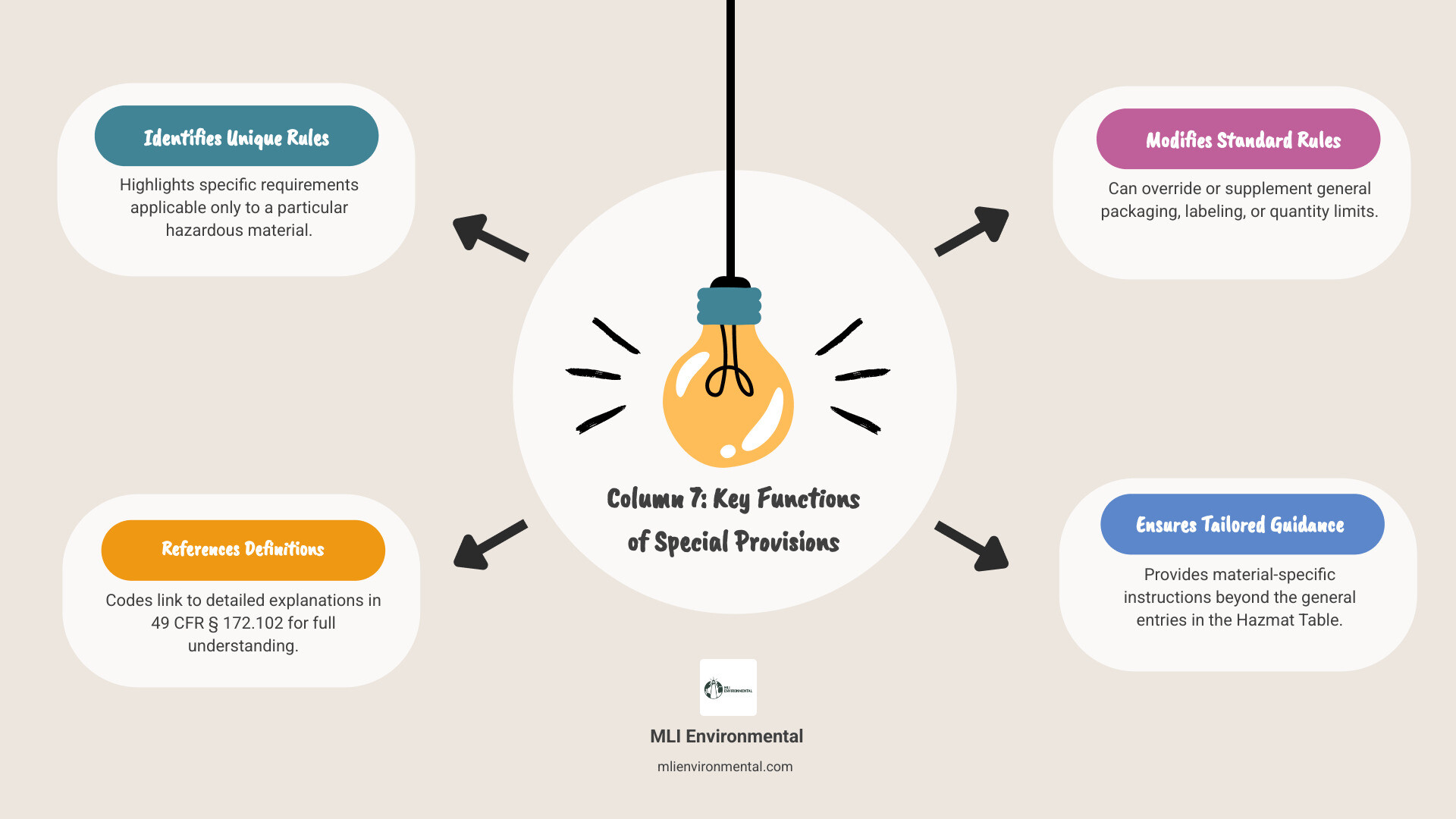
Here’s a quick look at what Column 7 does:
- Identifies unique rules: It lists codes for specific requirements that apply only to that hazardous material.
- References definitions: The codes refer to detailed explanations found in 49 CFR a7 172.102.
- Modifies standard rules: These special provisions can override or supplement general packaging, labeling, or quantity limits found in other columns.
- Ensures tailored guidance: They offer material-specific guidance beyond the general entries in the table.
Navigating the complexities of hazardous materials shipping can be tough. An important, but often overlooked, requirement is understanding these special provisions. They are key to safe and compliant transportation.
This guide will help you decode Column 7. Well explain what these codes mean and how they impact your shipping operations. Get ready to understand this vital part of hazmat regulations.
The Purpose and Role of Column 7 of the Hazardous Materials Table
The primary role of column 7 of the hazardous materials table is to act as a “fine print” section for hazardous materials. While other columns give you the broad strokes—like the hazard class or division or the UN identification number—Column 7 contains specific codes that signal additional requirements, exceptions, or limitations.
According to 49 CFR § 172.101, this column specifies codes for special provisions applicable to hazardous materials. These provisions are not just “suggestions”; they are legally binding requirements that can modify how a material must be packaged, labeled, or handled during transit. For example, a material might appear to have standard packaging requirements in Column 8, but a code in Column 7 could restrict that material to specific types of inner packagings or mandate a higher level of pressure testing for a portable tank.
Essentially, Column 7 ensures that the regulations account for the unique chemical or physical properties of a substance that a general classification might miss. It provides a way for the Department of Transportation (DOT) to apply surgical precision to safety protocols without cluttering the main table with endless text.
Where to Find Definitions for Column 7 of the Hazardous Materials Table
If you look at Column 7 in the HMT, you won’t see sentences. Instead, you’ll see a string of alphanumeric codes like “A7, IB2, IP3, T4, TP1.” To make any sense of these, you must cross-reference them with 49 CFR § 172.102.
This section of the Code of Federal Regulations is the “legend” or “decoder ring” for the table. It lists every numeric and alphanumeric code in order, providing the full text of the requirement. Some provisions are short, while others are extensive technical paragraphs. It is vital for shippers to look up every code listed for their specific material entry, as failing to follow even one can result in a non-compliant shipment.
How Shippers Use Column 7 of the Hazardous Materials Table
For a shipper, Column 7 is a critical stop in the process of shipping hazardous materials. Once you have identified your material and its packing group, you must check Column 7 to see if your standard packaging plan needs to change.
Shippers use this column to:
- Verify Packaging Eligibility: Determine if the material is allowed in certain types of Intermediate Bulk Containers (IBCs) or portable tanks.
- Identify Mode-Specific Rules: Check if there are unique restrictions for air, rail, or water transport that don’t apply to highway transport.
- Ensure Shipping Paper Accuracy: Some special provisions require specific notations or technical names to be added to the shipping papers.
- Confirm Exceptions: Sometimes Column 7 makes life easier by providing an exception that allows less stringent packaging under certain conditions.
Decoding the Codes: Understanding Letter and Numeric Designations
The codes in column 7 of the hazardous materials table aren’t just random letters and numbers. They follow a specific logic that tells you exactly what they apply to. There are over 300 numeric codes and eight primary letter codes.
A code consisting only of numbers (e.g., “128”) is multi-modal. This means it applies to all modes of transport (air, highway, rail, and water) and usually applies to both bulk and non-bulk packaging. However, when letters are involved, the scope narrows significantly.
The following table breaks down what the various letter prefixes mean, as detailed in special provision letter codes references:
| Letter Code | Meaning |
|---|---|
| A | Applies only to transportation by Aircraft. |
| B | Applies only to Bulk packaging requirements (other than IBCs or portable tanks). |
| IB | Applies only to Intermediate Bulk Containers (IBCs). |
| IP | Applies only to IBCs (usually specific to inner packaging or water-resistance). |
| N | Applies only to Non-bulk packaging requirements. |
| R | Applies only to transportation by Rail. |
| T | Applies only to UN or IM Specification portable tanks. |
| TP | Additional Portable Tank provisions (often regarding pressure relief or shell thickness). |
| W | Applies only to transportation by Water. |
Aircraft and Non-Bulk Provisions
When you see an “A” code, you need to pay close attention if you are planning to put that material on a plane. These codes often address specialized packing requirements or quantity limitations that are much stricter than those for ground transport. For example, an “A” code might forbid a certain material on passenger aircraft entirely, even if Column 9 suggests it might be allowed under other circumstances.
“N” codes are the best friends (or sometimes the headaches) of the small-scale shipper. These apply specifically to non-bulk packagings—think drums, jerricans, and boxes. They might mandate that a drum be made of a specific material (like plastic vs. steel) to prevent a chemical reaction with the hazardous material inside.
Bulk Packaging and Portable Tank Codes
For those moving large quantities, “B,” “IB,” “T,” and “TP” codes are the primary focus.
- B codes cover bulk packaging, such as cargo tanks and hopper cars.
- IB and IP codes are essential for anyone using IBCs (totes). For instance, IB2 is a very common code for flammable liquids, specifying which types of IBCs are authorized.
- T and TP codes are highly technical. T codes (T1 through T22) specify minimum test pressures and shell thicknesses for portable tanks. TP codes (Tank Provisions) provide additional instructions, such as TP1, which relates to the degree of filling allowed in the tank to account for thermal expansion.
How Column 7 Interacts with Other Table Columns
Column 7 does not exist in a vacuum. It is a “modifier” column that interacts with almost every other part of the HMT. It is often used to clarify or override the general rules found in Column 1 (Symbols), Column 5 (Packing Groups), and Column 8 (Packaging Authorizations).
For example, if you are shipping a material that is a poisonous substance, Column 7 might contain a code that mandates an “Inhalation Hazard” warning, even if Column 6 doesn’t explicitly list it as the primary label.
Interaction with Column 1 Symbols
The symbols in Column 1 often trigger the need for specific special provisions in Column 7.
- The ‘G’ Symbol: This symbol indicates that a technical name is required in parentheses on shipping papers. Special provisions in Column 7 might provide further guidance on which technical names are acceptable.
- The ‘A’ and ‘W’ Symbols: These symbols indicate that the material is only regulated when transported by aircraft or water, respectively. Column 7 codes with ‘A’ or ‘W’ prefixes will further define the rules for these specific modes.
You can find more about how these symbols work in the 49 CFR Part 172 Subpart B regulations.
Modifying Column 8 Packaging Authorizations
Column 8 is usually where shippers look to find the specific section of Part 173 that tells them how to pack their hazmat. However, Column 7 can completely override those sections.
If Column 8B points you to § 173.202 for a non-bulk liquid, but Column 7 contains a special provision that says “Packaging must be airtight,” you must follow the Column 7 requirement even if § 173.202 doesn’t mention airtightness. This ensures compliance with general packaging requirements under § 173.24, which mandate that packaging be compatible with the material it contains.
Consequences of Non-Compliance and Best Practices
The consequences of ignoring column 7 of the hazardous materials table can be severe. Because these provisions are part of federal law, failing to comply with them is a regulatory violation.
- Civil Penalties: Fines for non-compliance can reach tens of thousands of dollars per violation, per day.
- Transportation Delays: If an inspector finds that your IBC doesn’t meet the “IB” code requirements listed in Column 7, your shipment will be frustrated (stopped) until it is repacked.
- Safety Risks: These provisions exist to prevent leaks, fires, and explosions. Ignoring a code that mandates a specific shell thickness or a relief valve could lead to a catastrophic environmental or human safety incident.
Best Practices for Shippers:
- Training is Mandatory: Ensure all employees are trained in accordance with 49 CFR 172.704. They need to know how to read the HMT and look up codes in a7 172.102.
- Double-Check Every Code: Never assume you know what a code means. Even if you ship the same material often, regulations can change. Always look it up.
- Cross-Reference Shipping Papers: Ensure any requirements from Column 7 (like technical names or inhalation hazard zones) are clearly documented on your shipping papers.
- Stay Current: The PHMSA (Pipeline and Hazardous Materials Safety Administration) frequently updates these codes to harmonize with international standards.
Frequently Asked Questions About Column 7 of the Hazardous Materials Table
Can special provisions override standard labeling requirements?
Yes. While Column 6 lists the primary and subsidiary hazard labels, Column 7 can add requirements for additional markings or labels. For example, a special provision might require a “Keep Away From Heat” label or a specific “Poison-Inhalation Hazard” marking that isn’t standard for that hazard class.
What is the difference between numeric-only and letter codes?
Numeric-only codes are “universal”—they apply regardless of whether you are shipping by truck, plane, or boat. Letter codes are “specific.” An ‘A’ code only matters if the material is going on an airplane. If you see an ‘A’ code but you are shipping via a motor carrier in Maine or New Hampshire, that specific ‘A’ provision typically does not apply to your ground shipment.
How often are these special provisions updated?
They are updated fairly regularly through PHMSA rulemakings. These updates often occur to keep US regulations in line with international standards such as IATA (for air) or IMDG (for sea). It is wise to check for updates annually or whenever a new edition of the 49 CFR is released.
Contact MLI Environmental Today
Understanding column 7 of the hazardous materials table is more than just a regulatory hurdle; it is a fundamental part of a safety-first approach to logistics. These codes provide the granular detail needed to protect drivers, pilots, the public, and the environment from the unique risks posed by hazardous materials.
At MLI Environmental, we pride ourselves on our deep regulatory expertise. Whether you are shipping from Portland, Maine, or managing complex logistics in Boston, Massachusetts, our certified professionals ensure your shipments are fully compliant with all codes in the Hazardous Materials Table. We handle the “decoder ring” work so you can focus on your business, knowing your dangerous goods are in safe hands.
If you have questions about specific special provisions or need help navigating the complexities of hazmat transport, contact MLI Environmental for dangerous goods shipping today. We provide quick, safe service across Maine, New Hampshire, Massachusetts, Vermont, and Rhode Island.