

Safe Temporary Waste Storage Starts With Control and a Clear Clock
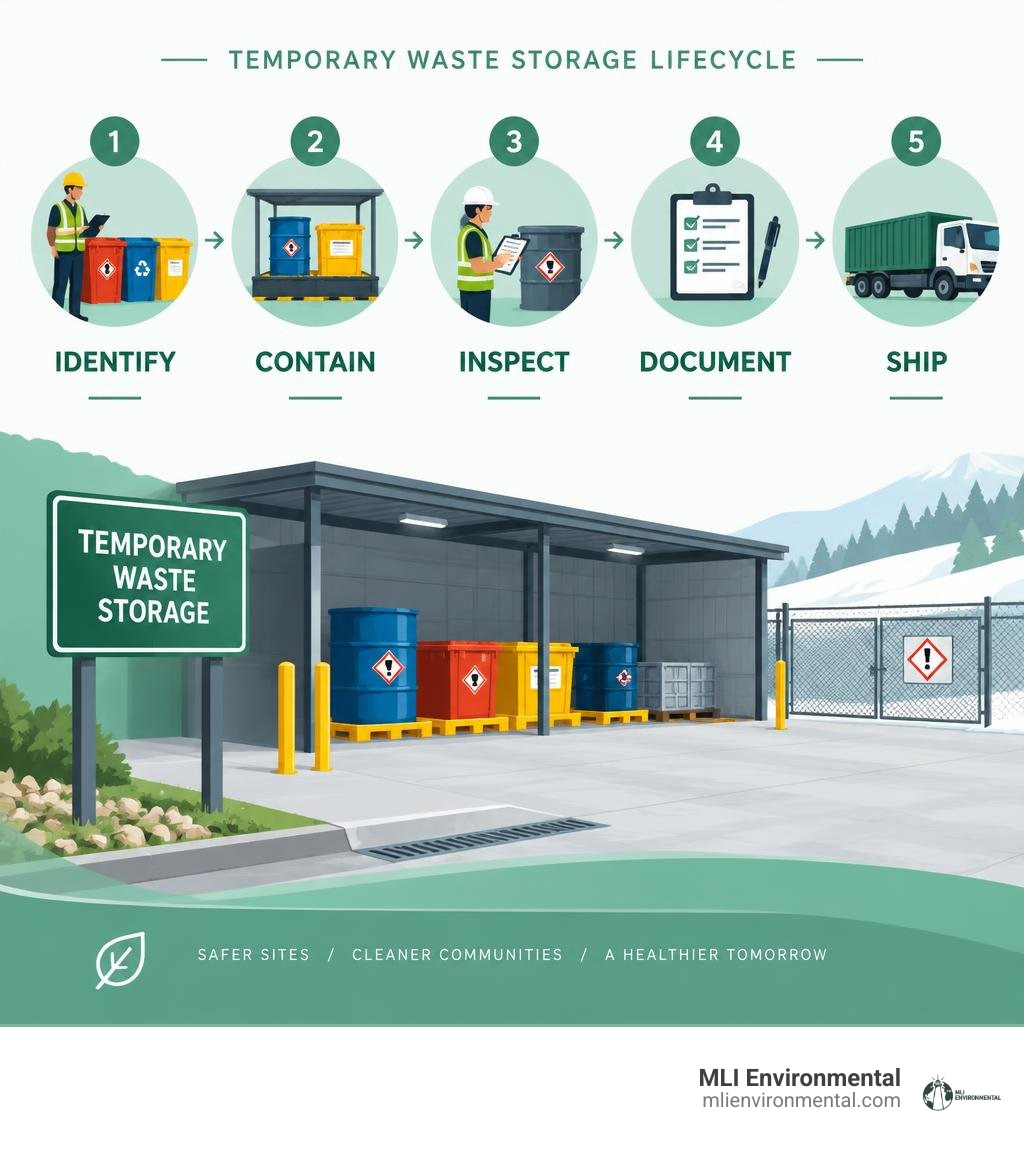
Temporary waste storage is the controlled, short-term holding of waste before it is recycled, treated, transported, or disposed of. For New England facilities, the safe approach is straightforward:
- Identify and separate each waste stream at the point of generation.
- Use closed, compatible, clearly labeled containers in a secure storage area.
- Protect floors, drains, and outdoor areas from leaks and stormwater.
- Track accumulation dates, quantities, inspections, and outbound shipments.
- Ship waste before the applicable federal and state storage deadline expires.
For hazardous waste, this is more than good housekeeping. It is part of the federal Resource Conservation and Recovery Act (RCRA) cradle-to-grave system. A container that is unlabeled, leaking, incompatible with its contents, or stored too long can create fire, exposure, soil contamination, and serious compliance risk.
New England businesses also need to account for state requirements and site conditions, including winter weather, snowmelt, freeze-thaw damage, and stormwater runoff. A well-run temporary storage area keeps waste contained, employees protected, and materials ready for compliant transport.
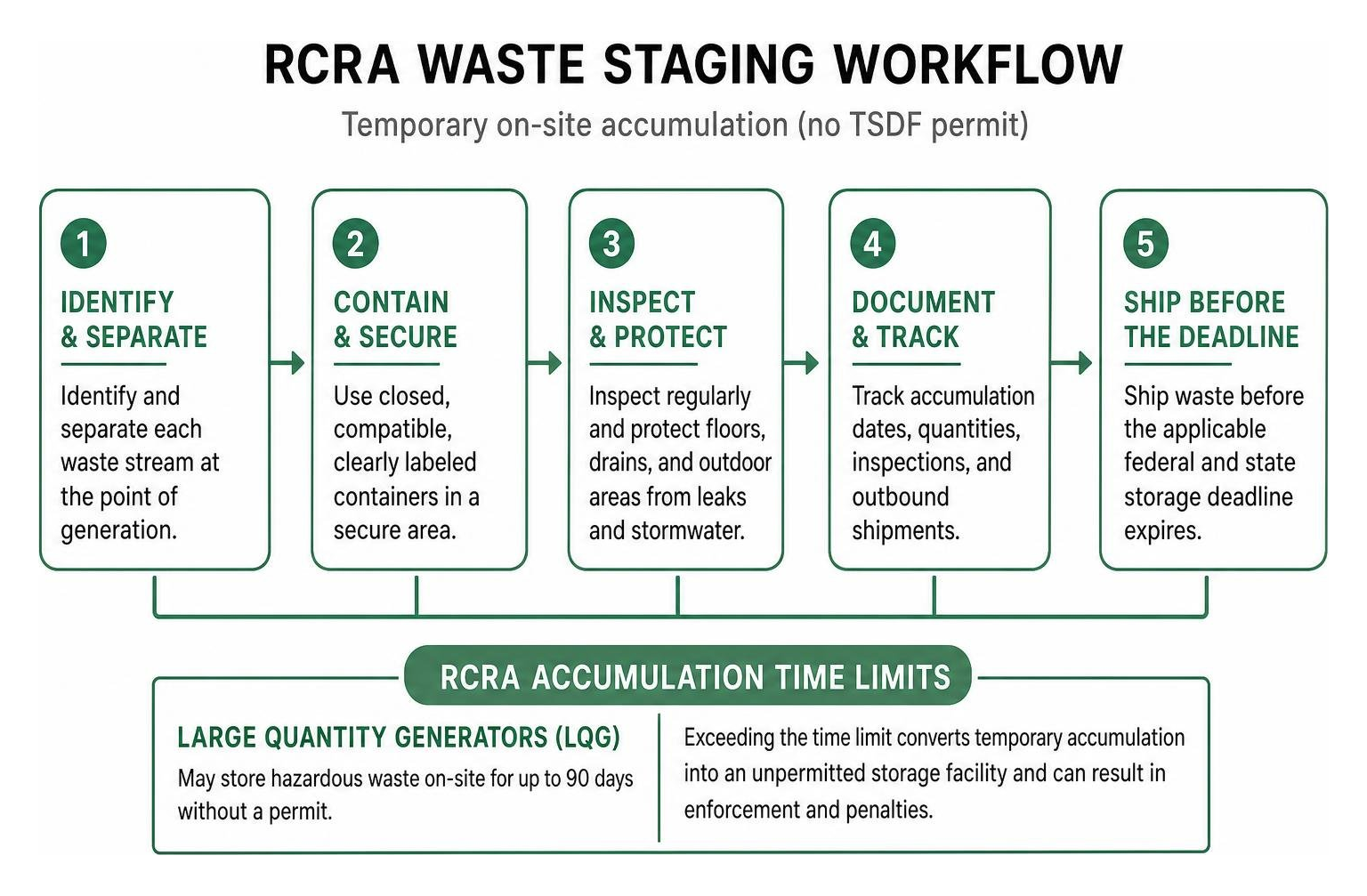
RCRA Framework and Temporary Waste Storage Limits
Under the Resource Conservation and Recovery Act (RCRA), holding hazardous waste temporarily on-site without a dedicated Treatment, Storage, and Disposal Facility (TSDF) permit is known as accumulation. Federal regulations under 40 CFR Part 262 provide conditional exemptions for generators, allowing them to stage and consolidate waste on their premises without triggering extensive TSDF permitting obligations.
Understanding your long-term responsibilities is vital because the legal accountability for waste never completely disappears from your facility ledger. Generators maintain strict cradle-to-grave hazardous waste shipping responsibilities, meaning your organization remains liable for the waste from its initial point of generation through staging, transport, and final destruction.
Exceeding established accumulation timeframes transforms an exempt temporary accumulation area into an unpermitted storage facility under the eyes of the Environmental Protection Agency (EPA). This regulatory threshold brings strict enforcement, potential administrative penalties, and operational disruption.
Generator Status and Temporary Waste Storage Time Limits
Your allowable accumulation window and on-site volume thresholds depend directly on your generator category. Facilities must accurately determine hazardous waste generator status on a calendar-month basis to ensure they do not exceed their authorized storage clocks:
- Large Quantity Generators (LQG): Facilities that generate 2,200 pounds or more of non-acute hazardous waste, or more than 2.2 pounds of acute hazardous waste per calendar month. LQGs may store waste on-site for a maximum of 90 days without a permit.
- Small Quantity Generators (SQG): Facilities that generate between 220 pounds and 2,200 pounds of non-acute hazardous waste per month. SQGs are granted up to 180 days of on-site accumulation (or 270 days if the waste must be transported more than 200 miles to reach a licensed disposal facility), provided their total accumulated on-site waste never exceeds 13,200 pounds.
- Very Small Quantity Generators (VSQG): Facilities generating less than 220 pounds of hazardous waste and less than 2.2 pounds of acute hazardous waste per month. While federal rules allow VSQGs to hold waste until reaching 2,200 pounds, state-specific rules across New England often enforce tighter timelines and formal disposal tracking.
If an unexpected process cleanout, chemical spill, or maintenance turnaround causes your waste generation to spike temporarily, EPA episodic generation provisions allow eligible facilities to maintain their standard lower generator status, provided strict notification and rapid staging requirements are satisfied.
Satellite Accumulation Areas vs. Central Accumulation Areas
Managing waste at the exact point of generation involves different operational parameters than consolidating materials in a dedicated central room. Regulatory frameworks distinguish between Satellite Accumulation Areas (SAAs) and Central Accumulation Areas (CAAs):
- Satellite Accumulation Areas: Allow operators to accumulate up to 55 gallons of non-acute hazardous waste (or 1 quart of liquid acute hazardous waste, or 2.2 pounds of solid acute hazardous waste) at or near the specific process generating the waste. The SAA container must remain under the direct control of the operator running the process, kept tightly closed except when actively adding or removing material, and marked with the words “Hazardous Waste” alongside clear hazard indicators.
- The 3-Day Transfer Rule: The instant an SAA container exceeds its 55-gallon limit, the generator has exactly three calendar days to date the container and transfer it to a designated CAA.
- Central Accumulation Areas: The main staging location where the site’s official 90-day (LQG) or 180-day (SQG) accumulation clock actively runs. CAAs must feature full emergency equipment, documented weekly inspections, certified containment systems, and formal aisle spacing.
Design and Containment Standards for Storage Areas
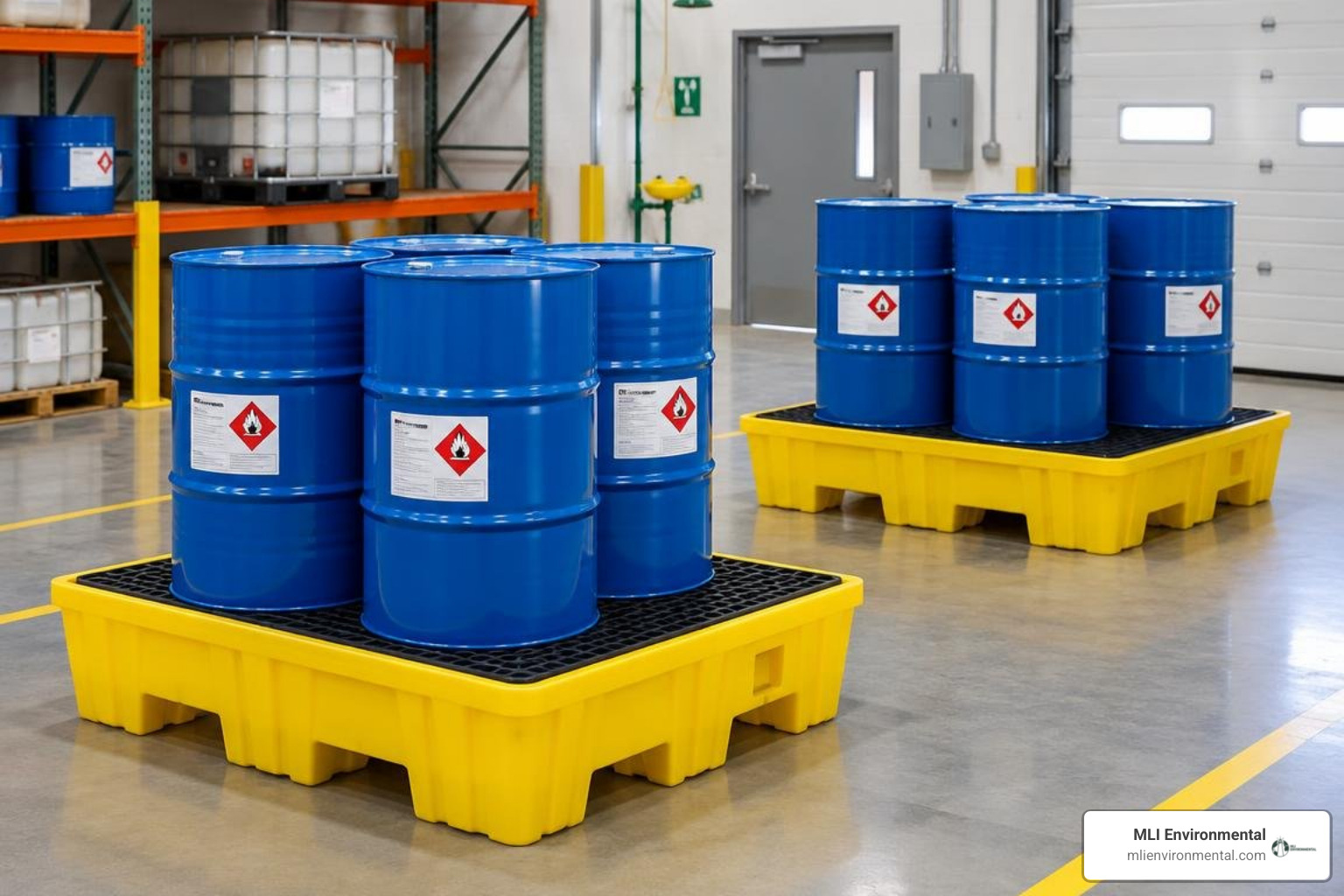
Constructing and maintaining a compliant storage zone requires strict attention to physical site engineering. A proper facility layout isolates chemical residues from human workspaces and prevents environmental releases into the subsurface or municipal utilities.
Engineering a compliant footprint requires consulting established hazardous waste storage area design standards, which emphasize sealed floors, physical impact barriers, and active spill pathways. Facilities must align with federal EPA RCRA container storage standards, which establish strict baseline criteria for structural integrity, drainage controls, and containment volume verification.
Secondary Containment and Impermeable Flooring
Any temporary storage area holding containers with free liquids must feature a secondary containment system designed to prevent floor contact and contain leaks. The containment structure must be engineered to hold at least 10% of the total volume of all containers in the area, or 100% of the capacity of the single largest container, whichever is greater.
Key containment design parameters include:
- Impermeable Base: Flooring must be free of cracks, unsealed seams, or unlined expansion joints. Applying chemical-resistant epoxy coatings prevents caustic or solvent materials from migrating into concrete pores.
- Elevation and Elevation Pads: Drums and totes must be elevated on corrosion-resistant pallets or containment decks so that leaking liquids do not pool around container bases.
- Drainage and Sump Control: Berms, sloped floors, and collection sumps should direct unexpected spills away from primary aisles and uncontained doorways.
Fire Protection and Incompatible Chemical Segregation
Mixing incompatible waste streams within a single temporary containment footprint can trigger exothermic reactions, toxic gas generation, spontaneous combustion, or structural explosions. To safeguard facilities, the National Fire Protection Association (NFPA) codes and RCRA standards mandate absolute separation between conflicting chemical classes.
For Large Quantity Generators storing ignitable or reactive wastes, 40 CFR 265.176 enforces the 50-foot rule: containers must be located at least 50 feet from the facility’s property line to prevent external ignition sources from threatening waste, and to protect adjacent properties in the event of an industrial fire.
| Primary Waste Hazard Class | Incompatible Chemical Classes | Minimum Separation Method | Potential Reaction Risk |
|---|---|---|---|
| Strong Acids (e.g., Sulfuric, Hydrochloric) | Strong Bases, Cyanides, Sulfides | Dedicated berms, separate containment sumps, or minimum 20-foot distance | Exothermic heat generation, toxic gas release (HCN, H₂S) |
| Ignitable Wastes & Solvents | Strong Oxidizers, Corrosives | Fire-rated separation walls or isolated secondary containment modules | Spontaneous ignition, accelerated fire spread |
| Strong Oxidizers (e.g., Peroxides, Nitrates) | Organic Solvents, Flammable Solids, Reducing Agents | Separate storage rooms or isolated fire-resistant containment units | Violent explosion, rapid thermal runaway |
| Water-Reactive Compounds | Aqueous Solutions, Liquid Waste Streams | Elevated dry storage units, isolated from all sprinkler/washdown zones | Hydrogen gas generation, self-heating, flash fires |
Best Practices for Safe Facility Operations and Monitoring

A well-designed storage area is only as effective as the daily operating procedures that govern it. Managing temporary staging safely requires selecting durable packaging, establishing systematic tracking, and ensuring operational personnel remain attentive to early indicators of container degradation.
Selecting certified packaging is the first line of defense. Facility managers should review criteria for choosing the right hazardous waste containers to guarantee that drum liners, poly drums, steel containers, or intermediate bulk containers (IBCs) match the corrosiveness, vapor pressure, and chemical weight of the materials being staged.
Container Selection and Proper RCRA Labeling
Every container placed into temporary accumulation must meet Department of Transportation (DOT) shipping specifications under 49 CFR. Using structural containers rated for transport eliminates the hazard of transferring hazardous materials between non-rated shop containers and road-ready drums prior to pickup.
Labeling must occur the moment waste first enters a container in a CAA or exceeds accumulation caps in an SAA. To avoid common citations, follow official hazardous waste label requirements, making sure each container displays:
- The clear phrase: “HAZARDOUS WASTE”
- The precise chemical composition and primary physical hazards (e.g., toxic, ignitable, corrosive, reactive)
- Applicable EPA waste codes (e.g., D001, F003)
- GHS hazard pictograms or DOT diamond placards indicating primary risks
- The official Accumulation Start Date (clearly visible on the front of the drum in a CAA)
Containers must remain securely closed, latched, or torqued shut during all storage intervals. Drums should only be opened when actively depositing or extracting materials; funnels left unlocked or open bungs represent instant regulatory violations and release volatile organic compounds (VOCs) into the indoor air.
Weekly Inspections and Emergency Preparedness
Federal RCRA standards under 40 CFR 265.174 require documented weekly inspections of all central accumulation areas. These reviews confirm container integrity, assess structural containment decks, verify visible label dates, and ensure unobstructed access to emergency gear.
To maintain compliance during unannounced state or federal audits, facilities should use a standardized hazardous waste inspection checklist for EPA visits to record inspection dates, inspector names, observed discrepancies, and corrective actions taken.
Aisle spacing must never be compromised. Facilities must maintain adequate aisle space (typically a minimum of 36 inches for personnel access, and up to 12 feet where forklift traffic operates) to allow the unobstructed movement of emergency personnel, decontamination equipment, and fire suppression units.
Every storage footprint must be backed by a site-specific hazmat emergency response plan that designates on-duty emergency coordinators with the authority to initiate containment operations.
Essential spill and safety equipment that must be stocked directly adjacent to the staging zone includes:
- Chemical-neutralizing absorbent pads, socks, and loose particulate
- Non-sparking recovery tools and explosion-proof transfer pumps
- Overpack drums (85-gallon or 110-gallon salvage containers)
- Calibrated portable eye-wash stations and emergency drench showers
- Appropriate multi-purpose Class ABC or Class D fire extinguishers
- Chemical-resistant personal protective equipment (PPE) suites, including splash goggles, heavy nitrile/neoprene gloves, and face shields
Managing Specific Waste Streams in New England Facilities
Facilities operating throughout Connecticut, Maine, Massachusetts, New Hampshire, Rhode Island, and Vermont must navigate a dual layer of oversight. While federal RCRA forms the regulatory backbone, state agencies—including the Connecticut Department of Energy and Environmental Protection (CT DEEP), the Maine Department of Environmental Protection (Maine DEP), the Massachusetts Department of Environmental Protection (MassDEP), the New Hampshire Department of Environmental Services (NHDES), the Vermont Department of Environmental Conservation (VT DEC), and the Rhode Island Department of Environmental Management (RIDEM)—frequently enforce more stringent operational thresholds.
For instance, Massachusetts does not formally recognize the federal VSQG designation; instead, it enforces Very Small Quantity Generator rules that require state notifications, registration thresholds, and dedicated recycling standards. Similarly, Maine and Connecticut regulate certain materials as state-specific hazardous wastes (such as waste polychlorinated biphenyls and specific industrial chemical mixtures) that would otherwise bypass federal subparts.
Universal Waste vs. Hazardous Temporary Waste Storage Rules
To streamline recycling and encourage resource recovery, the EPA and state regulators carved out specialized standards for Universal Waste. These items—including fluorescent light tubes, consumer and industrial batteries, mercury-containing devices, aerosol cans, and recalled pesticides—can be accumulated under streamlined rules compared to fully regulated RCRA hazardous waste streams.
Understanding the universal waste disposal regulations in New England helps facilities maximize allowable accumulation timelines:
- 1-Year Accumulation Window: Handlers may accumulate Universal Waste on-site for up to one full year from the date it was generated or received from another handler, giving businesses time to consolidate cost-effective shipment loads.
- Packaging Standards: Lamps and fragile devices must be stored in structurally sound, closed cardboard boxes or drums engineered to prevent breakage during standard handling.
- Labeling Requirements: Packages must be marked clearly with descriptors such as “Universal Waste—Lamps,” “Waste Batteries,” or “Universal Waste—Mercury-Containing Equipment,” accompanied by the earliest accumulation date.
Winterization and Environmental Protection in the Northeast
New England’s climate brings intense sub-zero freezes, heavy snow loads, and rapid spring thaw cycles. Storing wastes in unheated outbuildings, loading docks, or exterior sheds presents distinct physical risks that require proactive preparation.
To prevent cold-weather compliance failures, facilities should prepare your hazardous waste plan for winter by focusing on these operational safeguards:
- Freezing Aqueous Wastes: Water-based liquid wastes, coolants, and sludges can freeze, expand, and rupture plastic drums or warp steel seams. Store all liquid drums in climate-controlled, heated staging areas maintained above 40°F.
- Secondary Containment Snow Management: Outdoor containment berms and drive-over sumps that collect snow and ice lose their allowable secondary capacity. A secondary containment unit filled with frozen precipitation cannot capture an accidental chemical release, leaving your facility non-compliant. Inspect and clear outdoor sumps after every storm.
- Rapid Spring Thaw Runoff: Protect outdoor storage docks and waste roll-offs from heavy meltwater. Verify that nearby storm drain pathways, facility grates, and collection sumps are blocked or shielded so that accidental surface drips are not washed directly into municipal storm networks during heavy downpours.
Frequently Asked Questions About Temporary Waste Storage
What is the 90-day temporary waste storage rule?
The 90-day rule applies exclusively to RCRA Large Quantity Generators. Under 40 CFR 262.17, an LQG may accumulate hazardous waste in an authorized Central Accumulation Area for up to 90 consecutive days without requiring an interim status or full TSDF operating permit. The 90-day countdown starts the moment the first drop of waste enters a container in the CAA (or three days after an SAA exceeds its 55-gallon threshold). If unexpected, unforeseen, and temporary circumstances prevent shipment within 90 days, a generator must apply for a formal, short-term extension from their EPA Regional Administrator or state environmental agency before the deadline lapses.
How should incompatible chemicals be separated in temporary storage?
Incompatible chemicals must be physically isolated to prevent fires, explosions, or toxic off-gassing caused by accidental contact. Acceptable separation methods include storing incompatible classes in separate rooms, isolating containers across distinct secondary containment berms, or using non-combustible physical barrier dikes. When stored in the same open warehouse space, incompatible hazard classes (such as strong mineral acids and flammable organic solvents) must be separated by a minimum physical distance of at least 20 feet, with dedicated sumps ensuring that spills from opposing drums can never mix on the warehouse floor.
What are secondary containment requirements for hazardous waste drums?
Under 40 CFR 264.175, secondary containment systems for container storage areas holding free liquids must provide an impermeable, defect-free base that is sloped or engineered to drain and remove liquid leaks. The system must possess sufficient containment capacity to hold 100% of the volume of the single largest container in the staging zone, or 10% of the aggregate total volume of all liquid-holding containers, whichever is greater. Outdoor containment decks must also factor in additional capacity allowances to account for precipitation events.
Ready to Strengthen Your Temporary Waste Storage Program?
Mastering the rules of temporary waste accumulation protects your personnel, shields the local environment, and keeps your operations free from costly enforcement actions. Achieving compliant waste operations across New England requires consistent container tracking, proper containment engineering, strict compatibility segregation, and ongoing regulatory awareness.
MLI Environmental delivers comprehensive dangerous goods shipping, certified chemical staging assessments, and full-spectrum compliance support tailored to the regulatory landscape of Connecticut, Maine, Massachusetts, New Hampshire, Rhode Island, and Vermont. Whether you need an unannounced compliance audit, expert lab pack consolidation, or reliable turn-key transport, partner with industry leaders to maintain safe, seamless operations.
For professional assistance designing your accumulation areas or scheduling timely pickups, explore our certified hazardous waste management solutions today.