

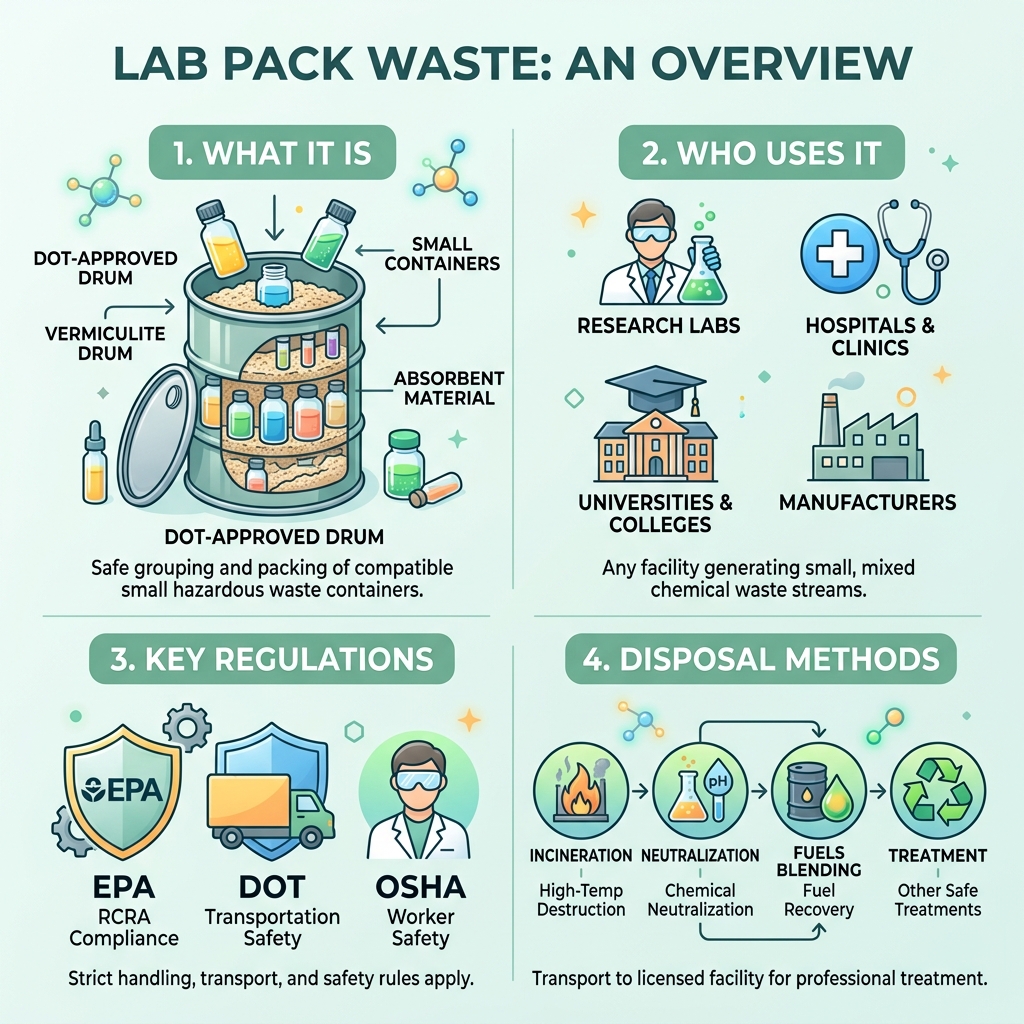
Lab pack waste consists of small containers of hazardous chemicals—such as solvents, acids, reagents, and cleaners—that are sorted by compatibility and packed into larger DOT-approved drums for safe transport and disposal.
Quick overview:
- What it is: Small chemical waste containers packed into an outer drum with absorbent material
- Who needs it: Labs, hospitals, universities, manufacturers, and facilities with accumulated chemicals
- Why it matters: Improper handling can cause fines, injuries, fires, toxic releases, and environmental damage
- Who regulates it: EPA under RCRA, DOT, and OSHA
- What happens next: Waste moves to a licensed facility for treatment, recycling, fuels blending, incineration, or stabilization
With roughly 35,000 labs operating across the United States, many facilities generate small, mixed quantities of hazardous waste that are difficult to manage without specialized expertise.
The compliance risk is real. A 1998 EPA inspection at MIT found violations in 56 of 114 laboratories and resulted in $150,000 in fines. Beyond penalties, poor chemical waste handling can lead to fires, toxic gas exposure, and environmental hazards.
Managing lab pack waste correctly is both a legal requirement and a safety priority.
What is a Lab Pack and How Does it Work?
A lab pack is a shipping container used to consolidate multiple small containers of compatible hazardous waste. Think of a chemistry storeroom with half-used reagents, expired solvents, acids, and cleaners. These materials cannot be thrown away, poured down the drain, or mixed together because many chemicals react dangerously when combined.
In the lab pack process, small inner containers—often vials, bottles, or pails—are placed inside a larger steel, fiber, or poly drum. Absorbent material such as vermiculite fills the void space so containers stay cushioned and separated during transport. Federal lab pack standards outline packaging and absorbent requirements for hazardous waste lab packs.
Overpacks are related but different: they enclose a leaking, damaged, or compromised container so it can be moved safely.
Common Materials in Lab Pack Waste
Lab pack waste often includes:
- Flammable solvents: Acetone, ethanol, hexane, and similar cleaning or extraction materials
- Corrosives: Strong acids such as hydrochloric acid and bases such as sodium hydroxide
- Toxic reagents: Chemicals that pose health risks in small amounts
- Oxidizers: Materials that intensify fire by supplying oxygen
- Aerosols and compressed gases: Spray containers and small lecture bottles
- Reactive chemicals: Materials that react with air, water, heat, or incompatible substances
Professional chemical lab pack services help prevent dangerous pairings, such as acids near cyanides or oxidizers near flammable solvents.
Industries Utilizing Lab Pack Waste Services
Many New England facilities—from Boston to Bangor—use lab packing services, including:
- Hospitals and healthcare facilities: Maintenance shops, pharmacies, and labs may generate disinfectants, solvents, and expired chemicals.
- Universities and schools: Chemistry and biology departments often accumulate small containers during semesters and cleanouts.
- Manufacturing and industrial sites: Quality control labs may store paints, inks, solvents, and process samples.
- Biotech and pharmaceutical companies: Research and production facilities generate specialized chemical waste streams.
For these organizations, professional lab hazmat transport services help maintain compliance while reducing risk for staff, students, patients, and transport teams.
The Step-by-Step Process of Managing Lab Pack Waste
Managing lab pack waste requires careful inventory, chemical knowledge, and compliant documentation—not just a drum and a label.
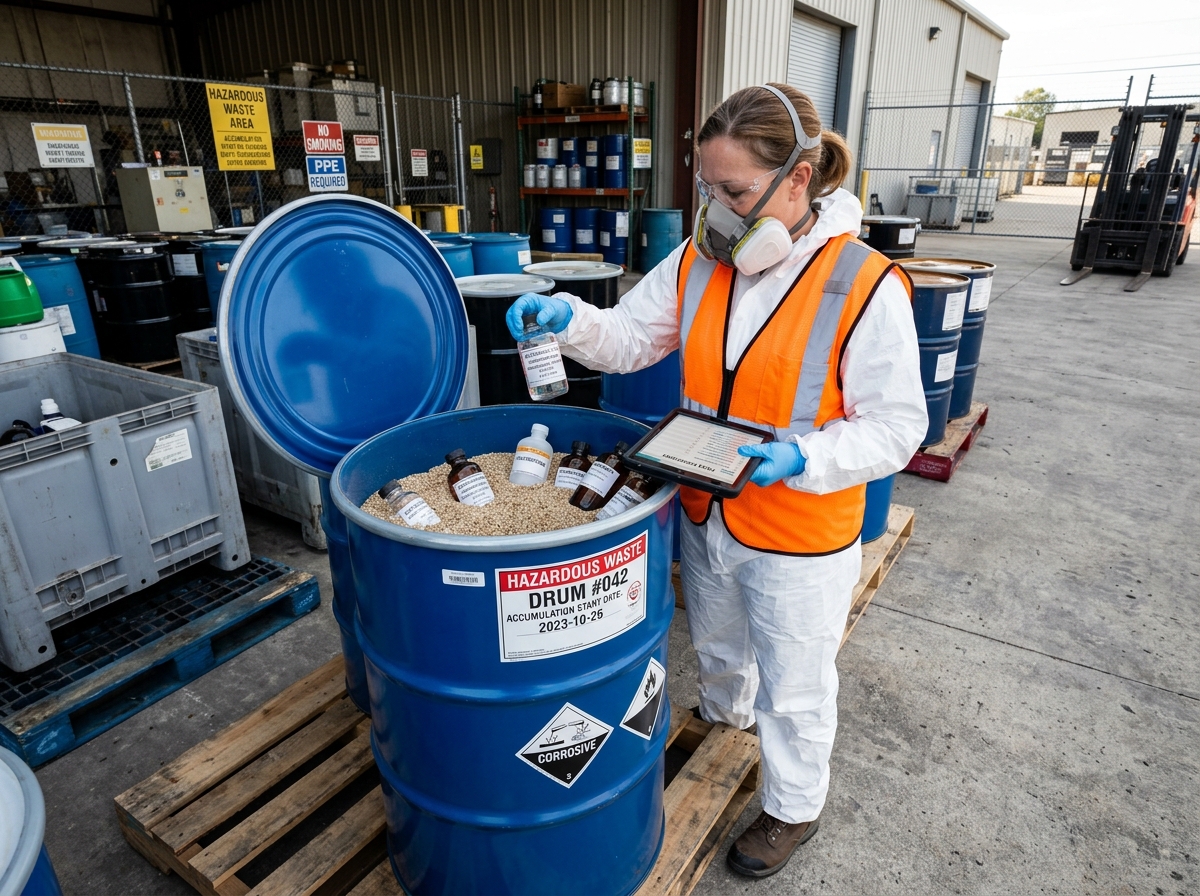
- Inventory and characterization: Every container is identified. Faded, missing, or unclear labels are treated as unknowns until characterized.
- Compatibility segregation: Chemicals are sorted by hazard class. Flammables stay with flammables, acids with acids, and oxidizers away from fuels.
- Packaging and cushioning: Absorbent material is added, containers are arranged to prevent contact or breakage, and void spaces are filled.
- Labeling and documentation: The sealed drum must meet DOT requirements for shipping names, hazard classes, labels, and paperwork.
A detailed lab pack guide can help facility managers understand the process before scheduling a cleanout.
Handling Unknowns and Reactive Materials
One of the biggest challenges is the “mystery bottle”—a container with a missing label, degraded ink, or unclear handwritten notation. Unknown waste cannot simply be shipped as-is.
Field chemists may use pH testing, water-reactivity screening, and flammability checks to identify broad hazards. High-risk materials require extra caution. Picric acid can become friction-sensitive as it dries, and peroxide-formers such as old ethyl ether may develop explosive crystals around the cap.
These risks are why experienced providers follow strict lab pack regulations before moving reactive or unstable materials.
Navigating Federal Regulations and Compliance Standards
Lab pack waste is regulated through several overlapping frameworks:
- RCRA: EPA’s cradle-to-grave hazardous waste program for identification, accumulation, tracking, treatment, and disposal
- DOT 49 CFR: Transportation rules for packaging, labeling, placarding, and moving hazardous materials on public roads
- CERCLA: Superfund liability rules that can keep the original generator responsible for contamination after waste leaves the site
- LDR: Land Disposal Restrictions requiring certain hazardous wastes to be treated before land disposal
| Generator Status | Monthly Waste Limit | Storage Time Limit |
|---|---|---|
| Very Small Quantity Generator (VSQG) | < 220 lbs | No limit until 2,200 lbs accumulated |
| Small Quantity Generator (SQG) | 220–2,200 lbs | 180 days |
| Large Quantity Generator (LQG) | > 2,200 lbs | 90 days |
Academic Labs and Subpart K Flexibility
Academic institutions often manage small amounts of hazardous waste across many rooms. EPA’s 40 CFR Part 262 Subpart K gives eligible colleges and universities more flexible lab waste management options when they maintain a formal Laboratory Management Plan (LMP).
This framework can shift certain responsibilities from individual labs to central accumulation systems. Specialized lab pack disposal service support can help schools avoid missed deadlines, incompatible storage, and enforcement risk.
Environmental Benefits and Post-Disposal Treatment
Lab pack services reduce the risk of chemical spills, reactions, fires, and improper disposal. Once waste leaves a facility in Springfield, Concord, Portland, or another New England community, it travels to a licensed Treatment, Storage, and Disposal Facility (TSDF).
Depending on the waste profile, treatment may include:
- Incineration: High-temperature destruction for toxic organics, pesticides, and other hazardous compounds
- Fuels blending: Reuse of compatible flammable solvents as a secondary fuel source
- Neutralization: Controlled treatment of acids and bases
- Stabilization: Binding of metals or other constituents to prevent leaching
The goal of modern lab pack disposal is to move chemicals toward the safest compliant treatment path while minimizing long-term environmental impact.
Frequently Asked Questions about Lab Packing
What are the risks of improper disposal?
Improperly discarding lab pack waste—such as pouring chemicals down the drain or placing them in ordinary trash—can cause legal, safety, and environmental consequences. Flammable vapors can ignite, incompatible chemicals can release toxic gas, and untrained staff may be exposed.
Can I pack my own lab waste?
Self-packing may be possible only with properly trained staff and compliant procedures. For most hazardous materials, a professional field chemist is safer because one compatibility mistake can create a fire, release, or transport violation.
How long can I store lab packs on-site?
Storage time depends on generator status. Large Quantity Generators generally have 90 days to move hazardous waste off-site, while Small Quantity Generators typically have 180 days. Routine cleanouts help prevent the accumulation of old, unstable, or unknown chemicals.
Protect Your Facility With Expert Lab Pack Waste Disposal
Lab pack waste management is complex because every step matters: inventory, compatibility review, packaging, labeling, documentation, transport, and final treatment. When handled correctly, it protects workers, reduces liability, and keeps hazardous chemicals out of the wrong waste stream.
MLI Environmental helps businesses, schools, hospitals, manufacturers, and research facilities across Maine, New Hampshire, Massachusetts, and Vermont manage hazardous chemical waste safely and efficiently. Whether you are decommissioning a lab in Boston, clearing a hospital storage room in Bangor, or organizing recurring chemical waste pickups in Portland, MLI’s certified professionals can help turn a difficult compliance challenge into a safer, more streamlined process.