

Drum waste disposal is the process of safely managing, transporting, and disposing of containers—typically 55-gallon drums—that hold or once held chemicals, hazardous materials, or other industrial waste. Here’s what you need to know:
Quick Overview:
- What it includes: Proper emptying, cleaning, labeling, transport, and final disposal or recycling of drums
- Why it matters: Prevents environmental contamination, ensures regulatory compliance, protects worker safety, and avoids steep fines
- Key regulations: RCRA (Resource Conservation and Recovery Act) and DOT (Department of Transportation) set strict standards
- Main options: Disposal at licensed facilities, recycling through drum reconditioning, or treatment methods like incineration
- Common mistake: Shipping drums that aren’t “RCRA empty” or properly labeled
If you work with industrial chemicals, you already know drums are everywhere. Industry experts handle millions of drums per year. But here’s the problem: mistakes in drum disposal are one of the most common reasons for EPA citations and fines.
The consequences go beyond paperwork. Drums in industrial settings often contain hazardous substances that can leach into soil or water if not disposed of properly. According to EPA data, 86 out of 181 drum reconditioning facilities—that’s 47.5%—have reported damage cases including fires, explosions, spills, and employee injuries.
The good news? Most drum waste disposal problems are completely avoidable when you understand the rules and follow the right procedures. Whether you’re dealing with residual chemicals, spent solvents, or contaminated materials, proper drum management protects your workers, your community, and your bottom line.
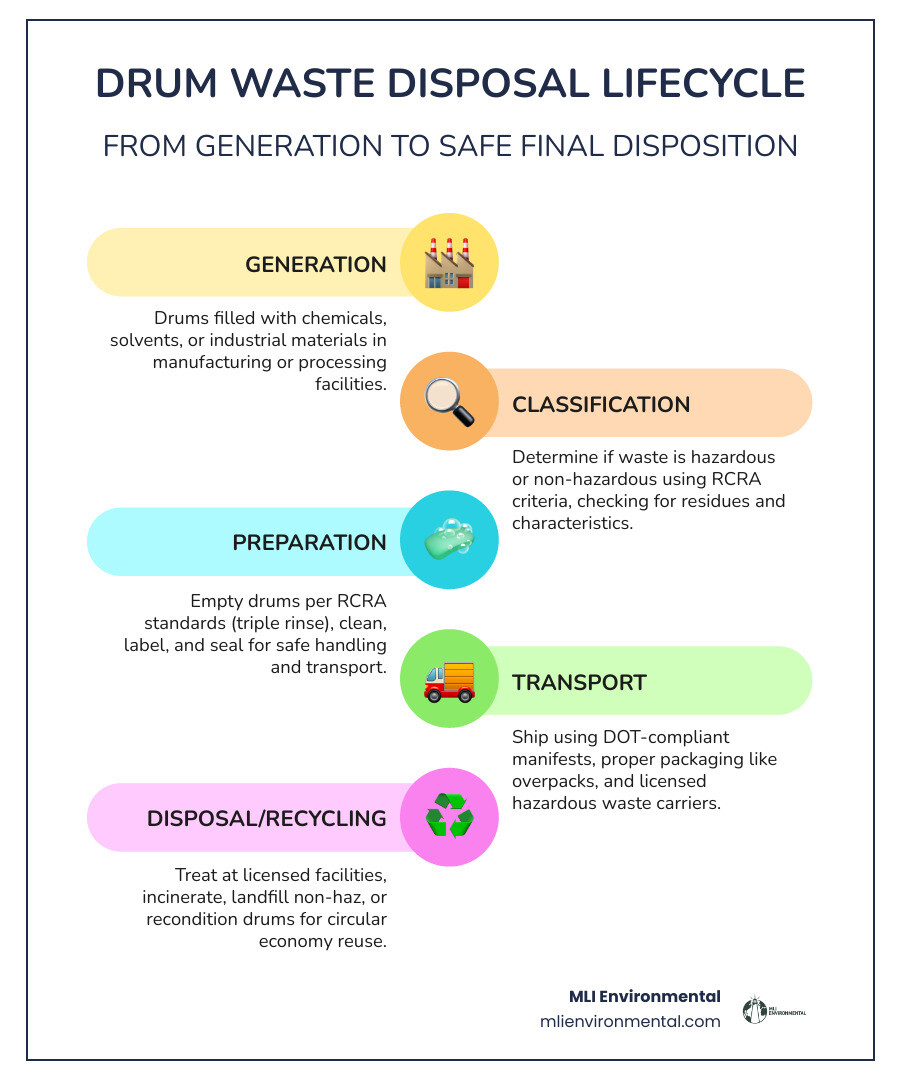
Understanding Drum Waste Disposal and Its Importance
When a business talks about drum waste disposal, they aren’t just talking about taking out the trash. They are talking about a complex lifecycle of environmental stewardship. Industrial drums are the workhorses of the chemical world, transporting everything from acids and oils to resins and food-grade liquids. However, once those drums are “empty,” they don’t just disappear.
Proper disposal is critical for several reasons:
- Environmental Protection: Residual chemicals in drums can be incredibly persistent. If a drum is left to rust in a field or sent to a landfill that isn’t equipped to handle it, those chemicals can leach into groundwater.
- Regulatory Compliance: The EPA and state agencies in places like Maine, Massachusetts, and New Hampshire don’t take kindly to “mystery drums.” Proper documentation and disposal methods are legal requirements.
- Worker Safety: A drum that seems empty can still contain pressurized gases or volatile residues. Handling these without a plan is a recipe for workplace accidents.
- Reputation and Sustainability: Modern businesses are expected to participate in a circular economy. Recycling a steel drum into a new product or reconditioning it for reuse is a hallmark of a sustainable operation.
For businesses operating in the Northeast—from the busy hubs of Boston and Worcester to the industrial zones of Portland and Bangor—staying on top of these requirements is a full-time job. Utilizing Onsite Hazardous Waste Services can help bridge the gap between daily operations and long-term compliance.
According to the EPA, there are approximately 181 drum reconditioning facilities nationwide processing about 40 million drums each year. This industry is a vital part of Used Drum Management and Reconditioning, but it relies on the original waste generators (that’s you!) to follow the rules before the drums ever leave the loading dock.
Navigating the Regulatory Landscape: RCRA and DOT
If you feel like you’re drowning in alphabet soup when dealing with the EPA, RCRA, and DOT, you aren’t alone. These agencies work together to ensure that drum waste disposal doesn’t result in a headline-making disaster.
The Resource Conservation and Recovery Act (RCRA) is the primary law governing the disposal of solid and hazardous waste. It focuses on the “cradle-to-grave” management of hazardous materials. On the other hand, the Department of Transportation (DOT) steps in the moment that the drum is loaded onto a truck.
Comparison of Regulatory Focus
| Feature | RCRA (EPA) | DOT |
|---|---|---|
| Primary Goal | Environmental protection and waste tracking. | Public safety during transport. |
| Key Document | Hazardous Waste Manifest. | Bill of Lading / Shipping Papers. |
| Focus Area | How the waste is stored and disposed of. | How the drum is sealed, labeled, and secured. |
| Empty Standards | Defines “RCRA Empty” for residue limits. | Focuses on whether a drum is “shippable.” |
Understanding these nuances is essential, especially when dealing with Hazardous Waste. For instance, a drum might be “empty” by your shop standards, but if it doesn’t meet the specific conditions found in Title 40 of the Code of Federal Regulations in Section 261.7, it is still legally considered a full container of hazardous waste.
This is also where Lab Pack Regulations come into play. If you have many small containers of different chemicals, they are often packed into a larger drum (a “lab pack”) for disposal. This method is highly efficient but requires even stricter adherence to compatibility rules.
Meeting RCRA Empty Standards for Drum Waste Disposal
One of the most misunderstood concepts in the industry is what it actually means for a drum to be “empty.” You can’t just turn it upside down, wait for the last drip, and call it a day. The EPA has a very specific “one-inch rule.”
To be considered “RCRA Empty” for non-acute hazardous waste:
- All wastes must be removed using common practices (pouring, pumping, or aspirating).
- No more than 2.5 centimeters (one inch) of residue can remain at the bottom.
- Alternatively, for containers 119 gallons or less, the residue must be less than 3% by weight of the total capacity.
However, if you are dealing with acute hazardous waste (the really nasty stuff), the rules are much tougher. These drums must be triple-rinsed with a solvent capable of removing the chemical or cleaned by another method shown to achieve equivalent removal. For a deep dive into these differences, check out the guide on RCRA Empty vs Empty.
Choosing the Right Containers for Drum Waste Disposal
Not all drums are created equal. Choosing the wrong material can lead to leaks, “bloating” drums, or chemical reactions that you definitely don’t want to witness.
- Steel Drums: The gold standard for strength and durability. They are often used for flammables and solvents. Lined steel drums can also handle some corrosive materials, but they are prone to rust if the contents aren’t compatible.
- Polyethylene (Plastic) Drums: These are the go-to for corrosive materials like acids or bases. They are lighter than steel—often half the weight—and generally cheaper. However, they can be susceptible to UV damage if stored outside for long periods.
- Fiber Drums: Usually reserved for solid, non-hazardous materials. They are lightweight and easy to dispose of but have zero resistance to moisture.
When choosing the right hazardous waste containers, always consider the “compatibility” factor. Putting a strong acid in a metal drum without a liner is like putting a hungry termite in a wooden box—it won’t stay contained for long.
Preparing Your Drums for Safe Transport and Disposal
Once you’ve identified your waste and picked the right container, it’s time for the “prep work.” This is where many businesses get tripped up during an inspection. A drum that is perfectly safe but looks messy can still trigger a fine.
The Preparation Checklist
- Sealing: Ensure the lid is secure. For open-head drums, the ring bolt should be tight and the gasket should be seated properly. For tight-head drums, the bungs (the little screw caps) must be tightened with a bung wrench. Hand-tight is not enough for the DOT!
- Cleaning: The outside of the drum must be clean. If there are drips of chemical running down the side, a transporter may refuse to pick it up. This is a major safety issue for anyone handling the drum later.
- Decontamination: If you are planning to reuse or recycle the drum, you may need to perform a triple-rinse. Be careful: the liquid you use to rinse the drum (the “rinsate”) usually becomes hazardous waste itself!
- Labeling: This is the big one. Every drum needs a clear, legible label. According to Hazardous Waste Label Requirements, you must include the waste’s name, the generator’s information, and the date accumulation started.
- Puncturing (For Non-Regulated Waste): In some jurisdictions, if a drum is truly empty and non-hazardous, it must be punctured (often in a specific pattern like top, middle, and bottom) to ensure it cannot be reused for liquids before being sent to a scrap yard.
For more tips on handling these containers, see the advice on Empty Chemical Container Disposal.
Recycling and Reconditioning: The Circular Economy of Drums
What happens to a drum after it leaves your facility? It doesn’t always head straight for a hole in the ground. In fact, the EPA encourages reconditioning because it consumes significantly less energy than manufacturing a new drum.
There are two primary ways drums are reconditioned:
- The Furnace Method (35% of drums): Metal drums are put through a high-temperature furnace that burns off any residual organic material. This is followed by shot-blasting to clean the metal, repainting, and testing for leaks.
- The Washing Method (65% of drums): Drums are cleaned using water and a caustic solution. This is common for plastic drums and steel drums that held less “sticky” materials.
If a drum is damaged beyond repair, it might meet the drum crusher. Drum crushers reduce the volume of the waste, making it cheaper to transport to a scrap metal recycler. This is a key part of Bulk Waste Disposal strategies.
The EPA is currently looking at how to improve this process. The Used Drum Management and Reconditioning: Advance Notice of Proposed Rulemaking is an effort to address the fact that many reconditioners receive drums that aren’t actually “RCRA empty,” which creates environmental risks at the recycling facility.
Frequently Asked Questions about Drum Waste
What is the difference between hazardous and non-hazardous drum waste?
Hazardous waste is specifically defined by the EPA as being ignitable, corrosive, reactive, or toxic. Non-hazardous waste might include things like food-grade oils, latex paint (if solidified), or certain grinding sludges. However, don’t let the name “non-hazardous” fool you—you still can’t just dump it down the drain. It still requires proper drum waste disposal to prevent “special waste” violations at landfills.
How do I know if my drum is DOT shippable?
A DOT-shippable drum must be “Sealed, Clean, and Undamaged.” If your drum has significant structural dents, heavy rust, or is bulging (a sign of internal pressure), it is not shippable in its current state. In these cases, you might need an “overpack drum”—a larger drum that your damaged drum sits inside of for safety.
Can empty drums be sent directly to a landfill?
Generally, no. Most municipal landfills will not accept 55-gallon drums because they take up too much space and might contain hidden liquids. To be landfill-accepted, drums usually need to be crushed or have both ends cut off to prove they are empty and won’t create “void spaces” in the landfill. It is almost always better to work with a dedicated waste management partner to ensure they go to a licensed TSDF (Treatment, Storage, and Disposal Facility).
Make Drum Waste Disposal Safer, Simpler, and Fully Compliant
Managing drum waste disposal doesn’t have to be a nightmare of regulations and red tape. By understanding the difference between a “shop empty” and a “RCRA empty” drum, choosing the right containers, and following strict labeling protocols, you can keep your facility running smoothly and safely.
Whether you are operating in the heart of Boston, the industrial parks of Springfield, or the coastal reaches of Rhode Island and Maine, compliance is about more than just avoiding fines—it’s about protecting the environment we all share.
MLI Environmental specializes in taking the guesswork out of this process. With certified professionals who understand the specific needs of New England businesses—from Manchester, New Hampshire to Burlington, Vermont—they provide the hazardous materials logistics and dangerous goods shipping expertise you need.
Ready to clear out your warehouse without the stress? Contact our hazardous waste management team today to ensure your drum waste is handled with the highest standards of safety and regulatory precision.