

Universal waste recycling is the process of collecting, handling, and diverting specific categories of hazardous waste — like batteries, fluorescent lamps, and pesticides — through streamlined EPA-regulated pathways instead of full hazardous waste disposal.
Here’s a quick overview of what that means in practice:
| Category | Common Examples | Key Hazard |
|---|---|---|
| Batteries | Lithium-ion, nickel-cadmium, alkaline | Lead, cadmium, mercury |
| Lamps | Fluorescent, HID, mercury vapor | Mercury |
| Mercury-Containing Equipment | Thermostats, thermometers | Mercury |
| Pesticides | Recalled or unused stocks | Toxic chemicals |
| Aerosol Cans | Industrial sprays, cleaners | Flammable propellants |
Nearly every business, facility, and household generates at least one of these waste types — often without realizing it falls under hazardous waste rules.
The problem is that most of these materials end up in the trash. And that’s where things get dangerous.
Just a quarter of a teaspoon of mercury can contaminate all the fish in a 20-acre lake. That’s not a hypothetical — it’s a documented environmental risk from something as ordinary as a broken fluorescent bulb.
The EPA created the Universal Waste Program specifically to make proper recycling easier, not harder. It offers relaxed storage, labeling, and transport requirements compared to standard hazardous waste rules — giving businesses a practical, lower-burden path to compliance.
This guide explains exactly how the system works, what your obligations are, and how to set up a recycling process that keeps your facility compliant and your community safe.
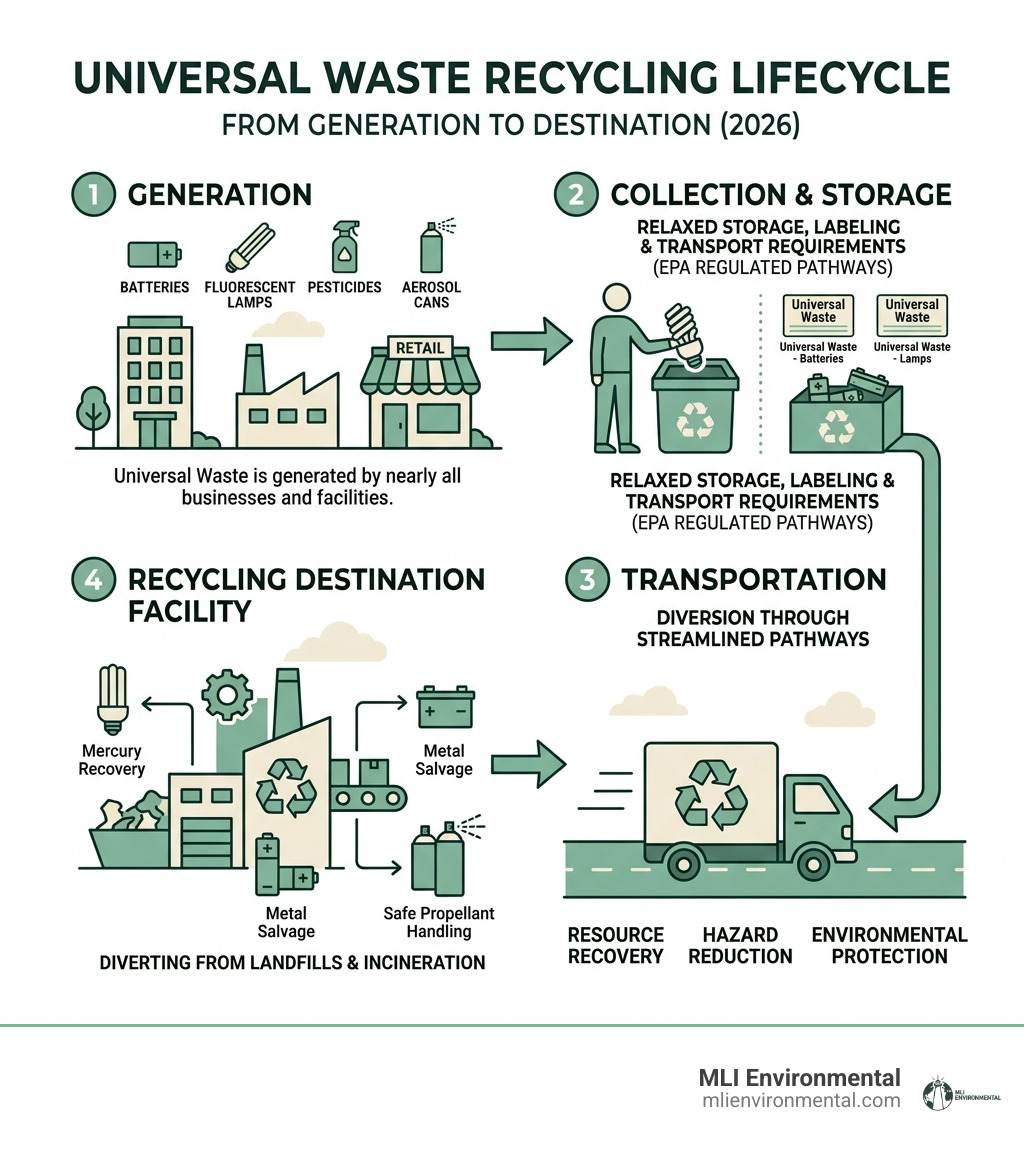
Important universal waste recycling terms:
- Drum waste disposal
- Hazardous waste removal companies
What is Universal Waste and Why is it Important?
In environmental regulation, “universal waste” is a bit of a friendly nickname for a specific group of hazardous wastes that are generated by almost everyone. Whether it’s a small office in Portland, Maine, or a massive manufacturing plant in Worcester, Massachusetts, these items are ubiquitous. Because they are so common, the EPA realized that forcing every small business to follow the same strict, mountain-high paperwork rules as a chemical refinery would actually discourage people from doing the right thing.
The goal of the Universal Waste program is to incentivize recycling. By classifying these items separately, the government allows for “streamlined” management. This means less red tape for you, but better protection for the planet. Proper management ensures that toxic heavy metals like lead and cadmium are recovered and reused rather than leaching into our soil.
Landfill diversion is the name of the game here. When we recycle these items, we aren’t just staying out of legal trouble; we are engaging in resource recovery. Many of these items contain rare metals and components that can be put back into the manufacturing stream, reducing the need for destructive mining.
The Environmental Impact of Improper Disposal
It’s easy to think, “It’s just one lightbulb,” but the cumulative effect is staggering. Mercury is a potent neurotoxin. When a fluorescent lamp breaks in a dumpster, that mercury vaporizes or enters the leachate system. As noted in our research, just a quarter of a teaspoon of mercury can contaminate all the fish in a 20-acre lake.
Beyond mercury, many universal wastes contain lead and cadmium. These substances don’t just “go away.” They persist in the ecosystem, moving up the food chain until they reach humans. By prioritizing universal waste recycling, businesses in New England play a direct role in protecting the local watersheds, from the coast of Maine to the hills of Vermont.
The 5 Main Types of Federal Universal Waste
Under the federal regulations found in 40 CFR Part 273, there are five primary categories that the EPA recognizes. While states can add more (and many in New England do!), these five form the backbone of the federal program.
| Waste Type | Federal Definition | Handling Priority |
|---|---|---|
| Batteries | Lead-acid, Ni-Cd, Lithium, etc. | Prevent leakage and short circuits |
| Pesticides | Recalled or unused stocks | Keep in original, labeled containers |
| Mercury Equipment | Thermostats, barometers, switches | Prevent breakage of glass ampules |
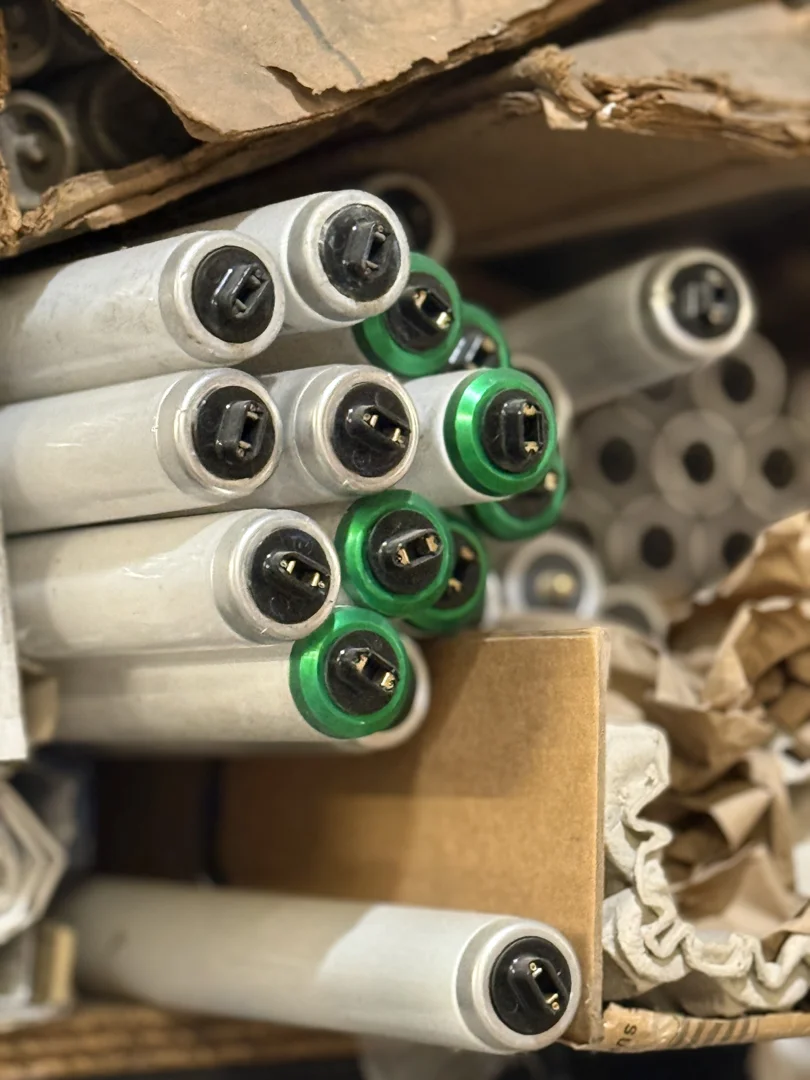
| Lamps | Fluorescent, neon, HID bulbs | Store in boxes to prevent crushing |
| Aerosol Cans | Non-empty hazardous spray cans | Protect from heat and puncturing |
Managing Batteries and Lamps for Universal Waste Recycling
Lamps and batteries are the most common items handled by facilities. Fluorescent bulbs, high-intensity discharge (HID) lamps, and mercury vapor lights all contain enough mercury to be classified as hazardous. When you Handle E-Waste, you often find these items embedded in old office equipment or lighting fixtures.
Lithium batteries have become a major focus as of April 2026. Because they can cause fires if crushed in a standard garbage truck, they must be managed carefully. For a deeper dive into these categories, you can explore the Universal Waste Category page to see how different chemistries require different storage approaches.
Handling Pesticides and Aerosol Cans
Pesticides qualify as universal waste if they are part of a voluntary or mandatory recall, or if they are “waste stocks” being gathered for disposal. This is particularly relevant for agricultural businesses in Central Maine or landscaping companies in New Hampshire.
Aerosol cans were added to the federal list more recently (2019). Most aerosol cans are hazardous because they contain flammable propellants or toxic residues. To stay compliant, these cans must be kept intact. If you plan on puncturing them for recycling, you must follow very specific safety protocols to capture the vapors. Professional Universal Waste Disposal Services can help ensure these items are moved safely from your site to a permitted facility.
Universal Waste Recycling Regulations and Compliance Standards
Compliance isn’t a one-size-fits-all situation. The EPA divides handlers into two main groups based on how much waste they have on-site at any one time.
- Small Quantity Handlers (SQH): These are facilities that accumulate less than 5,000 kilograms (about 11,000 lbs) of total universal waste at any time. Most small businesses and schools fall into this category. They don’t need an EPA ID number, but they must still follow basic labeling and training rules.
- Large Quantity Handlers (LQH): If you hit that 5,000 kg threshold, you’re in the big leagues. You must notify the EPA, get an ID number, and keep more detailed records of where your waste is going.
Understanding the Universal Waste Disposal Regulations in New England is vital because states like Massachusetts and New Hampshire have their own specific nuances.
Differences Between Universal and Standard Hazardous Waste
The “Universal Waste Rule” was designed to be a “Hazardous Waste Lite” program. Here are the key breaks the EPA gives you:
- No Manifests: Unlike standard hazardous waste, you don’t usually need a complex Uniform Hazardous Waste Manifest for transport (though some states still require basic tracking).
- Longer Storage: You can keep universal waste on-site for up to one year to accumulate enough for a cost-effective pickup.
- Transport: You don’t necessarily need a specialized hazardous waste transporter; a common carrier can often move these materials if they are packaged correctly.
According to Universal Waste Management and Recycling Companies, these exemptions significantly lower the cost of compliance for businesses that generate common items like light bulbs.
Proper Handling, Labeling, and Storage Requirements
Even though the rules are “streamlined,” you can’t just throw these items in a corner. The EPA is very specific about “closed container” rules.
- Integrity: Containers must be structurally sound and compatible with the waste. If a battery is leaking, it needs to go into a secondary leak-proof bag.
- Labeling: Every container must be clearly marked. You can use phrases like “Universal Waste—Batteries,” “Waste Lamps,” or “Used Electronics.”
- Dating: You must be able to prove how long the waste has been there. Most facilities do this by marking the “accumulation start date” on the container. You have a one-year limit!
For more details on the technical specifics, check out the main Universal Waste page.
Best Practices for Universal Waste Recycling in Facilities
Setting up a program doesn’t have to be a headache. Many businesses in Bangor, Maine, and Manchester, New Hampshire, find success using a “station” approach.
- Employee Training: Ensure everyone knows that a “burnt-out bulb” doesn’t go in the trash.
- Vapor Collection: For large-scale lamp recycling, some facilities use specialized systems that trap 99.99% of air-borne particles.
- Mail-Back Kits: For small offices, mail-back kits are a lifesaver. You fill a box, seal it, and ship it back via a standard carrier.
- Professional Pickup: For larger volumes, scheduling a pickup with a certified provider is the safest bet. Cities like Bangor have specific guidelines for Disposal of Electronic & Hazardous Waste that businesses should review.
For a quick reference, you can use A Pocket Guide to E-Waste Disposal Methods to train your staff on the fly.
State Variations and Emerging EPA Developments
While the federal government sets the floor, states often set the ceiling. In New England, state-specific rules are very common. For example, many states in our region classify Electronics (like computers and monitors) and CRTs (old glass TVs) as universal waste, even though the federal government hasn’t officially added them to the “Big Five” yet.
As of April 2026, the EPA is also moving toward adding Solar Panels and Lithium-Ion Batteries to the federal list. With the explosion of green energy in places like Vermont and Massachusetts, Regulation and Management of Solar Panel Waste is becoming a top priority for facility managers.
Additional State-Regulated Wastes
Depending on where you are located, you might need to manage these items as universal waste:
- Ballasts: Many older lighting ballasts contain PCBs and are regulated strictly in Maine and Massachusetts.
- Mercury Thermometers: Many states have active exchange programs to remove these from schools and labs.
- E-Waste: In Maine, there are very specific Universal Waste Management and Recycling Companies authorized to handle the high volume of discarded tech.
If you are curious about why we bother with old circuit boards, it’s not just about toxins. Recycling Gold from E-Waste is actually more efficient than mining new ore! For those in Maine, check What to Do with Old Electronics for local disposal options.
Frequently Asked Questions about Universal Waste
How long can a facility store universal waste on-site?
You generally have one year from the date the waste was first generated (or the date you received it from another handler) to get it to a destination facility. To stay compliant, you must clearly label the container with the date you started filling it.
What is the difference between a Small Quantity and Large Quantity Handler?
The magic number is 5,000 kilograms (approx. 11,000 lbs). If you never have more than that on-site at once, you are a Small Quantity Handler. If you exceed that limit even once, you become a Large Quantity Handler for the rest of the calendar year. LQHs have more rigorous notification and record-keeping requirements, including the need for an EPA ID number.
Are electronics always considered universal waste?
Not federally, but practically yes in most of New England. States like Maine, Massachusetts, and New Hampshire have adopted electronics into their state universal waste programs. This includes items like CPUs, monitors, and circuit boards.
Ready to Simplify Universal Waste Recycling?
Navigating universal waste recycling can seem daunting at first, but it is one of the most effective ways for a business to reduce its environmental footprint and lower its liability. By moving these common hazardous items out of the standard waste stream and into specialized recycling programs, you protect the local New England environment and ensure your business stays on the right side of the law.
Whether you are looking for a one-time cleanout or a recurring recycling program, MLI Environmental is here to help. As a trusted leader in hazardous materials and waste management, we provide quick, safe service across Maine, New Hampshire, Massachusetts, and Vermont through our certified professionals. From international logistics to local compliance, we make Hazardous Waste Management simple and sustainable for your facility.