

A hazardous waste storage area is a specially engineered space where facilities accumulate regulated chemical, biological, or physical wastes before off-site treatment or disposal. Under RCRA Subtitle C, the EPA sets cradle-to-grave management standards, while state agencies such as Maine DEP, MassDEP, and NHDES may enforce more stringent regional rules.
For EHS managers, compliant storage is both a safety control and a liability shield. Poorly stored hazardous materials can cause leaks, fires, toxic releases, environmental contamination, civil penalties, and, in severe cases, criminal exposure. Facilities need a practical grasp of RCRA’s physical and administrative requirements, from container compatibility to floor design and inspection records.
What Are the General Design and Site Selection Requirements for a Hazardous Waste Storage Area?
Designing a compliant storage space means balancing operational access with environmental protection. Hazardous waste storage area design requirements should isolate regulated materials from workers, traffic, stormwater, and sensitive environmental receptors.
The area should be secure, low-traffic, accessible to emergency responders and waste haulers, and separated from production lines, break rooms, wells, floodplains, and storm drains. Outdoor areas also need run-on controls so precipitation cannot flood containment zones or carry contaminants off-site.
Site Selection and Construction Standards
Storage units should use materials compatible with the chemicals stored there. Because untreated concrete can absorb solvents, acids, and bases, floors often need chemical-resistant epoxy coatings, berms, and slopes toward a sump, trench, or other collection point for quick spill detection and cleanup.
Specialized permits may require structural load ratings that support forklifts, pallet jacks, and stacked drums. The key is to prevent cracking, pooling, and hidden migration into soil or groundwater.
Ventilation, Lighting, and Security
Ventilation should prevent toxic, corrosive, or flammable vapors from accumulating or migrating into occupied areas. Lighting should allow staff to read labels, inspect containers, and spot corrosion or leaks. Access should be locked and limited to trained personnel, with clear warning signs such as “Danger: Hazardous Waste Storage Area — Unauthorized Personnel Keep Out.”
How Do You Select, Maintain, and Label Hazardous Waste Containers?
Containers are the first line of defense against releases. When choosing hazardous waste containers, facilities should prioritize DOT-compliant packaging under 49 CFR Part 178 and match the container material to the waste stream.
Chemical compatibility is critical. Corrosive acids can attack steel drums and may require polyethylene containers, while some solvents can soften plastic and may require steel packaging. Specialized chemicals, such as hydrofluoric acid, require particular care because they can react with certain container materials.

Container Maintenance and Closure Rules
Even the right container can become a violation if it is left open, corroded, damaged, or mislabeled. MLI Environmental’s guide to the top hazardous waste container issues highlights recurring inspection problems such as open lids, poor labels, rust, and physical damage.
Under RCRA, containers must remain securely closed except when waste is actively added or removed. Open funnels should not be left in place after use. If staff find severe rust, bulging, dents, or leaks, the waste should be transferred to a sound compatible container or placed in an approved overpack drum.
Labeling, Dating, and Recordkeeping Regulations
Labels are among the most scrutinized items during inspections. Every container should be marked “Hazardous Waste” or “Dangerous Waste” when accumulation begins, show the applicable hazards, and list full common chemical names rather than formulas or internal shorthand. See MLI Environmental’s hazardous waste label requirements for practical labeling guidance.
The accumulation start date should be added when waste first enters the container. Facilities should also maintain operating records, waste profiles, manifests, and container-location documentation to preserve cradle-to-grave traceability.
What Are the Requirements for Secondary Containment and Spill Prevention?
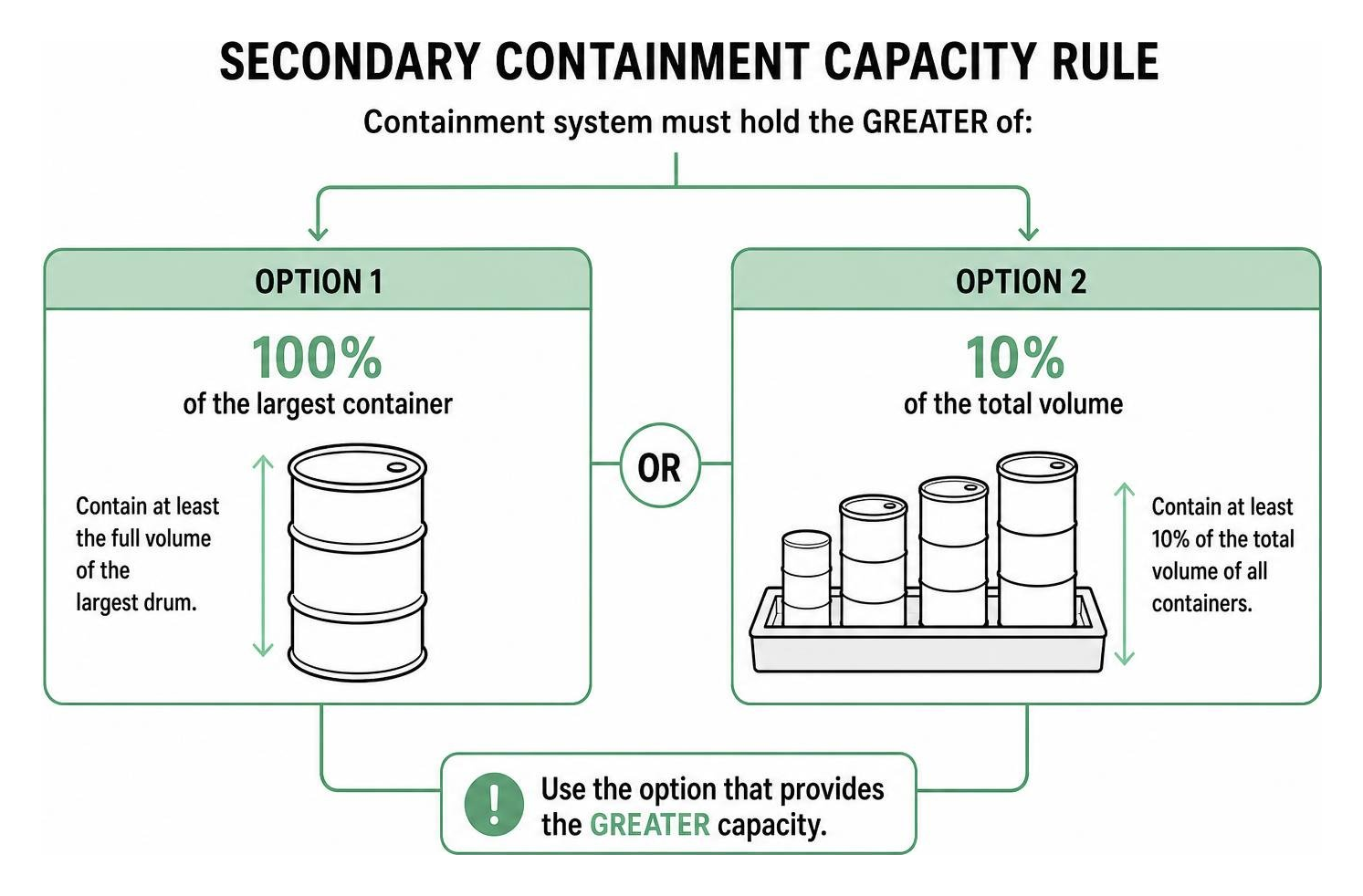
Secondary containment is the final barrier between a failed container and the environment. Any area storing liquid hazardous waste should have an engineered containment system with an impervious, crack-free base, berms or dikes, and a slope that supports fast removal of spilled material.
Secondary Containment Capacity and Engineering
For many central accumulation areas, containment capacity must be at least the greater of:
- 10% of the total container volume stored in the area, or
- 100% of the largest container’s volume.
Satellite Accumulation Areas often use trays or tubs sized to hold at least 110% of the largest container. Outdoor uncovered systems may need additional capacity for a 25-year, 24-hour storm event.
| Storage Setup | Containment Capacity Requirement | Engineering Design Features |
|---|---|---|
| Satellite Accumulation Area (SAA) | 110% of the largest container | Portable trays or chemical-resistant tubs |
| Indoor Central Accumulation Area (CAA) | Greater of 10% of total volume or 100% of largest container | Epoxy-coated concrete, sloped floors, berms, sumps |
| Outdoor Uncovered Storage Unit | CAA volume plus stormwater capacity | Concrete pads, elevated pallets, weather-tight sumps, run-on diversion |
Spill Response and Removal Protocols
Spill prevention is a daily duty. Leaks, spills, or accumulated rainwater in containment should be removed promptly, characterized correctly, and managed under applicable hazardous waste rules. Spill kits, chemical-resistant gloves, absorbents, neutralizers, and non-sparking tools should be kept near the storage area, and trays or sumps should be cleaned so residue does not hide new leaks.
How Should Incompatible, Ignitable, and Reactive Wastes Be Segregated?
Mixing incompatible wastes can trigger heat, pressure, toxic gas, fire, or explosions. Facilities should physically separate incompatible hazard classes, such as acids and bases or oxidizers and flammable solvents, so a spill cannot co-mingle in the same tray or containment zone.
Segregation of Incompatible Chemical Classes
Incompatible wastes may need separation by distance, berms, dikes, or fire-rated partitions. Staff should also avoid placing hazardous waste into unwashed containers that previously held incompatible materials. Pre-acceptance waste characterization helps confirm the chemical properties of each stream before it reaches the storage area.
Special Rules for Ignitable and Reactive Wastes
Ignitable and reactive wastes require extra separation from ignition sources, water-reactive materials, electrical equipment, open flames, and direct heat. Containers holding ignitable or reactive waste are commonly subject to the RCRA 50-foot property-line rule, and facilities should coordinate storage layouts with applicable fire-code requirements.
When transferring ignitable liquids, grounding and bonding help dissipate static electricity and reduce spark risk. Containers should also be stacked and handled to prevent tipping, crushing, or instability during routine operations or emergency response.
What Are the Storage Time and Quantity Limits for Different Generator Categories?
Hazardous waste storage limits depend on how much waste a facility generates each calendar month. Exceeding quantity limits or accumulation deadlines can move a facility into a more stringent generator category.
Generator Classifications and On-Site Storage Limits
The main generator categories are:
- Very Small Quantity Generators (VSQGs): 220 pounds (100 kg) or less per month.
- Small Quantity Generators (SQGs): More than 220 and less than 2,200 pounds (100 to 1,000 kg) per month.
- Large Quantity Generators (LQGs): 2,200 pounds (1,000 kg) or more per month.
Under federal rules, SQGs may accumulate up to 13,228 pounds (6,000 kg) for up to 180 days, or 270 days if the nearest disposal facility is more than 200 miles away. LQGs generally have a 90-day accumulation limit. Maine’s hazardous waste generator handbook and MLI Environmental’s guide to Maine hazardous waste storage requirements can help facilities understand state-specific expectations.
Satellite Accumulation Area (SAA) vs. Central Accumulation Area (CAA)
Satellite Accumulation Areas are located at or near the point of generation and remain under the control of the operator generating the waste. Under RCRA, an SAA is generally limited to 55 gallons of hazardous waste or 1 quart of acutely hazardous waste per waste stream. Once full, the container must be dated and moved to a Central Accumulation Area or shipped off-site within the required time window.
Central Accumulation Areas are the main storage zones where dated containers are managed before shipment. Facilities should use clear internal procedures so SAA containers are not forgotten, labels stay current, and waste is shipped before the applicable deadline.
How Do You Conduct Inspections and Decommission a Storage Area?
Compliance requires routine checks, documentation, and a plan for closure. Container storage areas should be inspected at least weekly, with findings recorded in a logbook.
Weekly Inspection Schedules and Checklists
A practical hazardous waste inspection checklist for EPA visits helps staff verify the items inspectors are likely to review, including:
- Container integrity: corrosion, bulging, dents, and instability.
- Leaks: pooled liquid, staining, wet spots, or residue.
- Labels: visible, legible, dated, and facing the aisle.
- Aisle space: clear routes for personnel and emergency equipment.
- Containment: cracks, rainwater, residue, or sump defects.
Inspection records should include the date, time, inspector name or signature, findings, and corrective actions. Retain records according to applicable federal and state requirements.
Closure and Decommissioning Requirements
When a storage unit is closed, relocated, or decommissioned, the facility should pursue clean closure. That typically means removing all hazardous waste, liners, and equipment; decontaminating floors, berms, walls, and sumps; testing concrete or nearby soil if contamination is suspected; excavating contaminated materials if needed; and submitting closure documentation to the regulator.
A professional engineer may need to certify that the unit was properly decontaminated. Clear closure records reduce long-term environmental liability and help show that contamination was not left behind.
Frequently Asked Questions About Hazardous Waste Storage Areas
How long can you store hazardous waste on-site without a permit?
Large Quantity Generators generally have a 90-day limit. Small Quantity Generators may store waste for up to 180 days, or 270 days if the waste must travel more than 200 miles to a disposal facility. VSQGs must stay below the applicable on-site accumulation threshold and should ship waste regularly to reduce risk.
What is the 50-foot rule for ignitable or reactive waste?
RCRA’s 50-foot rule generally requires containers holding ignitable or reactive hazardous waste to be stored at least 50 feet from the facility property line. Facilities should also check state rules and fire-code requirements.
What is the minimum aisle space required in a container storage area?
Federal RCRA rules require sufficient aisle space for inspection, emergency access, spill control, and decontamination equipment, but they do not set one universal width. Facilities using pallets, pallet jacks, or forklifts should set internal aisle standards that support safe movement and emergency response.
Secure Your Hazardous Waste Storage Area with MLI Environmental
Hazardous waste storage rules are complex, and a missed label, open container, or poor containment layout can create serious safety and compliance risk. MLI Environmental helps facilities manage hazardous materials logistics, dangerous goods shipping, waste disposal, and compliance support with certified professionals and responsive service.
Whether your facility is in Portland, Lewiston, Bangor, South Portland, or another Maine service area, MLI Environmental can help with hazardous waste management services, including:
- Storage area design and auditing: Build or improve compliant storage layouts for your waste streams.
- Compliance inspections: Find and correct container, label, aisle-space, and containment issues before regulators do.
- Waste disposal and shipping: Package, label, manifest, and transport hazardous materials safely.
Protect your facility, workers, and environmental record. Contact MLI Environmental today for practical hazardous waste compliance support.